 Polski

Dwarf hamster houses – safe hiding places, multi-room houses and hamster scaping houses
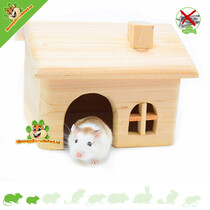
Compact 15 cm wooden house for mice and dwarf hamsters. Made of high-quality spruce wood, with an open bottom and without staples or nails.
Read more
17 cm wooden castle house for mice and dwarf hamsters. With multiple openings, two floors, and a nice lookout spot for scaving.
Read more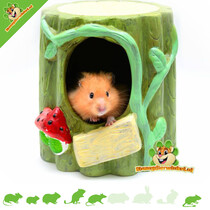
18 cm ceramic log house for mice, dwarf hamsters, hamsters, gerbils, pygmy rats, rats, and degus. As a shelter, cool house, or sand bath.
Read more
Natural coconut house with ladder for mice, dwarf hamsters, hamsters, and gerbils. Hanging for climbers or placed low for ground animals.
Read more- Voor 17 uur besteld, dezelfde dag verzonden!
- Rodent specialist since 2011
- Dispatched from our own stock
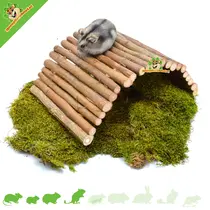
Flexible willow bridge measuring approx. 28 × 17 cm. Can be used as a bridge, tunnel, hiding place, stepping stone, or small landscaping wall for small rodents.
Read more
20 cm wooden house for mice and dwarf hamsters. With an open bottom, entrance, round window, and a natural look for hamsterscaping.
Read more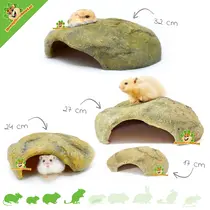
Low resin rock hideout. Choose 17 cm for mice or dwarf hamsters; larger sizes for Syrian Hamsters, gerbils or dwarf rats.
Read more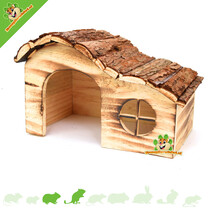
29 cm wooden house for hamsters and gerbils. With an open bottom, spacious entrance, flamed wood look, and a roof with willow branches.
Read more- Voor 17 uur besteld, dezelfde dag verzonden!
- Rodent specialist since 2011
- Dispatched from our own stock
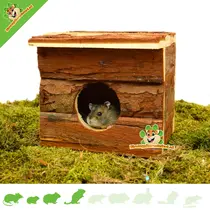
Small wooden house of 15 cm with an open bottom, round opening, and flat roof. Suitable as a shelter for mice, dwarf hamsters, hamsters, and gerbils.
Read more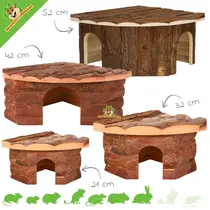
Compact wooden corner house of 21 cm with an open bottom and flat top. Suitable as a hiding place for mice, dwarf hamsters, and gerbils.
Read more
Natural coconut houses with a bridge for small rodents. Great as a hiding place, climbing challenge, or landscaping element for mice, dwarf hamsters, hamsters, and gerbils.
Read more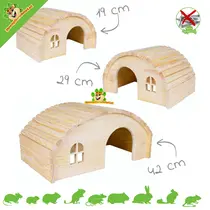
Nail-free wooden igloo house with two exits and an open bottom. Available in 19, 29, and 42 cm. Suitable as a shelter for various rodents.
Read more- Voor 17 uur besteld, dezelfde dag verzonden!
- Rodent specialist since 2011
- Dispatched from our own stock
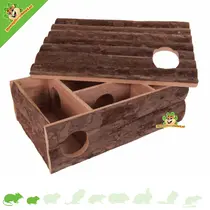
Spacious wooden multi-chamber house measuring 35 x 25 x 11 cm with four chambers, a removable roof, a ramp, and multiple openings. For mice, dwarf hamsters, and gerbils.
Read more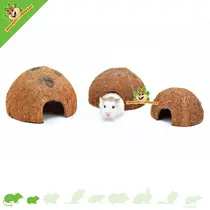
Set of 3 small coconut halves for mice, pygmy mice, and small dwarf hamsters. Naturally, as a hiding place, decoration, stepping stone, or landscaping accent.
Read more
30 cm wooden play tower for mice and dwarf hamsters, with 9 rooms, 3 levels, 2 ladders, food bowl, and plexiglass viewing window.
Read more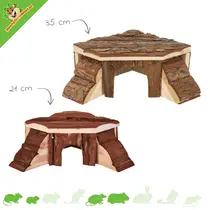
Wooden corner house with open bottom and flat roof. Choose 21 cm for mice or dwarf hamsters, or 35 cm for rats and guinea pigs.
Read more- Voor 17 uur besteld, dezelfde dag verzonden!
- Rodent specialist since 2011
- Dispatched from our own stock
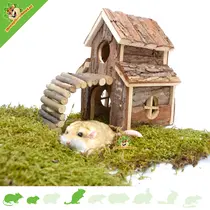
Playful wooden house for mice and dwarf hamsters. With two levels, an open bottom, and a small willow bridge as stairs to the upper floor.
Read more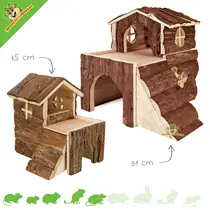
Wooden hideout with two levels. 15 cm for dwarf mice, mice and dwarf hamsters; 31 cm also for Syrian Hamsters (Golden Hamsters), gerbils, dwarf rats and rats.
Read more
Bendable willow ladder/bridge of 27 cm for mice, dwarf hamsters, hamsters, gerbils, and degus. Can be used as a bridge, hiding place, stepping stone, wall, or gnawing material.
Read more
The terracotta house is designed in the shape of an underground hole. But perhaps the biggest advantage of this house is the nail-wearing property of the rough surface. Because small rodents are active and curious, climbing and ...
Read more- Voor 17 uur besteld, dezelfde dag verzonden!
- Rodent specialist since 2011
- Dispatched from our own stock

Bendable willow bridge of 55 cm for mice, hamsters, gerbils, rats, and degus. Can be used as a bridge, tunnel, hiding place, low wall, or natural gnawing material.
Read more
Flexible willow bridge measuring 22 x 10 cm for mice, dwarf hamsters, and gerbils. Can be used as a bridge, tunnel, hiding place, step, or natural divider in the enclosure.
Read more
Spacious wooden play area measuring 47 × 22 × 15 cm for mice and dwarf hamsters. With multiple hiding places, levels, steps, and open bottoms. Great for hamsterscaping.
Read more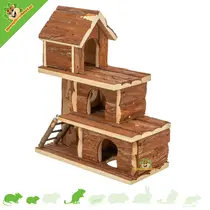
Wooden hamsterscaping house measuring 25 × 12 × 30 cm for mice and dwarf hamsters. With three levels, a ladder, a log tunnel, and a bottom opening for extra digging routes.
Read moreDwarf hamster houses – safe hiding, sleeping and hoarding
 A dwarf hamster home is much more than just a place to sleep. Dwarf hamsters are prey animals and burrow builders: they want to be able to retreat, build a nest, and often create a storage area. With the right dwarf hamster homes , you give your hamster peace, order, and control in its enclosure.
In this subcategory, you'll find houses suitable for dwarf hamsters (such as Russian, Campbell, Roborovski, and Chinese hamsters): with logical dimensions, safe materials, and clever details like multiple rooms or extra openings. Specialists since 2011 – we primarily select houses that work well in practice.
What size house for a dwarf hamster?
A dwarf hamster house doesn't need to be huge, but it should be spacious enough for comfortable turning, nesting, and perhaps even a small storage area. Also, always pay attention to the opening : it should be appropriate for the species and size of your hamster.
- House size: usually around 12 x 12 cm (larger is always welcome).
- Opening: guideline around ± 5 cm (depending on shape/type).
- Multiple openings: especially for larger or multi-room houses, 2 entrances is a nice plus.
Tip: Not sure about the size? Draw the house out on paper. That'll give you a quick sense of the volume.
Types of dwarf hamster houses: which one suits your decor?
In this category you will find dwarf hamster houses in different styles and functions:
- Sleeping houses (basic: sleeping, nesting, sheltering)
- Multi-room houses (sleeping + pantry + extra space)
- Tunnels / shelters (extra route and cover)
- Sand houses (bath house in combination with a sand bath)
- Ceramic houses (cooling spot/extra shelter, nice in warmer periods)
Why multi-room houses are so popular with dwarf hamsters
A multi-room house feels "logical" to many dwarf hamsters: it resembles a small system of tunnels and rooms. You often see one room serving as a nesting area, and another as a storage area or quiet hiding place.
- ✓ More structure: sleeping, supplies and resting place separated
- ✓ Less disturbance of the nest during inspection
- ✓ Can be beautifully incorporated into hamster scaping
See also: Multi-room houses
Wood, ceramic or plastic: what is best for dwarf hamsters?
For your dwarf hamster, a home is primarily a safe hiding place. For you, appearance and ease of cleaning are often important.
Placement in the enclosure: this is how dwarf hamsters get real hiding places
Dwarf hamsters thrive when they have a choice: a main house and additional hiding places scattered throughout the enclosure. Ideally, use a deep digging zone and build the house (partially) into the enclosure.
- Combine with dwarf hamster bedding so your hamster can dig and “grow”.
- Provide enough nesting material for a warm and sturdy nest.
- Work with tunnels/canopies (e.g. cork) to reduce the number of open areas.
For a natural design: Hamsterscaping .
How do you clean a dwarf hamster house?
Cleaning is best done locally: remove only really dirty parts and leave the nesting area as intact as possible. It's best not to soak wooden nests in water.
For odors/urine, an enzyme cleaner is useful: urine spray .
Checklist: choosing a dwarf hamster home
- ✓ From approx. 12 × 12 cm (larger is always allowed)
- ✓ Opening fits (often around ± 5 cm)
- ✓ Preferably open bottom for hygiene and "installation"
- ✓ Extra hiding places next to the main house
- ✓ Matches your theme/hamsterscaping and cleaning routine
Safety warnings
- ✓ Avoid houses and openings that are too small : comfortable turning must be possible.
- ✓ Place heavier items stably and not “loosely” on a deep digging layer.
- ✓ Keep the house dry and cool; check the edges and finishes regularly.
FAQ – Dwarf Hamster Houses
Why does a dwarf hamster need a home?
Because dwarf hamsters feel safer with a permanent hiding place. It's their sleeping place, nesting place, and often also a storage area.
Is one house enough?
One main shelter is the minimum, but multiple hiding places are better. Consider an additional tunnel, a small shelter, or a shelter in the digging area.
Is a house with an open floor better?
Often, yes. It ventilates better, urine can drain into the bedding, and your dwarf hamster can more easily build into the house.
Which type of house is the most popular?
Multi-room houses are a favorite because they provide structure: sleeping and storing are separated. Tunnels and compact hiding places are also helpful for extra cover.
How do I clean a wooden house?
Do not soak in water. Apply locally and, for odors/urine, preferably use an enzyme cleaner such as urine spray .
Useful links for dwarf hamster houses
- All hamster houses
- Syrian hamster (golden hamster) houses
- Dwarf hamster bedding
- Nesting material
- Sand & sand bath
- Hamsterscaping
✓ Houses for dwarf hamsters with suitable sizes and openings
✓ Sleeping, hiding and multi-room houses for hamster scaping
✓ Specialist since 2011 – need help? We're happy to help

