 Polski


Pairing rabbits: safely introducing and living together
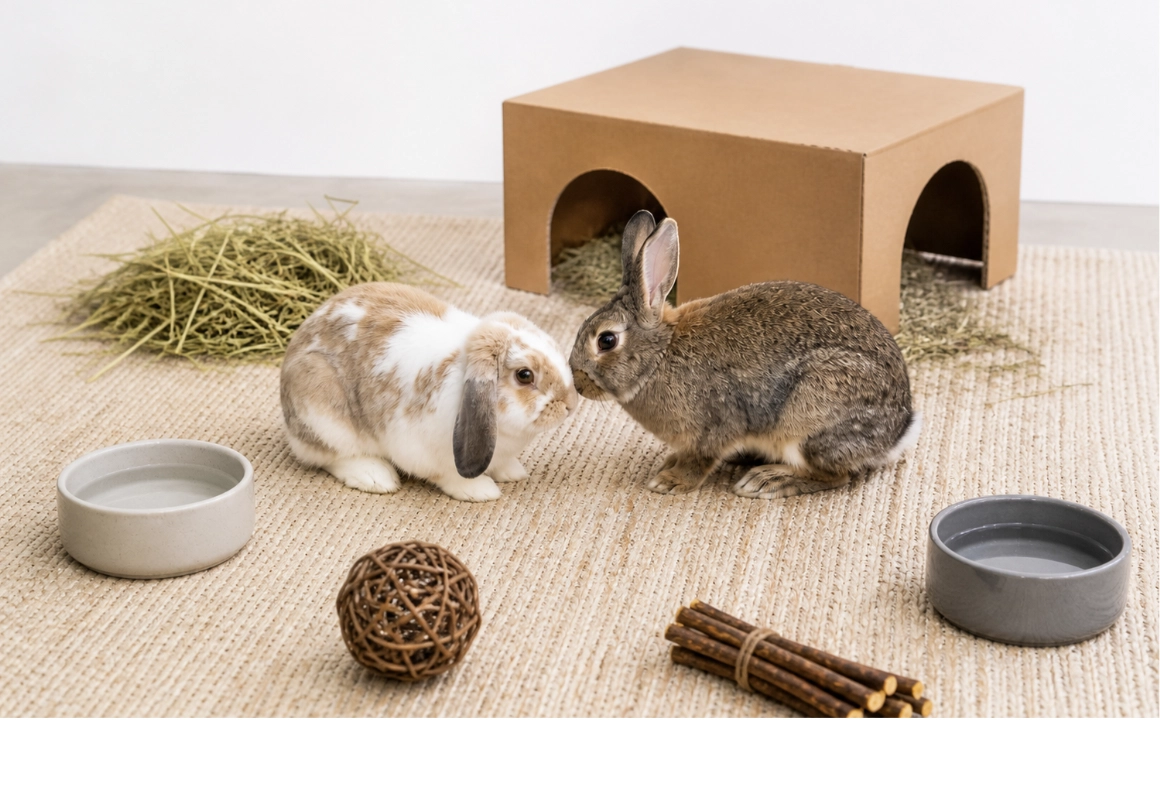 Rabbits are social animals and prefer to live with a suitable companion. However, you cannot simply put two unknown rabbits together. Rabbits have their own scent, territory, and distinct body language. A successful pairing therefore requires preparation, supervision, a neutral space, and enough time to see if the animals are truly compatible.
This page is part of our Rabbit Information . Here you can read how to prepare for bonding, what supplies are useful, how to assess behavior, and how to make the transition to living together in a rabbit run , rabbit room , or other suitable enclosure.
✓ In short: pair rabbits on neutral territory, so not directly in the enclosure of either rabbit.
✓ Stay with them, pay close attention to body language, and only build up living together further when things calm down.
✓ A run, neutral bonding area, hay, water, multiple feeding spots, and a well-organized layout make the process more practical.
Quick links:
Why keep it together? · Preparation · Neutral space · Recognizing behavior · Building cohabitation · Furnishings & products · Checklist · FAQ
Neutral start
Use a spot that does not belong to either of the rabbits. This reduces territorial tension during the first introduction.
Observe quietly
Running, riding, chasing, and sniffing can be part of a bond. Real fighting or biting requires immediate intervention.
Building up living together
Only when the connection becomes more stable do you take the step towards a shared, well-cleaned living space.
Why keep rabbits together?
Rabbits benefit greatly from a suitable companion. They can rest together, groom each other, eat together, follow each other, and seek support from one another. A human can provide a lot of care and attention, but cannot replace a rabbit buddy who speaks the same language.
That does not mean that every combination works automatically. Character, gender, age, hormones, health, previous experiences, and space all play a role. That is why careful matching is important. A good match brings peace; a bad or too rapid pairing can actually cause stress and fighting.
Useful shopping routes: Rabbit runs · Rabbit room · Rabbit hutch selection guide
Preparing to pair rabbits
Bonding begins before the first meeting. Ensure that both rabbits are healthy enough, that you know whether they have been neutered or are fertile, and that you have the time to supervise. Do you have doubts about health, age, sex, hormones, or previous problems? Then consult a rabbit-savvy veterinarian or an experienced rabbit rescue beforehand.
Also prepare the space and materials. During the bonding process, you don't want to have to search for a run, towel, water bowl, hay, or extra fencing. Make sure everything is ready before you put the rabbits together.
Preparation in brief
✓ Check if both rabbits are healthy, alert, and eating well.
✓ Discuss neutering, fertility, and sex with a veterinarian if in doubt.
✓ Choose a neutral bonding area where neither rabbit has territory.
✓ Prepare hay, water, and possibly several small feeding spots.
✓ Monitor and ensure you can intervene safely if necessary.
✓ Only prepare the permanent enclosure later, once the coupling is more stable.
Neutral coupling space: why so important?
A neutral space is a place where neither rabbit has lived before or established a clear territory. This is important because rabbits can view their enclosure as their own territory. If you place a new rabbit directly into your first rabbit's existing enclosure, it can cause a lot of stress.
A neutral space must be easy to keep an eye on. There must be enough room to move around and avoid each other, but the space should not be so large that you can no longer supervise. Preferably do not use narrow, dead-end hiding places where a single rabbit can be confined. Opt for an open, safe layout and ensure that you can clearly see what is happening.
What do you put in a coupling room?
✓ A safe run or fenced-off area.
✓ Hay in several small spots.
✓ A stable water bowl or drinking spot.
✓ Optionally, multiple small feeding spots to reduce fighting.
✓ An open cardboard box or simple shelter without a dead-end pitfall.
✓ No favorite items of either rabbit in the first phase.
Handy shopping routes: Rabbit runs · Rabbit hay · Drinking bottles & water bowls · Food bowls
Recognizing behavior during pairing
During the bonding process, a lot of behavior can be visible. Sniffing, circling, mounting, brief chasing, stamping, hair pulling, or running away can all be signs of tension and dominance. This does not automatically mean that the bonding has failed. However, you must keep a close eye on the intensity, duration, and whether both rabbits are still able to relax.
Real fighting is something else. Think of biting, rolling around while fighting, refusing to let go, injuries, or panic where one rabbit has nowhere to go. In that case, you must intervene safely and stop or scale back the bonding. Never use your bare hands between fighting rabbits; use a sturdy board, towel, or other safe tool to separate them.
Behavior that you can see
✓ Sniffing: getting acquainted and taking in scent.
✓ Mounting: may be related to tension, hormones, or dominance.
✓ Brief pursuit: can be part of the bond, as long as it does not escalate.
✓ Eating together: often a good sign, especially when the atmosphere becomes calmer.
✓ Resting side by side: a positive signal when it occurs in a relaxed manner.
✓ Digging in or rolling while fighting: reason to intervene safely.
From matchmaking to living together
Is things becoming calmer in the neutral space, are the rabbits eating near each other, and is tension decreasing? Then you can cautiously start thinking about the step of living together. Clean the permanent enclosure thoroughly beforehand and change the layout where necessary so that it feels less like the old territory of a single rabbit.
Build up the transition gradually and stay nearby. Do not place the rabbits together in the permanent enclosure for the first time just before you have to leave or late in the evening. Choose a moment when you can observe them for the rest of the day. Do you notice tension rising again in the permanent enclosure? Then take a step back to the neutral bonding area.
Preparing for final residence
✓ Clean the enclosure thoroughly before both rabbits go in.
✓ Change the layout so that it is less strongly the old territory.
✓ Provide multiple hay stations, drinking stations, or feeding stations when that promotes calm.
✓ Use shelters with multiple exits so that no one gets trapped.
✓ Continue to observe closely during the first period.
Convenient setup and products for connecting
Products cannot “solve” bonding, but they can make the process more practical. An adjustable run helps to cordon off a neutral space. Hay in multiple locations provides quiet activity. Multiple feeding or drinking stations can reduce tension. In the permanent enclosure, tunnels, houses, and hiding places are nice, as long as you prevent one rabbit from trapping the other.
When designing the space, always think in terms of functions: can both rabbits eat, drink, rest, hide, move out of the way, and move without constantly blocking each other? If so, the space is much more logically arranged than if there is only one important spot that both rabbits want to go to at the same time.
Practical for connecting
✓ A run or enclosure for neutral bonding space.
✓ Hay in multiple places as a quiet activity.
✓ Water trough or drinking facility that remains easily accessible.
✓ Multiple feeding spots if eating together still causes tension.
✓ Shelters with multiple exits in the later phase.
✓ Cleaning supplies for the final stay before they move in together.
Convenient shopping routes: Rabbit runs · Rabbit hay · Drinking bottles & water bowls · Food bowls · Rabbit houses · Rabbit tunnels · Rabbit cleaning products
Checklist: bonding rabbits
Check these points
✓ Are both rabbits healthy enough to be paired?
✓ Is it clear what sex, castration, and potential fertility are?
✓ Is there a neutral bonding area where neither rabbit has territory?
✓ Can you supervise and intervene safely if necessary?
✓ Is there hay, water, and possibly several small feeding spots?
✓ Is the mating area tidy and not cluttered with territorial items?
✓ Is the final residence clean and logically redecorated before they move in together?
✓ Will you continue to monitor food, droppings, rest, tension, and behavior during the first period?
Important to know
Bonding can go smoothly, but it can also be stressful. Take your time and do not force them to live together if there is a lot of stress, panic, or fighting. Sometimes, help from an experienced rabbit rescue or a rabbit-savvy professional is the best choice.
Is one of the rabbits eating less, not defecating or barely defecating, getting injured, or do you see clear signs of stress that are not recovering? Contact a rabbit-specialist veterinarian or an experienced shelter.
Frequently asked questions about bonding rabbits
Can you just put two rabbits together?
No, that is not wise. Rabbits are territorial and may fight if you place them directly in the enclosure of one of the animals. Use a neutral space and supervise.
What is a neutral space when bonding rabbits?
A neutral space is a place where neither rabbit has lived before or has a clear territory. As a result, there is a lower chance that one rabbit will immediately defend the spot.
Which rabbits get along best?
A combination of a neutered male and a female often works well, but temperament, age, health, and previous experience also play a role. If in doubt, seek guidance from an experienced rescue center or a rabbit-savvy veterinarian.
Is driving while clutching normal?
Mounting can occur during bonding and may be related to tension, hormones, or dominance. Pay particular attention to whether the behavior escalates and whether both rabbits can still relax.
When should you stop a clutch?
Stop or intervene safely in case of biting, rolling fights, injuries, panic, or when one rabbit can no longer escape. Do not use your bare hands between fighting rabbits.
When can rabbits be placed together in their permanent enclosure?
Only when the bonding is calmer and more stable. Clean the permanent enclosure thoroughly beforehand, change the layout, and continue to observe closely during the initial period.
What items are useful for bonding rabbits?
A run or fenced-off neutral space, hay, water, multiple feeding spots, optionally simple shelter, and cleaning supplies for the permanent enclosure are useful.
What if my rabbits start fighting again after bonding?
Take a step back, check the room, see if a struggle arises over food, the litter box, hiding places, or territory, and ask for help if the tension persists. In case of injuries, not eating, or obvious stress, contact a rabbit-savvy veterinarian or an experienced rescue center.
Continue reading within Rabbit Information
Do you want to go over the basics for rabbits first? Then check out the Rabbit Checklist . Do you want to properly set up an enclosure for two rabbits? Then read the Rabbit Enclosure Selection Guide and Setting up a Rabbit Room . For toilet behavior, you can read more at Potty Training a Rabbit . Or go back to the Rabbit Information .
Products for a practical living space for two and two people
At DRD Knaagdierwinkel®, you will find products that can help practically furnish a neutral bonding area and, later, a shared living space. Think of rabbit runs, hay, water bowls, food bowls, litter boxes, houses, tunnels, bedding mats, and cleaning supplies. These products do not automatically guarantee a successful bonding, but they do help make the space organized, safe, and functional.
✓ Runs, hay, feeding areas, and drinking areas conveniently grouped together
✓ Practical shopping routes for couples, living together, and furnishing a residence
✓ Specialist since 2011
✓ Delivered from our own stock
View now: Rabbit runs · Rabbit room · Rabbit hay · Rabbit toilets · Rabbit houses · Rabbit tunnels .
