 Polski


How much space do rabbits need?
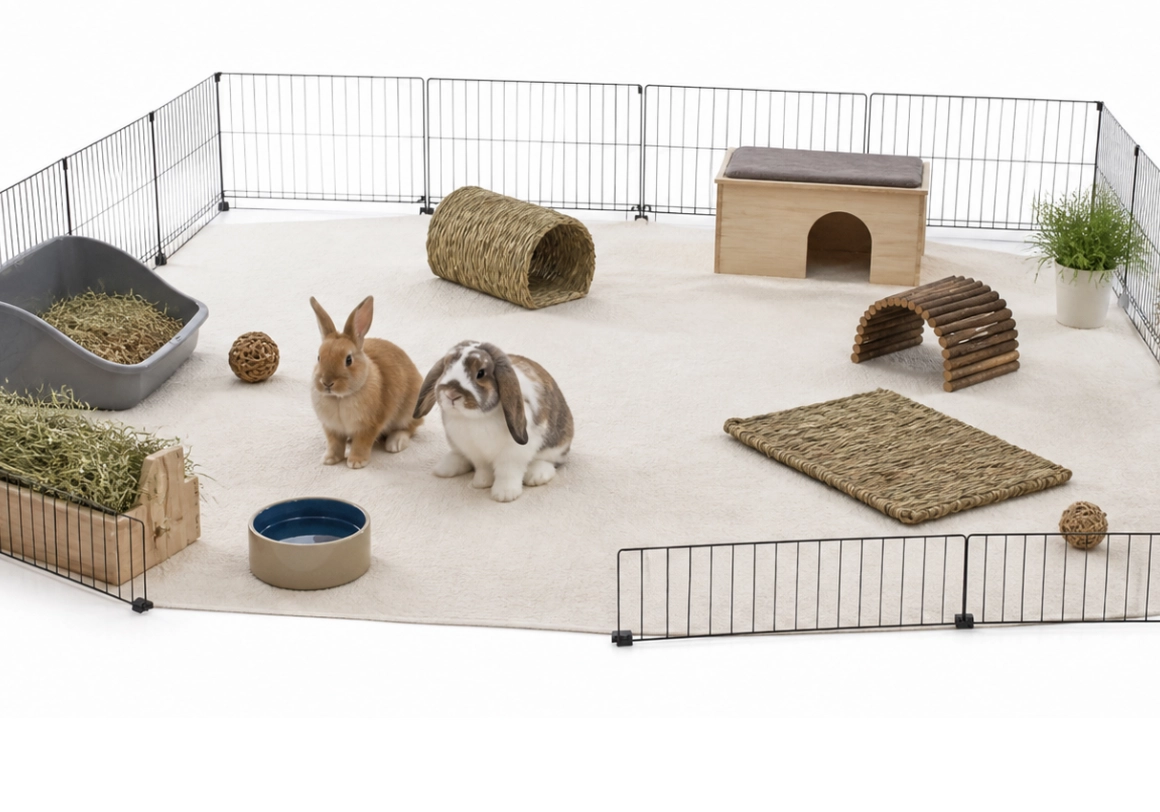 Rabbits need much more space than just a hutch. They must be able to walk, turn around, run, jump, lie down stretched out, sit upright, avoid each other, rest together, and choose different spots within their enclosure. A good rabbit enclosure therefore consists of a safe basic space with room to move, hiding places, hay, a litter box, drinking water, and enrichment.
This page is part of our Rabbit Information . Here you can read how to assess space for rabbits, why a standard hutch is usually too cramped, and how to logically arrange an enclosure, run, or rabbit room .
✓ In short: a hutch alone is not enough for rabbits; they need permanent living space to move, rest, shelter, and avoid each other.
✓ Use 4 to 5 m² as a practical starting point for an average pair of rabbits, and preferably choose a larger area if your rabbits are bigger, more active, or kept with more animals.
✓ Don't just look at square meters, but also at the layout: grip, hiding places, hay, a toilet, free movement space, safety, and enrichment determine whether the space really works.
Quick links:
Why space is important · How much space? · Why one hutch is not enough · Good layout · Indoors or outdoors · Multiple rabbits · Checklist · FAQ
Exercise
Rabbits must be able to walk, turn, jump, run, and lie stretched out without the enclosure immediately becoming crowded.
Divert
With multiple rabbits, space is needed to be together, but also to pass and avoid each other calmly.
Zones
A good enclosure has separate areas for hay, toilet, rest, shelter, exercise, and enrichment.
Why is space so important for rabbits?
Rabbits are active animals. They move not only to get from A to B, but also to explore their surroundings, expend energy, and exhibit natural behavior. They want to be able to run, take short sprints, jump, turn, dig, sniff, and rest stretched out.
Space is also important for peace between rabbits. A suitable pair or group can lie together, groom each other, and eat together, but there must also be escape routes. When everything is too cramped, the toilet area, feeding spot, hiding place, and runway can clash.
That is why at DRD we look not only at the external dimensions of a hutch or run, but above all at the question: can your rabbits really live, move around, choose, and relax here?
How much space do rabbits need at a minimum?
As a practical starting point, you can think of approximately 4 to 5 m² of permanent living space for an average pair of rabbits. Larger rabbits, energetic rabbits, or multiple rabbits require more space. Bigger is almost always better, as long as the space remains safe, manageable, and well-furnished.
Important: this concerns space your rabbits have constant access to, not just a few hours of free running per day. Extra free run is nice, but it does not replace a good basic living space. The permanent living area must itself provide sufficient opportunities to move, eat, rest, and retreat.
Assessing space in practice
✓ Can your rabbits make multiple hops in a row?
✓ Can they lie stretched out without blocking the walking route?
✓ Can they sit upright without getting stuck under a low floor?
✓ Can they pass each other without constantly bumping into one another?
✓ Is there room for a toilet, hay, water, shelters, and enrichment without everything being crowded?
✓ Is the space permanently available, even when you are not at home?
Useful shopping routes: Rabbit runs · Rabbit room · Rabbit cages
Why a rabbit hutch alone is usually not enough
Many standard rabbit hutches are primarily designed as a sheltered base, not as a complete living space. A hutch can be useful as a night shelter, resting place, toilet area, or part of a larger enclosure, but a hutch alone usually offers too little room to move around for rabbits.
Therefore, view a hutch rather as part of a system: hutch plus run, hutch plus run, or an indoor space with a permanent rabbit room. This way, your rabbits get both shelter and space. The enclosure then becomes not just a place they “fit into,” but a place where they can truly exhibit behavior.
A pen works better if
✓ Night shelter or hiding place within a larger enclosure.
✓ Dry resting place near a safe run.
✓ Sheltered hay or toilet area.
✓ Part of an outdoor enclosure with permanent freedom of movement.
✓ Part of an indoor space where your rabbits can actually walk and move out of the way.
A good stay is about more than square meters
A large space can still feel restless or impractical if the layout is incorrect. Rabbits often feel more comfortable when there is shelter, when they can walk along edges, and when the functions are clear. So, do not place everything in the middle of the room, but work with logical zones.
Consider a hay and toilet area, a rest area, a free-roaming area, and an enrichment area. This keeps the enclosure organized, easier to keep clean, and more pleasant for your rabbits.
Logical zones in a rabbit enclosure
✓ Hay and toilet area: rabbit toilet, toilet bedding, hay, and hay rack together.
✓ Rest zone: houses, tunnels, or sheltered spots where your rabbits can retreat.
✓ Running zone: free space to move, turn, jump, and pass each other.
✓ Enrichment zone: digging box, gnawing material, sniffing mat, herbs, or foraging toys.
✓ Control zone: place where you can easily provide water, hay, droppings, toilet, and coat checks.
Useful shopping routes: Rabbit toilets · Hay racks · Rabbit houses · Rabbit tunnels
Indoor or outdoor space: what is the difference?
Both indoors and outdoors can be suitable, but the points of attention are different. Indoors, you pay particular attention to grip, cables, plants, furniture, flooring, cleanliness, and the temperature in the house. Outdoors, you pay extra attention to predators, escapes, digging, shade, rain, wind, frost, flies, and drinking water.
The basics remain the same: your rabbits need permanent living space where they can move, rest, shelter, eat, drink, defecate, and avoid each other. So, don't choose solely based on "indoors or outdoors," but based on what you can practically make safe and spacious enough.
Interior space
✓ Grip on slippery floors.
✓ Make cables, plants, and furniture rabbit-proof.
✓ Clear toilet and hay corner.
✓ Quiet place without drafts, bright sun behind glass, or overheating.
Outdoor space
✓ Protect the run from escape and predators.
✓ Dry, windproof, and draft-free night shelter.
✓ Shade, rain shelter and drinking water control.
✓ Seasonal check during heat, cold, frost, and flies.
Useful information pages: Keeping rabbits indoors · Keeping rabbits outdoors · Setting up a rabbit room
Space for two or more rabbits
Because rabbits are social animals, it is preferable to set up their living space for a suitable pair or group. This means there must be enough room to rest together, but also to separate. A single house, a single narrow tunnel, or a single feeding area can cause tension when there is no alternative.
Therefore, make several important places accessible. Think of multiple hiding places, a spacious toilet area, hay in a logical location, sufficient drinking water, and unobstructed walking routes. Especially after bonding or when setting up a new enclosure, it is wise to carefully check whether both rabbits can eat, rest, and move around peacefully.
Pay extra attention to multiple rabbits
✓ Enough clear space to pass each other.
✓ Shelters with multiple openings where possible.
✓ No narrow dead-ends where a single rabbit can be tethered.
✓ Sufficient space around hay, toilet, and drinking water.
✓ Additional observation after connection, relocation, or redesign.
Useful information page: Pairing rabbits .
Using space for enrichment
Space only becomes truly valuable when your rabbits can do something with it. An empty square space without shelter does not always feel safe to prey animals. Therefore, combine open run space with sheltered edges, tunnels, houses, gnawing material, a digging box, or foraging areas.
Please ensure that enrichment does not block off the walking space. It is better to place a few products in logical spots than loose items everywhere. This keeps the enclosure calm, organized, and easy to keep clean.
Enrichment without filling up the space
✓ Tunnels along edges or walkways.
✓ Huts in sheltered spots, not in the middle of the walking zone.
✓ Digging box or sniffing box as a clear enrichment area.
✓ Chewing material in places where your rabbits like to be active.
✓ Foraging with hay, herbs, or a portion of the daily pellets.
Useful information pages: Foraging for rabbits · Digging box for rabbits · Chewing material for rabbits
Checklist: Does your rabbit enclosure have enough space?
Check these points
✓ Do your rabbits have permanent living space and not just temporary free-roaming moments?
✓ Is there enough room to make multiple hops in a row?
✓ Can your rabbits lie stretched out without blocking each other or their route?
✓ Can your rabbits pass and avoid each other?
✓ Is there room for hay, a toilet, drinking water, shelter, and enrichment?
✓ Is there free walking space remaining after the enclosure has been set up?
✓ Are there sheltered spots and open spots?
✓ Is the space safe against cables, predators, escapes, slippery floors, or digging?
✓ Can you easily keep the enclosure clean and check it daily?
Important to know
Space is not a luxury, but part of good rabbit care. A larger enclosure only truly helps when it is safe, clean, sheltered, and logically laid out.
Is one of your rabbits eating less, is one of your rabbits not pooping, is one of your rabbits sitting still a lot, or is tension developing between your rabbits? Then also look at space, layout, health, and group dynamics.
Frequently asked questions about space for rabbits
How much space do rabbits need?
For an average pair of rabbits, you can use approximately 4 to 5 m² of permanent living space as a practical starting point. Larger, more energetic, or multiple rabbits require more space.
Is a rabbit hutch enough?
No, a hutch alone is usually too restrictive. A hutch can be useful as a night shelter or resting place, but rabbits also need a run, rabbit room, or other permanent exercise space.
Does running loose in the house count as space?
Free-roaming is nice, but it does not replace a good basic space. Your rabbits must also have enough permanent living space when you are not at home or not actively supervising them.
Do two rabbits need twice as much space?
Two rabbits primarily need space to be together and to avoid each other. Provide plenty of room to move, multiple hiding places, and enough space around the hay, litter box, and drinking water.
What is more important: loft size or run size?
The total permanent living space is more important than just the hutch size. A hutch works best as part of a larger enclosure with a run, exercise area, and sheltered spots.
How do you spatially arrange a rabbit enclosure well?
Work with zones: hay and toilet area together, hiding places along the edges, open space in the middle, and enrichment in logical places without cluttering the route.
Can rabbits get enough space indoors?
Yes, that works well indoors with a rabbit room, spacious run, or safe, enclosed living space. Just pay extra attention to grip, cables, poisonous plants, a litter box, and daily cleaning.
Can rabbits get enough space outside?
Yes, that is possible outdoors with a safe run and a dry night shelter. Outdoors, pay extra attention to predators, escapes, digging, shade, rain, wind, drinking water, and seasonal checks.
Continue reading within Rabbit Information
Do you want to determine which enclosure is the best fit? Then read the Rabbit Enclosure Selection Guide . For indoor space, you can read more at Keeping Rabbits Indoors and Furnishing a Rabbit Room . For outdoor space, check out Keeping Rabbits Outdoors . Or go back to the Rabbit Information .
Runs, enclosures, and furnishings at DRD Knaagdierwinkel®
At DRD Knaagdierwinkel®, you will find products to logically build your rabbits' living space: rabbit runs, rabbit room products, floor mats, litter boxes, hay racks, houses, tunnels, digging boxes, gnawing material, and foraging toys. This way, you don't just choose a product, but build an enclosure that truly works for your rabbits.
✓ Products for the room, run, rabbit room, and enclosure neatly organized together
✓ Practical shopping routes for exercise, rest, hay, toilet, and enrichment
✓ Specialist since 2011
✓ Delivered from our own stock
View now: Rabbit runs · Rabbit room · Floor mats · Rabbit toilets · Hay racks · Rabbit houses · Play & foraging .
