 Polski

Dwarf Rat Cage – spacious, safe and with nice bar spacing
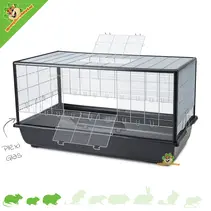
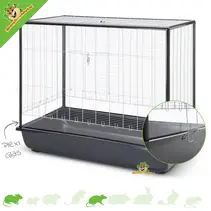

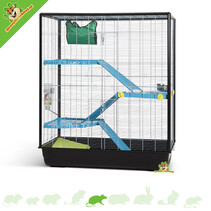

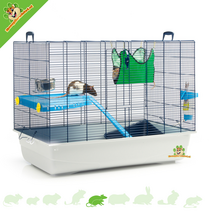
Dwarf Rat Cage – spacious, safe and with nice bar spacing
 You do not choose a smaller dwarf rat cage simply because dwarf rats are smaller. Dwarf rats remain social, active, and intelligent rats that need space, routes, height, resting places, and challenges. The difference lies primarily in safety and product fit: appropriate bar spacing, well-closing doors, no dangerous gaps, and a layout that is right for small, tame rats.
Therefore, when it comes to dwarf rat cages, DRD pays extra attention to fine bars, ventilation, usable height, safe routes, and a practical layout. Dwarf rats can still differ significantly in size and build from one another, as they are a relatively young variant or mutation. Therefore, never choose a cage based solely on the name "dwarf rat," but always match the bar spacing, passageways, doors, and layout to the actual size and build of your animals.
In this category, you will find cages and enclosures that are better suited for small rats than standard large rat cages with wide bar spacing. Combine your cage with dwarf rat houses , dwarf rat ratscaping , dwarf rat bedding , and, where appropriate, a dwarf rat exercise wheel . For food, simply choose good quality rat food .
In short
✓ Dwarf rats need a spacious cage; a smaller animal does not automatically mean a small cage.
✓ Bar spacing is especially important, because dwarf rats can be smaller and slimmer than many common pet rats.
✓ Because dwarf rats can vary in size, always match your cage and furnishings to the actual size of your animals.
Quick links
Why a separate dwarf rat cage? · Size & space · Bar spacing · Setting up the cage · Safety & escape · Maintenance · Checklist · Shopping routes · FAQ
Nice bar spacing
Dwarf rats are small and agile. Therefore, pay extra attention to bars, doors, corners, and openings they might try to crawl through.
Space remains the basis
Even small rats need space for social behavior, routes, resting places, climbing, sniffing, and daily activity.
Smart furnishing
With little houses, platforms, tunnels, hanging spots, and Ratscaping, you make the cage usable, cozy, and better suited for small rats.
Why a dwarf rat cage is chosen differently
Dwarf rats are smaller than regular pet rats, but they are not hamsters, nor are they solitary animals. They are social, active, intelligent, and curious. Therefore, you should choose a cage not only based on the size of the animal, but primarily on its behavior: can they live together, climb, use routes, hide, play, eat, and rest?
The most important difference compared to standard rat cages is that, due to their smaller build, dwarf rats are at greater risk with bars that are too wide, small gaps, or awkward door closures. Because dwarf rats can vary in size and build among themselves, it is especially important not to rely blindly on a single fixed measure, but always to observe your own animals.
DRD opts for a clear product fit here: not making everything unnecessarily separately, but giving special attention to the cage when size, bar spacing, and safety really make a difference.
Size & space: dwarf rats still need a spacious cage.
For rats, a cage of at least 100 × 50 × 70 cm is often used as the lower limit for two animals. Space remains important for dwarf rats as well. They may be smaller, but they still want to move around together, use routes, climb, play, forage, and be able to rest in multiple places.
- It is better to choose a generous size than a tight one, even for small rats.
- Pay attention to ground area and usable height.
- Ensure there is room for multiple resting areas and alternative routes.
- Use platforms, tunnels, and hanging areas to make height safely usable.
- Leave room for food, water, litter box, bedding, and toys.
- With more than two animals, extra ground space is important.
Do you want to compare more broadly? Then also read the Rat Cage Buying Guide .
Bar spacing: the most important consideration for dwarf rats
For dwarf rats, bar spacing is especially important. They are smaller, slimmer, and often surprisingly agile. While a regular adult rat stays neatly in a cage, a small or young dwarf rat might well try to crawl through wider openings.
Good to know: dwarf rats can still vary significantly in size and build, as this is a relatively young variant/mutation. Therefore, always check whether the bar spacing, doors, gaps, and passageways are suitable for the actual size of your animals. The product name provides guidance, but your animals ultimately determine whether the cage is a safe fit.
- For dwarf rats, preferably choose a fine bar spacing.
- Check not only the side walls, but also the doors, top, corners, and connection points.
- Pay attention to openings around drink bottle holders, doors, and accessories.
- Check the cage extra carefully for young, small, or slender animals.
- Test the locks: smart rats can be surprisingly handy.
- If you are unsure about the bar spacing, it is better to choose a finer and safer option.
Practical tip
✓ Don't just look at the product name "rat cage," but always check if the bar spacing is suitable for your dwarf rats.
✓ A spacious cage with bars that are too wide is not automatically a safe choice for dwarf rats.
✓ After arranging, check again whether any new steps towards openings are forming anywhere.
Setting up a dwarf rat cage: routes, resting places, and a nice scale
A dwarf rat cage only becomes truly enjoyable when the setup is right. Dwarf rats enjoy using routes and hiding places. Because they are smaller, the setup can be finer and more compact than for large rats, but still sturdy and spacious enough for group use.
- Use multiple houses or hiding places so that pygmy rats can rest both together and separately.
- Create routes with tunnels, platforms, ladders, and hanging spots.
- Ensure that the height is safely usable and does not consist of large open fall sections.
- Choose low-dust bedding and easily keep soiled spots clean.
- Create a small digging zone or Ratscaping corner for sniffing and searching.
- Ensure that feeding and drinking areas are easily accessible, even for quieter animals in the group.
You can find handy combinations at Dwarf Rat Houses , Dwarf Rat Ratscaping , and Dwarf Rat Bedding .
Safety: escape routes, doors, gaps, and placement
Dwarf rats are smart explorers. A safe cage is therefore more than just a cage with fine bars. Also consider the latches, the placement in the house, the interior design, and the accessibility of everything inside the cage.
- Check that doors close securely and are not easy to push open.
- Pay attention to gaps at corners, panels, feed openings, and the top.
- Place the cage in a draft-free location, out of direct sunlight, and not right next to a heater.
- Ensure good ventilation, especially since rats have sensitive airways.
- Use low-dust bedding and avoid dusty materials.
- Check whether routes and suspension points are still safe after every major redesign.
For practical cage furnishing, you can also take a look at Rat Cage Accessories , as many hanging and mounting aids are also useful for dwarf rats.
Keeping the dwarf rat cage clean and practical
A good cage should not only be comfortable for your dwarf rats, but also practical for you. You should be able to easily reach the food and water areas, change the bedding, check for urine spots, and easily clean or change accessories.
- Choose a cage with doors you can easily work through.
- Use toilets or pee pads in places where your pygmy rats often urinate.
- Check ground cover and digging zones for moisture, odor, and dust.
- Keep platforms, houses, and tunnels clean and within easy reach.
- It is better to use multiple clear zones than one full, cluttered cage.
- Check regularly for gnawing damage, loose parts, and sharp edges.
For hygiene and bedding selection, this page ties in nicely with Dwarf Rat Bedding and the broader category Rat Care .
Checklist: how to choose a dwarf rat cage that is right
✓ The cage is spacious enough for social behavior, routes, resting places, and enrichment.
✓ The bar spacing matches the actual size and build of your dwarf rats.
✓ Doors, corners, tops, closures, and gaps have been checked for escape routes.
✓ The cage is well-ventilated and is not placed in a draft, direct sunlight, or dry heating air.
✓ There is room for houses, tunnels, platforms, hanging spots, food, water, a toilet, and bedding.
✓ The cage remains practical to clean and easy to check.
Handy shopping routes for cage, furnishings, and basics
A dwarf rat cage works best when the layout is logically incorporated from the start. With these routes, you quickly create a safe and practical foundation.
Cage & bottom
Start with a spacious, safe cage and a low-dust bedding suitable for sensitive airways.
Custom interior design
Make the cage usable with houses, pathways, hiding places, and small-scale ratscaping.
Dwarf Grate Houses
Dwarf Rat Ratscaping
Dwarf rats Running wheels
Nutrition & care
Dwarf rats eat like pet rats. Choose good rat food and maintain practical hygiene.
Learn more about dwarf rats and rat cages
Do you want more guidance regarding dwarf rats, cage setup, and preparation? These information pages are a good fit for this category:
FAQ – frequently asked questions about dwarf rat cages
Do dwarf rats need a smaller cage than regular rats?
No, not automatically. Dwarf rats are smaller, but they remain social and active rats. They need space to live together, climb, rest, play, and explore. So choose a spacious one, but pay extra attention to a nice bar spacing.
What is the most important difference in a dwarf rat cage?
Bar spacing and escape security are the most important factors. Because dwarf rats can vary in size and build, always observe your own animals. Check doors, corners, tops, latches, and gaps very carefully.
Can a pygmy rat live in a regular rat cage?
Sometimes yes, but only if the bar spacing and gaps are safe for small rats. A spacious standard rat cage with bars that are too wide can still be unsuitable for dwarf rats.
Is a hamster cage suitable for dwarf rats?
Usually not. Dwarf rats are social rats and require more space, height, routes, and a group-oriented setup than a typical hamster cage offers. It is better to choose an enclosure that is specifically designed for rat-like behavior.
Where do you place a dwarf rat cage?
Place the cage in a quiet, sheltered spot in the house: out of a draft, out of direct sunlight, and not directly next to a heater. Good ventilation is important, but you want to avoid strong air currents and dusty materials.
What belongs in a dwarf rat cage?
Consider low-dust bedding, multiple hiding places, tunnels, platforms, hanging spots, feeding and drinking points, a toilet or pee pads, and enrichment such as Ratscaping or foraging. The setup must remain safe, clean, and easily accessible.
DRD selects dwarf rat cages based on safety, space, and product fit.
At DRD Knaagdierwinkel®, when it comes to dwarf rat cages, we look not only at size, but above all at what truly works for small, tame rats. A good dwarf rat cage is spacious, safe, well-ventilated, practical to clean, and can be furnished with pleasant routes and resting spots.
Are you undecided between a dwarf rat cage, a standard rat cage, a terrarium-style enclosure, or a nice wire cage? Then check out the Dwarf Rat Webshop or contact us via Service & Contact . We are happy to help you decide.
✓ Dwarf rat cages with attention to space, comfortable bar spacing, ventilation, and a safe design
✓ Always match the actual size and build of your dwarf rats
✓ Smartly combines with houses, bedding, Ratscaping, exercise wheels, and good rat food
✓ Specialist since 2011
✓ Ordered before 17:00, shipped the same day from our own stock
