 Polski

Choosing rat bedding: low-dust, absorbent, and practical
 Good rat bedding makes a big difference in the rat cage. It is not just about absorbing odors, but also about dust, moisture, ventilation, urine spots, ease of cleaning, and how your rats use the bedding. Rats are active, curious, and have sensitive respiratory systems. Therefore, you should always choose rat bedding carefully.
At DRD Knaagdierwinkel®, we view rat bedding from the perspective of health, behavior, and daily use. DRD selects products and advice not only based on “absorbs well,” but primarily on product fit: is the bedding low-dust, pleasant to use, easy to combine with rat toilets , pee mats , hammocks , digging boxes , and a practical cleaning routine? The LICG states that rats have sensitive airways and that bedding must be dust-free. Therefore, we steer towards low-dust choices for rats and do not use chinchilla sand or fine sand as a sand bath.
✓ In short: preferably choose low-dust or dust-free bedding for rats, because rats have sensitive airways.
✓ You reduce odor not only with an absorbent floor, but especially with toilets, urinals, spot cleaning, and good ventilation.
✓ Do not use chinchilla sand or fine sand as a sand bath for rats; rats do not need a sand bath.
Quick links:
Choosing low-dust · Materials · Absorption & odor · Toilets & urinals · Zones & excavator bucket · Maintenance · Checklist · Good to know · Useful shopping routes · FAQ
Low dust as a base
For rats, dust-free teething is a major factor because their airways are sensitive.
Tackling odor smartly
Use bedding together with litter boxes, pee pads, and spot cleaning for a fresher cage.
Practical layout
Think in zones: ground, toilet, resting places, foraging, and possibly a separate digging bucket.
Low-dust bedding for rats: why so important?
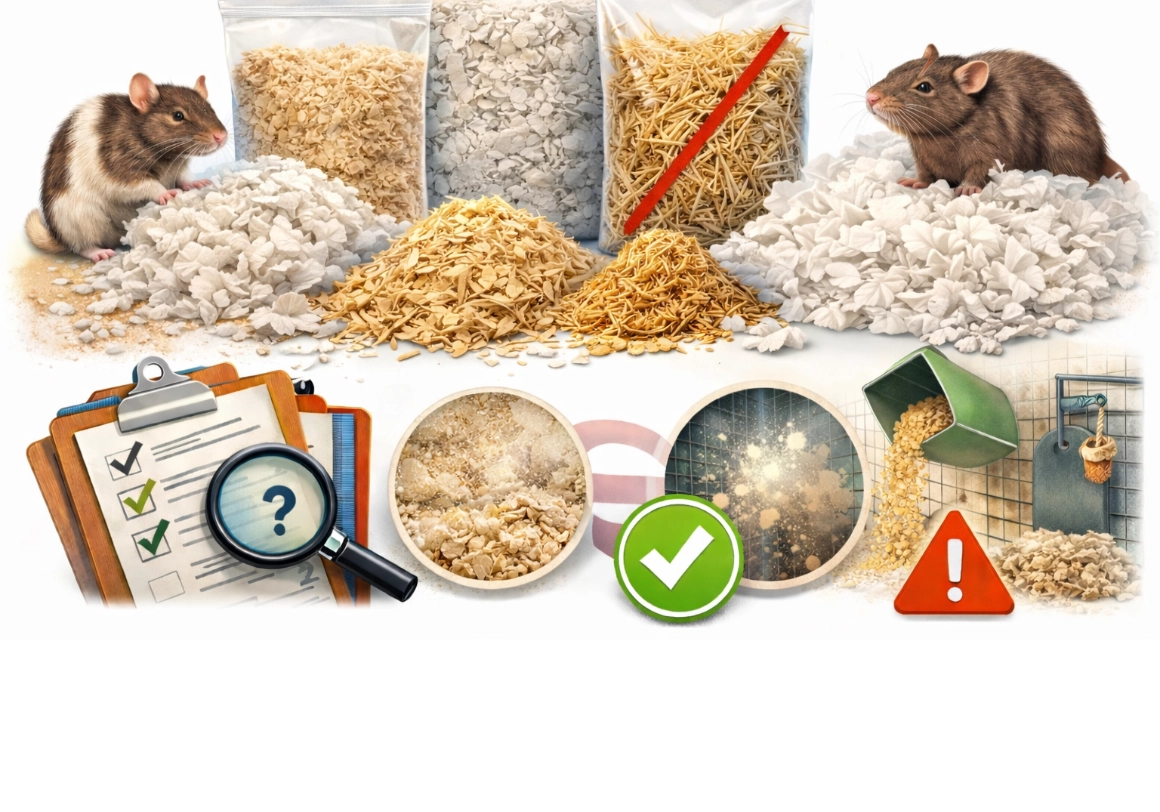
Rats have sensitive airways. The LICG therefore advises that rat bedding must be dust-free and must not emit harmful fumes. In practice, at DRD we prefer the term "low-dust" or "dust-free," because no natural bedding remains completely dust-free during every use. The most important thing is that the bedding releases visibly little dust and remains pleasant during daily use.
Dusty bedding can make the living environment unpleasant, especially in combination with urine odor, poor ventilation, or damp spots. Therefore, pay attention not only to what is stated on the packaging, but also to what you observe yourself when you fluff, distribute, or clean the bedding.
Dust-free assessment in practice
✓ Do you see visible dust when you shake out the bedding?
✓ Does dust remain on shelves, bars, or your hands?
✓ Do your rats sneeze more after a new bedding?
✓ Does the cage remain well-ventilated and not too humid?
✓ Can you easily recognize and remove wet spots?
Which materials are suitable as rat bedding?
According to the LICG, paper, clean cardboard, fine beech wood chips, and bedding based on corn or hemp can be suitable for rats. Sawdust is unsuitable for rats. At DRD, we also always consider the practical quality of each product: dust, absorption, odor, texture, ease of use, and how well it fits a rat cage.
Not every material works the same for every owner. Some substrates are good for absorption, while others are preferable for a play layer or sniffing zone. Therefore, consider the goal: do you primarily want to reduce odor, better manage urine spots, add more structure to the substrate, or create a separate digging box?
Material selection for rats
✓ Paper or cardboard: often practical, lightweight, and suitable for hygiene or play layers.
✓ Hemp: may be suitable if it is low-dust and fits your cleaning routine.
✓ Corn: can be practical as an absorbent base or toilet filler, depending on the product and use.
✓ Beech chips: can be used if they are fine and low-dust enough, but watch out for comfort and damp spots.
✓ Sawdust: do not use as rat bedding; the LICG designates sawdust as unsuitable for rats.
Absorption and scent: what works for rats?
Odor in a rat cage is usually caused by urine stains, wet bedding, soiled hammocks, old food remnants, and insufficient ventilation. An absorbent base helps, but it does not solve everything on its own. The real difference often lies in the combination of bedding, litter boxes, pee pads, and daily spot cleaning.
Therefore, pay close attention to where your rats urinate. Many rats have designated spots to urinate, for example in corners, on platforms, or under favorite hammocks. Focus on cleaning and catching the urine in those areas. This way, the rest of the cage stays fresh longer, and you won't have to replace the entire bedding every time.
Reducing odor through soil management
✓ Choose a substrate that absorbs urine well without sticking and getting wet.
✓ Remove wet spots daily.
✓ Use toilets at designated urination spots.
✓ Place pee mats on platforms or resting areas that get wet quickly.
✓ Wash hammocks and fabric parts on time.
Read more: Cleaning a rat cage
Combine toilets and pee pads with floor covering
A rat cage often remains much more manageable when you combine bedding with a designated toilet area. Not every rat becomes fully house-trained, but many rats do choose recurring spots to urinate or defecate. By placing a litter box there, you can better manage those spots.
Pee mats are useful on platforms, resting places, and spots where rats often lie or urinate. They help protect the surface and are easier to replace or wash than cleaning the entire cage setup every time.
Smart combination
✓ Bedding for the base of the cage.
✓ Toilet tray in permanent pee or droppings places.
✓ Pee mats on platforms, resting places, and under hammocks.
✓ Daily spot cleaning on the areas that are really dirty.
✓ Refresh partially weekly instead of always replacing everything at once.
View now: Rat Toilets · Rat Pee Mats · Litter Training Rats
Soil zones, play layer and rat digging box
You don't have to use exactly the same bedding throughout the cage. With rats, it often works well to think in zones. Use a practical base layer, create a toilet zone for wet spots, and optionally add a separate play layer or digging box for sniffing and searching.
A rat digging box is different from a sand bath. Rats do not need a sand bath like chinchillas and degus. Therefore, do not use chinchilla sand or fine sand for rats. A digging box is intended for sniffing, searching, digging, and foraging with rat-suitable materials that you can easily check for dust, moisture, odor, and food remnants.
Base soil
Dry, low-dust, absorbent, and practical for daily maintenance.
Toilet area
A fixed corner with toilet bowl, toilet filler, or pee pad to manage wet spots.
Play level
A messy or foraging spot where rats can search, sniff, and be active.
Excavator bucket
A separate container for digging and searching with suitable material, not intended as a sand bath.
Read more: Rat burrow selection guide · Rat Burrow Burrow · Ratscaping
Maintenance and cleaning routine
The best bedding only works well with a suitable cleaning routine. For rats, a quick daily check is often more effective than waiting until the entire cage is dirty. Remove wet spots, old food remnants, and heavily soiled areas immediately. This keeps the cage fresher and allows you to see sooner where your setup can be improved.
Do not always automatically replace everything at once. Some of the familiar scent can be pleasant for rats. Preferably work with spot cleaning, litter boxes, pee pads, and periodic more thorough cleaning. Allow washed parts to dry thoroughly before returning them to the cage.
Cleaning routine
✓ Daily: check wet spots, food residue, and toilet area.
✓ Several times a week: check pee pads and busy urination spots.
✓ Weekly: partially replace contaminated bedding and change textiles where necessary.
✓ Periodically: clean the base tray, platforms, ladders, and accessories more thoroughly.
✓ Always: let everything dry thoroughly before putting it back in the cage.
Checklist: Is your rat bedding right?
Use this checklist to assess whether your current bedding is still suitable for your rats, your cage, and your cleaning routine.
Ground cover checklist
✓ The bedding is visibly low-dust or dust-free.
✓ The bottom absorbs urine sufficiently without remaining sticky and wet.
✓ Wet spots are easy to recognize and remove.
✓ There is a toilet zone or designated spot for urine and feces.
✓ Plaster mats or underlays catch wet spots on platforms.
✓ The cage remains well-ventilated and not damp.
✓ You do not use sawdust, chinchilla sand, or fine sand as rat bedding.
Good to know
✓ Do not use heavily dusty bedding for rats; rats have sensitive airways.
✓ According to the LICG, sawdust is unsuitable for rats.
✓ Do not use chinchilla sand or fine sand as a sand bath for rats.
✓ Replace bedding in time when it is wet, musty, dusty, or heavily soiled.
✓ Do you see a lot of sneezing, wheezing, shortness of breath, or lethargic behavior? Check dust, smell, and ventilation, and contact a veterinarian specializing in rats if in doubt.
Handy shopping routes for rat bedding
Bedding works best as part of a complete rat cage. Combine the right bedding with toilet areas, pee pads, cleaning, hammocks, and optionally a digging box.
Rat Digger Box
For sniffing, searching, and digging with suitable material, not as a sand bath.
Cleaning the rat cage
For explanations regarding odor, urine stains, washing textiles, and hygiene.
Read more about soil, airways, and design
Do you want to combine the choice of bedding with the rest of the rat cage? Then also read the information pages on choosing a cage, cleaning, health signs, Ratscaping, and digging boxes.
Rat cage buying guide · Cleaning a rat cage · Rat health signs · Ratscaping for beginners · Rat burrow box buying guide
Frequently asked questions about rat bedding
Which bedding is suitable for rats?
Suitable bedding for rats is primarily low-dust or dust-free, absorbent, and practically easy to keep clean. The LICG lists paper, clean cardboard, fine beech shavings, and bedding based on corn or hemp as suitable options, among others.
Why must rat bedding be low-dust?
Rats have sensitive airways. Dusty bedding can make the living environment unpleasant, especially in combination with urine odor, dampness, or poor ventilation.
Is sawdust suitable for rats?
No, according to the LICG, sawdust is unsuitable for rats. It is better to choose low-dust bedding that is suitable for rats and can be easily combined with litter boxes, pee pads, and cleaning.
Which bedding helps reduce odors for rats?
An absorbent, low-dust floor helps, but you reduce odor mainly by removing wet spots daily, using toilets, placing pee pads smartly, and washing hammocks regularly.
Do you need to use a toilet for rats?
A toilet is not mandatory, but it is very practical. Many rats choose specific spots to urinate or defecate. By placing a litter tray there, you can keep the cage clean and fresh more easily.
Are pee pads useful for rats?
Yes, pee pads are useful on platforms, resting places, and spots where rats often urinate. They protect the surface and are easier to replace or wash than many cage parts.
Can rats be given a digging box?
Yes, a digging box can be fun for sniffing, searching, and digging with suitable material. A digging box is not a sand bath. Do not use chinchilla sand or fine sand for rats.
Do rats need a sand bath?
No, rats do not need a sand bath like chinchillas and degus. Do not use chinchilla sand or fine sand for rats, as fine dust can be harsh on their sensitive airways.
How often should you change rat bedding?
Check the cage daily for wet spots and old food remnants. Replace soiled parts in a timely manner and perform a thorough cleaning periodically. How often this is necessary depends on the cage, the number of rats, the bedding, and your litter/pee pad routine.
Choosing rat bedding at DRD Knaagdierwinkel®
At DRD Knaagdierwinkel®, we help you choose rat bedding that suits the animal and daily use. Not just absorbent paper, but low-dust, practical, easy to combine with litter boxes and pee pads, and suitable for a fresh, well-ventilated rat cage.
✓ Selection guide for low-dust bedding, absorption, odor, and maintenance
✓ Direct routes to rat bedding, toilets, pee pads, and digging bins
✓ Extra attention to sensitive airways, hygiene, and good ventilation
✓ No sand bath, chinchilla sand, or fine sand positioning for rats
✓ Specialist since 2011
✓ Delivered from our own stock
