 Polski


Keeping rabbits indoors: safe living space in the house
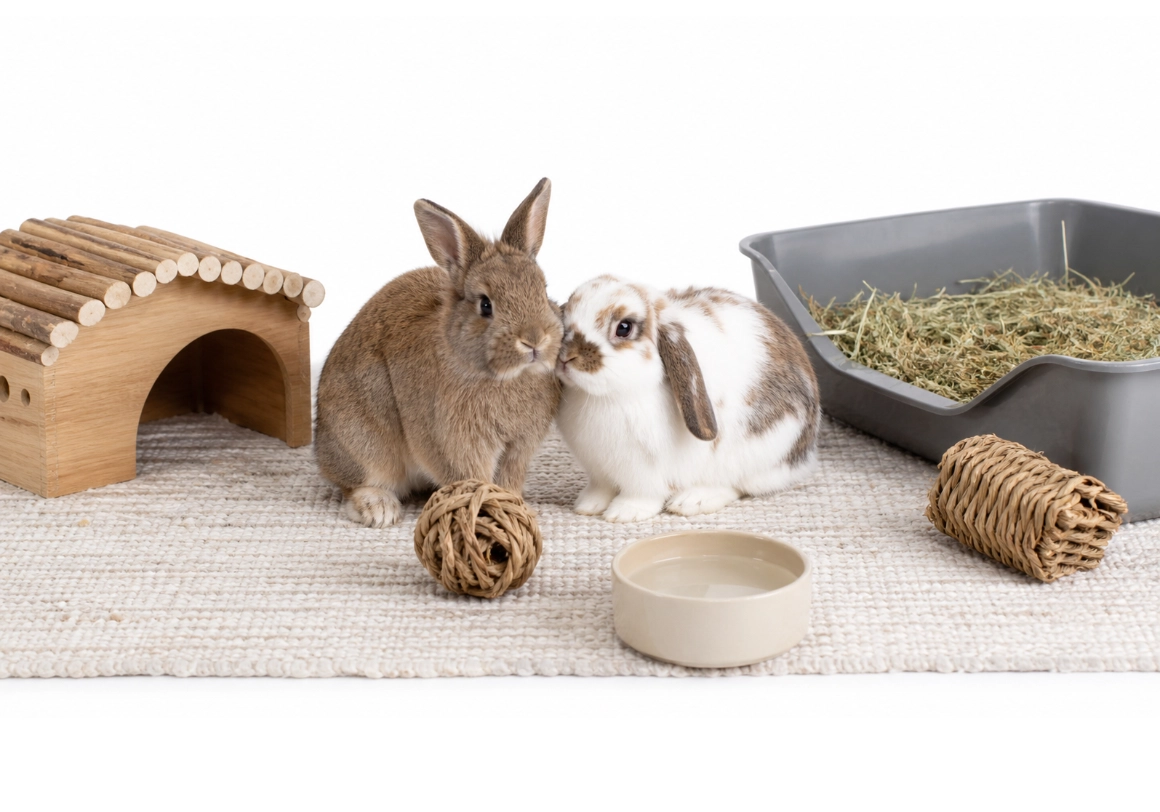 Keeping rabbits indoors can be very pleasant when the living space is well-arranged. Indoor rabbits need more than a cage or a corner in the room. They need space to move, grip on the floor, a designated litter box, plenty of hay, drinking water, hiding places, safe routes, and enrichment such as tunnels, gnawing material, and foraging toys.
This page is part of our Rabbit Information . Here you can read how to make your home safe for rabbits, why grip and litter training are so important, and how to logically structure an indoor space using products from the categories Rabbit Room , Floor Mats , Rabbit Toilets , and Play & Foraging .
✓ In short: indoor rabbits need a safe, spacious, and rabbit-proof living space with grip, a litter box, hay, hiding places, and enrichment.
✓ Preferably keep rabbits as a suitable pair or group, because rabbits are social animals and need companions.
✓ Keeping indoors also means: hiding cables, removing poisonous plants, making the floor safe, and checking food, droppings, water, and behavior daily.
Quick links:
Can rabbits live indoors? · Space & layout · Rabbit-proofing · Flooring & grip · Litter box & hay corner · Enrichment · Daily check · FAQ
Rabbit-proof house
Cables, plants, baseboards, furniture, and smooth floors require attention before your rabbits can move freely around the house.
Grip and calm
A slippery floor can be stressful or burdensome. Floor mats and designated walking routes provide more grip and security.
Potty trained and well-organized
With a clearly defined toilet area and hay corner, the interior space remains easier to keep clean.
Can rabbits live indoors?
Yes, rabbits can live indoors if your house or room is set up suitablely. Keeping them indoors is not the same as putting rabbits in a small cage. They need a permanent living space where they can move around, rest, shelter, eat hay, drink, defecate, gnaw, and search for food.
Indoor rabbits should remain accustomed to being indoors. Do not simply put them outside in the middle of winter, and do not switch daily between warm indoor and cold outdoor spaces. Large temperature differences are unpleasant and can be stressful. If you want to switch from indoors to outdoors or vice versa, do so thoughtfully and at the right time of year.
The same applies indoors: rabbits are social animals. Therefore, do not set up the living space for a single rabbit, but consider a suitable pair or small group with enough space to be together and be able to avoid each other.
Useful information pages: Bonding rabbits · Rabbit hutch selection guide · Furnishing a rabbit room
Space and layout for indoor rabbits
A pleasant indoor space serves various functions: eating, drinking, toilet, rest, shelter, exercise, and enrichment. When everything is mixed together, the space becomes cluttered more quickly and less clear for your rabbits. Therefore, work with zones.
A rabbit room is ideal if you have the space. However, a large fenced-off corner or a secure run inside the house can also work, as long as your rabbits have enough space permanently and aren't just allowed out for “a few hours.” Letting them run free can be especially nice, but the basic space itself must be right as well.
Logical zones within
✓ Hay and toilet area: litter box, toilet bedding, hay, and hay rack together.
✓ Rest zone: small houses, tunnels, or sheltered spots along the edge.
✓ Exercise zone: open space where your rabbits can move around and pass each other.
✓ Enrichment zone: digging box, gnawing material, sniffing mat, or foraging toys.
✓ Care zone: place where you can easily clean, check, and refill.
View now: Rabbit room · Rabbit runs · Rabbit houses
Making your house rabbit-proof
Indoor rabbits explore their surroundings with their noses, paws, and teeth. Therefore, safety is the first step. Cables, chargers, power strips, poisonous plants, cleaning products, sharp edges, baseboards, curtains, carpets, and furniture can be interesting to gnaw on or crawl behind.
Secure vulnerable areas before your rabbits roam freely. Tuck away cables, screen off corners, and ensure your rabbits cannot get stuck behind cabinets, under sofas, or in narrow openings. Afterwards, do offer attractive alternatives, such as gnawing material, tunnels, houses, and foraging areas.
Rabbit-proof checklist
✓ Cables, chargers, and power strips are concealed or shielded.
✓ Poisonous plants are out of reach.
✓ Cleaning products and small items are safely stored away.
✓ Skirtings, furniture, and carpet edges are protected where necessary.
✓ There are no narrow openings where rabbits can get stuck behind or under.
✓ There are safe alternatives for gnawing, digging, hiding, and exploring.
Useful information page: Chewing material for rabbits .
Flooring and grip for indoor rabbits
Many floors in the home are slippery for rabbits. Laminate, PVC, tiles, and smooth wood offer little grip. As a result, rabbits may move uncertainly, be less willing to run, or have difficulty turning and pushing off. Grip is therefore an important part of keeping them indoors.
Ground mats, washable mats, or other grippy surfaces help create clear pathways and resting places. Ensure that the mats stay in place well, are easy to clean, and are regularly checked for gnaw marks or loose threads.
Indoor floor check
✓ Can your rabbits walk, turn, and push off without slipping?
✓ Are there designated walking routes with sufficient grip?
✓ Do mats stay in place well?
✓ Is the surface easy to keep clean?
✓ Do you check for gnaw marks, loose threads, and wear?
View now: Floor mats for rabbits .
Indoor toilet area and hay corner
A clear toilet area makes keeping them indoors much more practical. Place the rabbit toilet in a spot where your rabbits already like to urinate or defecate. Use suitable litter bedding in the litter box and keep the rest of the room distinctly different, for example with floor mats or a different surface.
Hay by the litter box often works well, as many rabbits enjoy eating hay while sitting on or near the box. A hay rack, hay sack, or hay feeder next to or above the litter box can make the spot logical. Just make sure the hay stays clean and dry.
Indoor toilet area
✓ Choose a spacious litter box where your rabbits can sit comfortably.
✓ Use absorbent toilet bedding in the toilet bowl.
✓ Place hay at or above the toilet area.
✓ If you have multiple rabbits or a large room, consider creating multiple litter boxes.
✓ Check daily for wet spots, odor, and abnormal droppings.
View now: Rabbit toilets · Rabbit toilet bedding · Hay racks · Potty training a rabbit
Enrichment for indoor rabbits
Indoor rabbits need daily enrichment. Stimuli indoors are different from those outdoors: fewer digging opportunities, fewer natural scents, and often more smooth or fragile materials. Therefore, it is important to offer safe activities.
Think of tunnels, houses, digging boxes, gnawing material, snuffle mats, treat balls, and foraging toys. It is better to use a few logical enrichment spots than to fill the entire room with loose items. Vary the items and see what your rabbits really enjoy playing with.
Enriching from within
✓ Tunnels along edges or walkways.
✓ Houses and hiding places that both rabbits can use.
✓ A digging box or sniffing box as a permanent activity area.
✓ Chewing material in places where your rabbits like to be active.
✓ Foraging with hay, herbs, or a portion of the daily pellets.
Useful information pages: Foraging for rabbits · Digging box for rabbits · Chewing material for rabbits
View now: Rabbits play & foraging · Rabbit tunnels · Chewing material
Temperature, ventilation and peace in the house
Indoor rabbits live in the climate of your home. Therefore, pay attention to heat, drafts, direct sunlight behind glass, radiators, underfloor heating, and ventilation. A spot in full sun behind a window can quickly become warm. Conversely, a spot next to an open door or in a drafty hallway can be restless or cold.
Choose a quiet spot with fresh air, but without drafts. Ensure your rabbits can always choose between an open area, a sheltered spot, and a cooler resting place. Do not place the enclosure directly next to a radiator, in bright sunlight, or in a place with loud noises.
Indoor climate check
✓ No exposure to direct sunlight behind glass.
✓ Not directly next to a radiator, stove, or underfloor heating without an alternative space.
✓ Fresh air without drafts.
✓ Quiet place without constant hustle and bustle or loud noises.
✓ Possibility to choose between open space and shelter.
Daily check on indoor rabbits
You often see your rabbits more frequently indoors than outdoors, but precisely because of this, small changes can sometimes start to seem normal. Therefore, maintain a regular daily check. Look at food, hay, water, droppings, litter box, coat, exercise, and behavior.
Also look out for gnaw marks on mats, furniture, and toys. Indoor materials can be more vulnerable than outdoor materials. Remove broken, sharp, wet, or heavily gnawed materials in time.
Daily internal check
✓ Do your rabbits eat hay and feed well?
✓ Are there normal droppings?
✓ Is drinking water clean and accessible?
✓ Is the toilet area clean and dry enough?
✓ Is the fur around the hindquarters clean and dry?
✓ Are mats, tunnels, houses, and gnawing products still intact?
✓ Are your rabbits alert and moving normally?
Useful information pages: Caring for a rabbit · Rabbit droppings: what is normal? · Rabbit is not eating
Checklist: keeping rabbits indoors
Check these points
✓ Do your rabbits have sufficient permanent living space?
✓ Is the area safely fenced off and made rabbit-proof?
✓ Are cables, plants, cleaning products, and small objects out of reach?
✓ Is there sufficient grip on the floor?
✓ Is there a designated toilet area with hay nearby?
✓ Are there multiple shelters or sheltered routes?
✓ Is there safe enrichment such as tunnels, gnawing material, a digging box, or foraging toys?
✓ Can your rabbits pass each other, move aside, and rest together?
✓ Do you check food, droppings, water, coat, behavior, and wear daily?
Important to know
Keeping them indoors is pleasant when the living space is right, but it does require daily monitoring. A house contains materials that rabbits might find interesting to gnaw on, such as cables, mats, furniture, and plants.
Is one of your rabbits not eating, is one of your rabbits not pooping, is one of your rabbits puffed up or lethargic, or do you see clear signs of pain? Contact a rabbit-specialist veterinarian immediately.
Frequently asked questions about keeping rabbits indoors
Can rabbits be kept indoors?
Yes, rabbits can be kept indoors provided the space is safe, spacious, and well-furnished. Think of grip, a litter box, hay, hiding places, companions, drinking water, and enrichment.
Is a cage enough for indoor rabbits?
No, a cage alone is too restrictive. Rabbits need permanent living space to move around, retreat, rest, eat, and exhibit natural behavior.
How do you make a room safe for rabbits?
Tuck away cables, remove poisonous plants, screen vulnerable furniture and baseboards, and ensure that rabbits cannot get trapped behind or under furniture.
Which floor is suitable for indoor rabbits?
A floor must provide sufficient grip and be easy to keep clean. On slippery floors, floor mats or other grippy surfaces are often useful.
How do you litter train indoor rabbits?
Create a clear litter box where your rabbits like to urinate or defecate. Use litter box bedding and place hay near or above the litter box, as many rabbits enjoy eating hay there.
Can indoor rabbits go outside?
Not just like that. Rabbits do not tolerate large temperature fluctuations well. So do not suddenly place indoor rabbits in the cold, and do not switch daily between a warm indoor space and a cold outdoor space.
What do you put in an indoor enclosure for rabbits?
Think of floor mats, a litter box, litter bedding, a hay rack, drinking water, houses, tunnels, gnawing material, a digging box, and foraging toys. Ensure that there is also plenty of free space left for movement.
What do you pay attention to daily with indoor rabbits?
Check food, hay, water, droppings, litter box, coat, behavior, exercise, and wear on mats, toys, tunnels, and gnawing material.
Continue reading within Rabbit Information
Do you want to organize the indoor space step by step? Then read Furnishing the Rabbit Room . For toilet behavior, you can read on at Potty Training a Rabbit . Do you want to do more with enrichment? Then check out Foraging for Rabbits , Digging Box for Rabbits , and Chewing Material for Rabbits . Or go back to the Rabbit Information .
Products for indoor rabbits at DRD Knaagdierwinkel®
At DRD Knaagdierwinkel®, you will find products to furnish your rabbits' indoor space practically and safely. Think of floor mats, rabbit toilets, litter bedding, hay racks, houses, tunnels, digging boxes, gnawing material, drinking facilities, cleaning products, and foraging toys.
✓ Products for indoor spaces, grip, toilet, hay, and enrichment conveniently grouped together
✓ Practical shopping routes for the rabbit room, bedding, litter training, and foraging
✓ Specialist since 2011
✓ Delivered from our own stock
View now: Rabbit room · Floor mats · Rabbit toilets · Hay racks · Rabbit houses · Rabbit tunnels · Play & foraging .
