 Polski

Rat food for pet rats and pygmy rats





- Voor 17 uur besteld, dezelfde dag verzonden!
- Rodent specialist since 2011
- Dispatched from our own stock



Rat food for pet rats and pygmy rats
 Rat food is the daily foundation for pet rats. In this category, you will find complete kibble, pellets, and natural mixes suitable for curious, social rats. When it comes to rat nutrition, DRD looks not only at “what’s in the bowl?”, but primarily at how the food fits into daily care: basic food, portion size, variety, snacks, herbs, and foraging.
Do you have dwarf rats? Then you can simply choose good quality rat food. Dwarf rats are small domesticated rats and basically eat the same things as regular domesticated rats. The difference does not lie in a separate food category, but mainly in portion size, activity level, age, and how you offer food or small extras. For dwarf rats, therefore, you tailor the quantity and foraging times to your animals, while the basics simply fall within this rat food category.
Combine good rat food with suitable rat snacks , rat herbs and seeds , and rat play & foraging . This makes feeding not only practical, but also more fun and natural for your rats.
In short
✓ Rat food is the daily basis for pet rats and dwarf rats.
✓ Choose from complete kibble, pellets, and natural mixes, depending on your preference and your animals' feed intake.
✓ Use snacks, herbs, seeds, and small extras primarily as a supplement, reward, or foraging moment.
Quick links
Why good rat food? · Types of rat food · Dwarf rat food? · Feeding & foraging · Combining · Checklist · Shopping routes · FAQ
Daily basis
Good rat food forms the basis of the menu. Treats are nice, but they do not replace the main food.
Also for pygmy rats
Basically, dwarf rats eat the same things as domestic rats. You mainly adjust the portion and the way it is served.
Feeding with a twist
Scatter or hide small portions of food to encourage sniffing, searching, and natural behavior.
Why good rat food is important
Rats are curious omnivores who enjoy searching, sniffing, selecting, and exploring. Good rat food provides a clear daily foundation. From there, you can supplement with small snacks, herbs, seeds, or foraging products.
The best choice depends on your animals and your feeding method. Some owners prefer complete kibble or pellets because every bite is more uniform. Other owners appreciate a natural mix because it provides more texture, aroma, and variety. Both can be suitable if you carefully consider food intake, behavior, and use within the group.
- Choose basic food that is suitable for pet rats.
- Check if all the animals have enough to eat.
- Prevent supplements from displacing the basic diet.
- Also use food as enrichment by hiding small portions.
- Keep feeding areas clean and check for old leftovers.
- Adjust portions based on age, activity, group size, and fitness level.
Types of rat food: kibble, pellets, and natural mixes
When it comes to rat food, you can roughly choose between complete kibble/pellets and natural mixes. The difference lies mainly in texture, feed intake, and the method of presentation. DRD selects products that suit pet rats and their daily care.
Complete kibble and basic feed
Complete kibble or basic foods are convenient when you want a clear daily foundation. They help keep the menu organized and are easy to portion.
Rat pellets
Pellets can be useful as a base, supplement, or foraging product, depending on the type of pellet. Pay close attention to the product description: some pellets are intended as complete food, while others are meant as a natural extra or reward.
Natural mixes
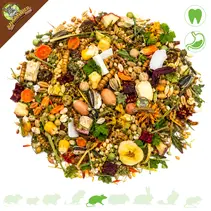
Natural mixes provide more scent, texture, and variety. They are fun for rats that enjoy searching and selecting. When using mixes, however, ensure that all components are eaten and that the mix fits within the overall diet.
Snacks, herbs and seeds
Snacks, herbs, and seeds are intended as a supplement to rat food. They are particularly suitable for rewarding, supporting taming, foraging, or adding extra scent and variety.
Dwarf rat food: do dwarf rats need separate food?
No, dwarf rats basically do not need separate dwarf rat food. Dwarf rats are small domesticated rats and eat the same type of rat food as regular domesticated rats. Therefore, we deliberately refer to this rat food category regarding dwarf rats.
However, it is important to observe your own animals closely. Dwarf rats can vary in size and build among themselves, as it is a relatively young variant/mutation. Regarding feeding, this primarily means tailoring portions, snacks, and foraging times to size, activity, and group composition.
- Choose good rat food as a basis.
- Do not use a separate food category for dwarf rats if it is not necessary in terms of content.
- Adjust portions to the actual size and activity of your animals.
- Use snacks in smaller quantities and primarily as a reward or foraging moment.
- Check that all animals can eat in peace.
- If necessary, distribute feed across multiple locations within a group.
Good to know for pygmy rats
✓ The basic food is the same as for pet rats.
✓ The difference lies mainly in dosing, observing, and smart presentation.
✓ For dwarf rat-specific choices, the cage, bar spacing, houses, exercise wheels, bedding, and Ratscaping are particularly important.
Feeding with a twist: foraging for rats
Rats enjoy searching. Therefore, you don't always have to offer food only in a food bowl. You can scatter part of the food, hide it, or incorporate it into a sniffing zone, digging box, or foraging toy. This way, you immediately turn feeding into an activity.
- Scatter a small portion of the food through the bedding or sniffing zone.
- Hide small portions in safe foraging products.
- Use herbs and seeds as small foraging stimuli.
- Combine foraging with Ratscaping or Dwarf Rat Ratscaping .
- Do not use wet or perishable food in places that you cannot properly control.
- Remove old feed residues on time.
Also check out Rat Play & Foraging for products that make searching for food more fun.
Combine rat food with snacks, herbs, and enrichment
A good rat menu starts with basic food. Around this, you can work with small supplements. Think of snacks for rewarding, herbs and seeds for scent and foraging, or gnawing material and natural furnishings to give your rats more to do.
- Use rat food as a daily basis.
- Use snacks consciously and in small quantities.
- Use herbs and seeds primarily for scent, variety, and foraging.
- Combine feeding with tunnels, houses, digging boxes, or Ratscaping.
- For groups, check if all animals can eat together.
- Keep feeding areas fresh and prevent old leftovers in houses or tunnels.
Useful categories are Rat Snacks , Rat Herbs and Seeds , and Rat Gnawing Material .
Checklist: how to choose the right rat food
✓ The food is suitable as a basic diet for pet rats.
✓ For dwarf rats, choose the same type of rat food, but tailor the portion and snacks to their size and activity level.
✓ All animals in the group can eat in peace.
✓ Snacks, herbs, and seeds remain additions alongside the base.
✓ Food can be safely used for foraging and sniffing.
✓ Feeding areas, shelters, and sniffing zones remain clean and inspectable.
Handy shopping routes for rat food
Rat feeding works best when basic food, rewards, and foraging logically come together. You can practically build up the menu and the feeding area via these routes.
Rewards & variation
For small rewards, taming, training, and variety alongside the basic food.
Foraging & setup
For searching, sniffing, and feeding with a twist in the cage or Ratscaping setup.
Learn more about rat food
Would you like to read more about rats, dwarf rats, and nutrition? These information pages are a good complement:
FAQ – frequently asked questions about rat food
What food is suitable for pet rats?
Choose food intended as a staple diet for pet rats. Depending on your preference, you can choose complete kibble, pellets, or natural mixes. Above all, check if your rats eat it well and if it fits into your daily care routine.
Do dwarf rats need special dwarf rat food?
No, basically, dwarf rats eat the same as regular pet rats. Choose good rat food and tailor portions, snacks, and foraging times to the actual size, build, and activity of your dwarf rats.
What is better: rat pellets or a rat mix?
That depends on your animals and your feeding method. Kibble or complete pellets are clear and more uniform. A natural mix provides more aroma, texture, and variety. When using mixes, pay close attention to ensure that all components are eaten.
Can you use rat food to forage?
Yes, you can scatter or hide part of the food in a sniffing zone, digging box, or foraging toy. This stimulates searching and sniffing. Do keep an eye out for old food remnants and wet spots.
Are rat snacks the same as rat food?
No, snacks are supplements to the basic food. Use them as rewards, for taming, training, or foraging. The daily base remains good rat food.
How do you prevent picky eating?
Consider choosing complete kibble or pellets if you notice your rats mainly picking out the tastiest parts. With mixes, it helps to carefully observe whether all parts are eaten.
DRD selects rat food based on basis, behavior, and smart combinations.
At DRD Knaagdierwinkel®, when it comes to rat food, we look at more than just the food bowl. Good nutrition is the foundation, but the way you feed makes the difference: portioning, combining, rewarding, foraging, and observing. For pet rats *and* dwarf rats, good rat food remains the logical daily basis.
Undecided between complete kibble, natural mixes, pellets, snacks, or herbs and seeds? Then check out the Ratten Webshop or contact us via Service & Contact . We are happy to help you decide.
✓ Rat food for pet rats and dwarf rats: basic food, kibble, pellets and natural mixes
✓ Dwarf rats eat the same basic food; portions and snacks should be tailored to size, build, and activity.
✓ Smartly combines with snacks, herbs, seeds, Ratscaping, and foraging toys
✓ Specialist since 2011
✓ Ordered before 17:00, shipped the same day from our own stock
