 Polski

Guinea Pig Houses & Homes and Hiding Places
It's no secret that guinea pigs love tunnels, burrows, and cardboard boxes. As prey animals, guinea pigs thrive on a safe space where they can hide, nap, and, of course, get up to mischief!
Read more
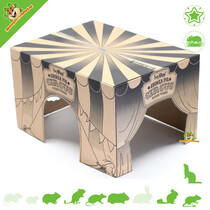
HayPigs cardboard playhouse for rodents who love to hide, gnaw, and destroy. With multiple openings, an open base, and a spacious design for fun and shelter.
Read more
Soft fleece tunnel from HayPigs with a removable pee pad and plastic insert for extra sturdiness. Great as a hiding place or sleeping tunnel for guinea pigs, rats, and other larger rodents.
Read more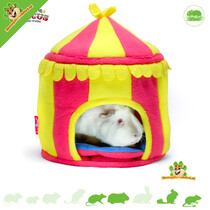
Soft HayPigs Circus Tent with two removable pee pads for guinea pigs, rats, and other rodents. A great hiding place for resting, sleeping, and sheltering.
Read more- Voor 17 uur besteld, dezelfde dag verzonden!
- Rodent specialist since 2011
- Dispatched from our own stock
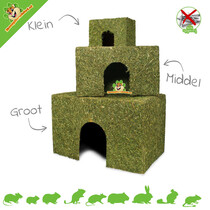
Natural hay house without topping, made with mountain meadow hay. Available in small, medium, and large. To shelter in, explore, and nibble on.
Read more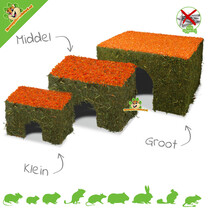
Natural hay house with carrot topping for sheltering, nibbling, and exploring. Available in small, medium, and large.
Read more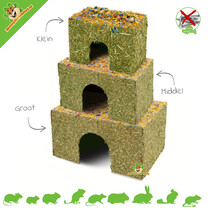
Natural hay house with floral topping for sheltering, nibbling, and exploring. Available in small, medium, and large.
Read more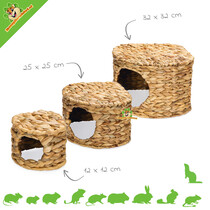
Grass House Corner Water Hyacinth in 3 sizes. Natural water hyacinth corner house with an open base and reinforcement. Choose the correct size via the green animal logos on the product image.
Read more- Voor 17 uur besteld, dezelfde dag verzonden!
- Rodent specialist since 2011
- Dispatched from our own stock
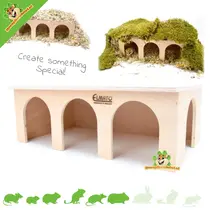
Spacious 45 cm wooden station house for guinea pigs and rats. Can also be used as a large buried watchbox for mice, dwarf hamsters, hamsters, and gerbils.
Read more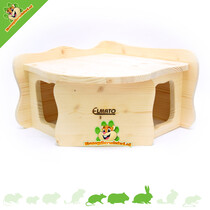
Spacious wooden corner house of 32 cm for larger groups of rats, guinea pigs, and possibly small rabbit breeds. With an open bottom, two entrances, and a flat roof.
Read more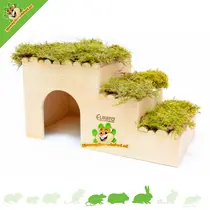
Spacious wooden ladder house measuring 42 cm. Ideal as a large sleeping house for rats and guinea pigs. For small rodents, it can primarily be used as a buried hideout.
Read more
Spacious wooden house measuring 29.5 cm for rats and guinea pigs. Can also be used by hamsters as a large buried cave. With an open bottom and a sloping branch roof.
Read more- Voor 17 uur besteld, dezelfde dag verzonden!
- Rodent specialist since 2011
- Dispatched from our own stock
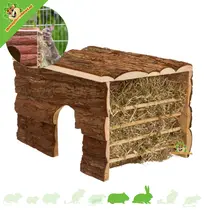
Spacious 40 cm wooden house with an open bottom, two openings, and an integrated hay rack. Suitable for guinea pigs and small rabbits/dwarf rabbits.
Read more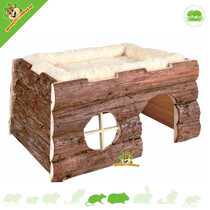
Spacious bark wood house for rats and guinea pigs, with an open bottom, door, small window, and a soft, removable cushion on the roof as an extra relaxation spot.
Read more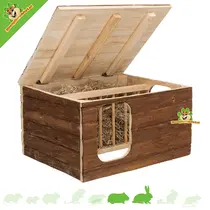
Wooden house with built-in hay rack for guinea pigs and dwarf rabbits. With an open bottom, two entrances, and a removable roof for easy refilling of the hay.
Read more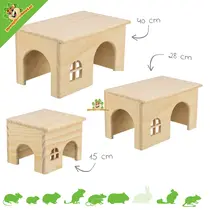
Sturdy wooden log house made of untreated spruce with an open bottom, flat roof, and two entrances. Available in three sizes for different rodents.
Read more- Voor 17 uur besteld, dezelfde dag verzonden!
- Rodent specialist since 2011
- Dispatched from our own stock
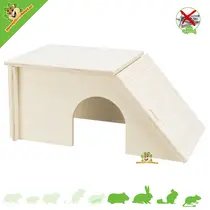
Spacious nail-free wooden house with an open bottom, two entrances, and a sloping roof. Suitable for rats, guinea pigs, chinchillas, and degus. Available in multiple sizes.
Read more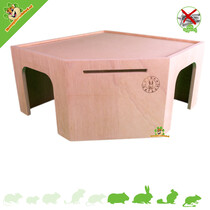
Spacious wooden corner house of approx. 35 × 35 × 18 cm with 2 entrances, an open bottom, and a flat roof. Suitable for guinea pigs, small rabbits, chinchillas, and degus.
Read more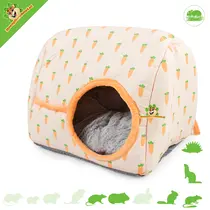
Soft plush carrot house of approx. 30 cm for rats, guinea pigs, ferrets, chinchillas, and degus. With a cozy shape and removable cushion.
Read more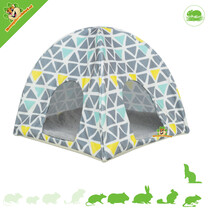
Soft 37 cm Trixie tent with two openings and a removable cushion. Great as a hiding place for guinea pigs, small rabbits, and ferrets, and for rats especially as an accessory during run.
Read more- Voor 17 uur besteld, dezelfde dag verzonden!
- Rodent specialist since 2011
- Dispatched from our own stock
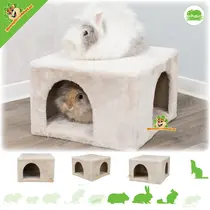
Soft plush relaxation hideout, 36 cm, for guinea pigs, rabbits, chinchillas, and ferrets. For use outside the permanent enclosure, in a run or supervised free-roaming area.
Read more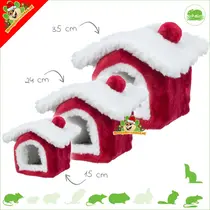
Soft plush Christmas house in three sizes. Cozy festive hideout for mice, rats, guinea pigs, rabbits, chinchillas, and degus. Use under supervision.
Read more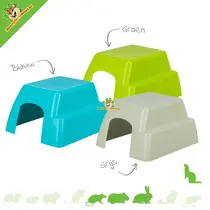
Spacious plastic igloo house measuring 29 × 33 x 19 cm for rats, guinea pigs, and small rabbits. With an open bottom, step, and easy-to-clean plastic.
Read more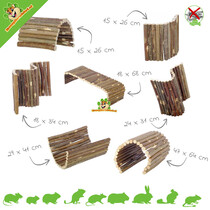
You can really go in any direction with this fun Hazelnut Bridge! The bridge can be easily bent, so it can be used as:
Read more
Choosing guinea pig houses & hiding places: peace, shelter, and a clear view of the enclosure
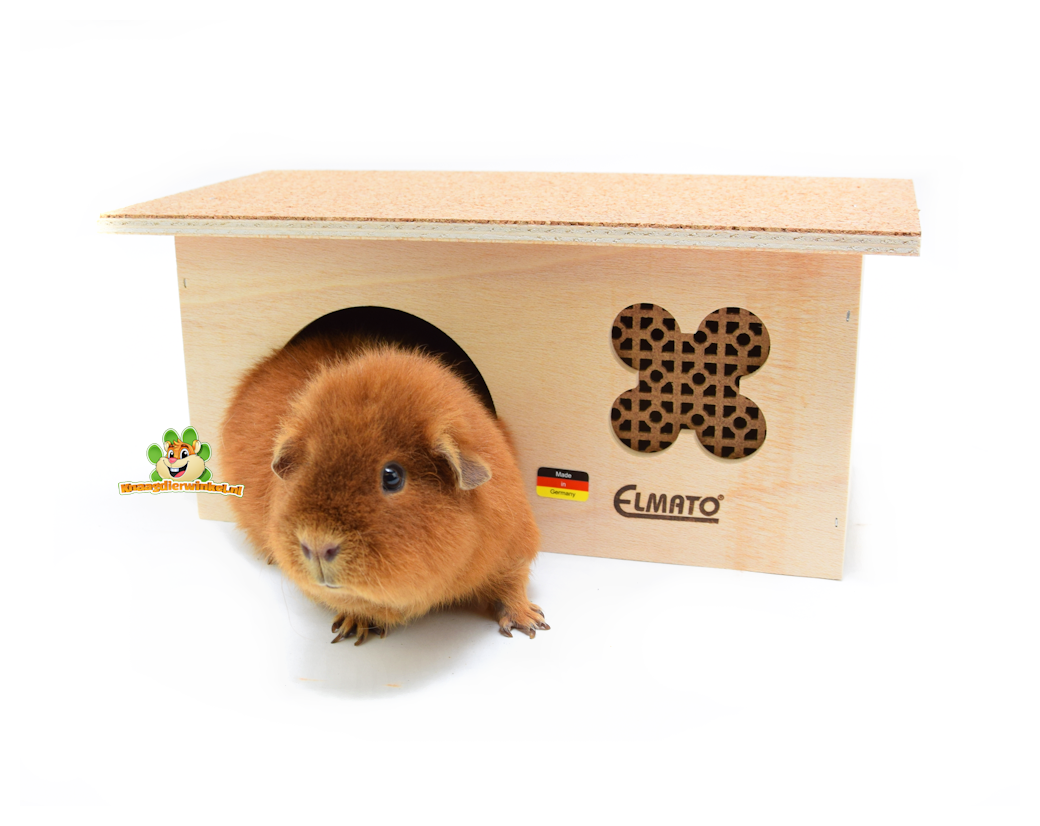 Guinea pig houses are important for peace, shelter, and freedom of choice within the enclosure. Guinea pigs are social ground animals, but they also want to be able to retreat quickly when startled, want to rest, or need a moment of distance from another guinea pig.
A good guinea pig enclosure therefore does not have just one random house, but multiple hiding places that are logically distributed. Think of a spacious guinea pig house, a corner house, a hay house, a tunnel, a soft resting spot, or a sheltered route. This way, guinea pigs can choose where they want to lie down, eat, pass through, or take shelter.
At DRD Knaagdierwinkel®, we view houses as part of the overall setup. Does the house suit the size of your guinea pigs? Are enough routes left open? Are there multiple entrances or exits? Does it combine well with guinea pig tunnels , bedding , and the rest of the cage? This is how you choose a hiding place that really works in daily practice. Specialist since 2011.
✓ Guinea pig houses, corner houses, hay houses, and hiding places for peace and a good overview
✓ Multiple hiding places help guinea pigs avoid each other more easily
✓ Combines well with tunnels, cushions, hay racks, C&C cages, and bedding
✓ Selected by DRD Knaagdierwinkel® – Specialist since 2011
Quick links
In short • Why houses? • Types of houses • Multiple guinea pigs • Setting up a cage • C&C enclosure • Handy combinations • Checklist • FAQ
In short: which house is suitable for guinea pigs?
A suitable guinea pig house is spacious enough, stable, easily accessible, and matches the decor of the enclosure. Guinea pigs must be able to get in and out easily. For multiple guinea pigs, houses with two openings or extra tunnels are often practical, as a guinea pig is less likely to get stuck in a hiding place.
For two guinea pigs, it is beneficial to provide multiple hiding places. Consider at least one private hiding place per guinea pig, and optionally a larger shared resting area. The goal is not to overcrowd the cage, but to offer enough choice without sacrificing movement space.
So, do not just look at the size of the shelter, but also at its location within the enclosure. A shelter should provide peace and quiet, but not block an important route to hay, water, food, or another shelter.
More than enough
A guinea pig must be able to comfortably go in, turn around, and go back out.
Multiple places
For groups, having more than one shelter often creates a calmer atmosphere than one popular little house.
Open routes
Place the houses so that guinea pigs can pass each other and do not get stuck.
Why do guinea pigs need houses and hiding places?
Guinea pigs are naturally alert. They find open spaces exciting and want to be able to take cover quickly when they hear or see something unexpected. A small house provides shelter and helps guinea pigs feel safer in their enclosure.
Hiding places are also important for social behavior. Guinea pigs like to live together, but that doesn't mean they always want to sit next to each other. They need choices: resting together, lying separately, avoiding each other, or going to another spot via a tunnel.
Read more: Understanding guinea pig language , Pairing guinea pigs , and Taming a guinea pig .
Types of guinea pig houses and hiding places
Not every little house serves the same function. One house is primarily a resting place, while another acts as a corner shelter, hay house, passageway, or a combination with feed and hay. By combining different types, more variety is created within the enclosure.
| Type of shelter | Goes well with | What do you look out for? |
|---|---|---|
| Spacious wooden house | Resting place, permanent shelter and group dwelling | Pay attention to size, stability, and good access. |
| Corner house | Corners, C&C accommodations and quiet zones | Handy for making smart use of space without blocking walkways. |
| Hay house | Hiding, nibbling, and fragrant variety | Use as an extra shelter and supplement, not as a replacement for regular hay. |
| Tunnel | Sheltered route, playing and moving quickly | Ensure that the tunnel is wide enough and remains firmly in place. |
| Soft resting place | Dry resting area, older guinea pigs or extra comfort | Place in a dry place and check regularly for moisture and dirt. |
Guinea pig houses for multiple guinea pigs
With multiple guinea pigs, it is important that there is enough choice. A small house can become a favorite spot. If there is only one good hiding place, one guinea pig may start claiming that spot. This can cause unrest, especially when the other one has nowhere to lie comfortably or cannot easily get away.
A practical guideline is: at least one hiding place per guinea pig, plus optionally an extra shared spot. So, with two guinea pigs, it is better to choose two or three resting places rather than one large house. For males, young animals, or groups with a clear hierarchy, extra space and spacing are even more important.
✔ Use multiple houses or shelters distributed throughout the enclosure.
✔ For groups, please choose houses with two openings or combine with tunnels.
✔ Do not place all hiding places in one spot, but distribute them logically.
✔ Keep pathways open to hay, water, and feed.
✔ Be careful about claiming, blocking, or driving away popular homes.
Useful information: Pairing guinea pigs , Guinea pig language and Guinea pig cage selection guide .
Furnishing a guinea pig cage with houses and tunnels
Do not just place houses wherever there is space left. Start with the most important routes: hay, water, food, rest, and open running space. Then, place houses so that guinea pigs can walk in a sheltered area and pass each other.
Tunnels are very handy for this. A tunnel is not only a toy, but also a sheltered route. You can use a tunnel between two open areas, near a small house, or as an extra escape route when a guinea pig gets startled.
Guinea pig tunnels
For sheltered routes, passageways, and extra safety in the enclosure.
Guinea pig cushions and baskets
For soft resting places in dry areas of the enclosure.
Guinea pig hammocks
For soft, low resting places when they are placed in an easily accessible and stable location.
Guinea pig houses in a C&C enclosure
In a C&C guinea pig cage, you can place houses and tunnels very strategically. Because C&C enclosures often have more floor space and straight zones, it is better to work with resting corners, a hay corner, open runways, and separate hiding places.
Ensure that a C&C enclosure does not become too crowded. Houses are important, but guinea pigs also need room to move. Preferably place larger houses along the edge or in a corner, and use tunnels as routes, not as a blockage in the middle of the enclosure.
Useful accessories: C&C guinea pig cages , C&C bedding , guinea pig floor mats and pee pads , and guinea pig hay racks .
DRD chooses: cottages as part of the route at the accommodation
At DRD, we view houses as part of the overall setup. A house should provide a sense of calm, but also fit into your guinea pigs' route. Where is the hay? Where are the water and food? Where are the wet spots? And where can guinea pigs easily pass each other?
A well-chosen house helps your guinea pigs feel safe. A well-placed house helps you keep the enclosure organized, clean, and practical.
Handy to combine with guinea pig houses
Accommodation & space
Guinea pig cage • C&C guinea pig cages • Guinea pig runs and enclosures • Guinea pig cage selection guide
Ground & resting places
Guinea pig bedding • Guinea pig floor mats and pee pads • Guinea pig cushions and baskets • Guinea pig hammocks
Routes & enrichment
Guinea pig tunnels • Guinea pig play and foraging • Guinea pig gnawing material • Guinea pig hay racks
Behavior & information
Guinea Pig Language • Pairing guinea pigs • Taming a guinea pig • What do you need for guinea pigs?
Checklist – choosing a guinea pig house
✓ Is the house spacious enough for your guinea pig?
✓ Can guinea pigs easily go in and out?
✓ Are there enough hiding places for all the guinea pigs in the group?
✓ Do the routes to hay, water, and feed remain open?
✓ Is the little house positioned stably and logically within the enclosure?
✓ Is the house easy to lift or clean?
✓ Does the little house match the base, tunnels, and the rest of the decor?
Important to know
Regularly check houses for wear, sharp edges, loose parts, and gnawing damage. Place houses stably and ensure they cannot fall over when guinea pigs walk into them or lean on them.
For soft houses, cushions, and baskets, dryness is especially important. Check regularly to ensure they do not become damp, dirty, or strong-smelling, especially in favorite resting and potty spots.
Frequently asked questions about guinea pig houses
Does a guinea pig need a house?
Yes, guinea pigs need hiding places to feel safe. A small house provides peace, shelter, and a place where your guinea pig can retreat.
How many houses do two guinea pigs need?
For two guinea pigs, at least two hiding places are nice. Even better is an extra resting place or tunnel, so they can choose and avoid each other more easily.
Is one large house enough for two guinea pigs?
A large house can be nice, but it does not always replace multiple hiding places. Guinea pigs can claim houses. Therefore, it is wise to offer more than one resting place.
Why are two openings useful on a guinea pig house?
Two openings make it easier to walk away when another guinea pig approaches. This creates more peace within groups and prevents a guinea pig from quickly getting stuck in a house.
Where do you put a guinea pig house in the cage?
Place houses in quiet spots, but keep walking routes open. Preferably place large houses along the edge or in a corner, so that the center of the enclosure remains usable.
Are tunnels also hiding places for guinea pigs?
Yes, tunnels are nice additional hiding places. They provide sheltered routes and make the enclosure more interesting, especially when they are spacious enough and remain stable.
Can a guinea pig house fit in a C&C cage?
Yes, specifically in a C&C guinea pig cage, you can distribute houses well across different zones. Make sure that enough walking space remains and that the houses do not block all routes.
Are soft houses and baskets suitable for guinea pigs?
Soft houses, cushions, and baskets can be nice resting places in dry areas. However, be sure to check them regularly for moisture, dirt, and wear.
Why does my guinea pig fight over a house?
A small house can become a favorite spot. If there are too few hiding places, guinea pigs may chase each other away or block each other. More hiding places and open routes often provide more peace.
What do you combine with guinea pig houses?
Combine guinea pig houses with tunnels, floor mats, bedding, cushions, hay racks, C&C enclosures, foraging products, and sufficient open run space.
✓ Guinea pig houses and hiding places for peace, safety, and freedom of choice
✓ Handy for groups, C&C guinea pig cages, tunnels, and logical cage layout
✓ Can be combined with bedding, pee mats, cushions, hay racks, and foraging
✓ Ordered before 5 PM, shipped the same day
✓ Specialist since 2011
✓ Delivered from our own stock
Unsure which house or hiding place best suits your guinea pigs and enclosure? Feel free to contact us via our contact page . We are happy to help you decide.
