 Polski



Wooden Hay Rack with Snack Compartment and Bottom 40 cm


- Dispatched from our own stock
- Personal & expert advice
- Always 100% rodent-friendly
- Ordered before 5 p.m., shipped the same day!
- Customer service from 09:00 to 18:00
Trixie Wooden Hay Rack with snack compartment and bottom 40 cm
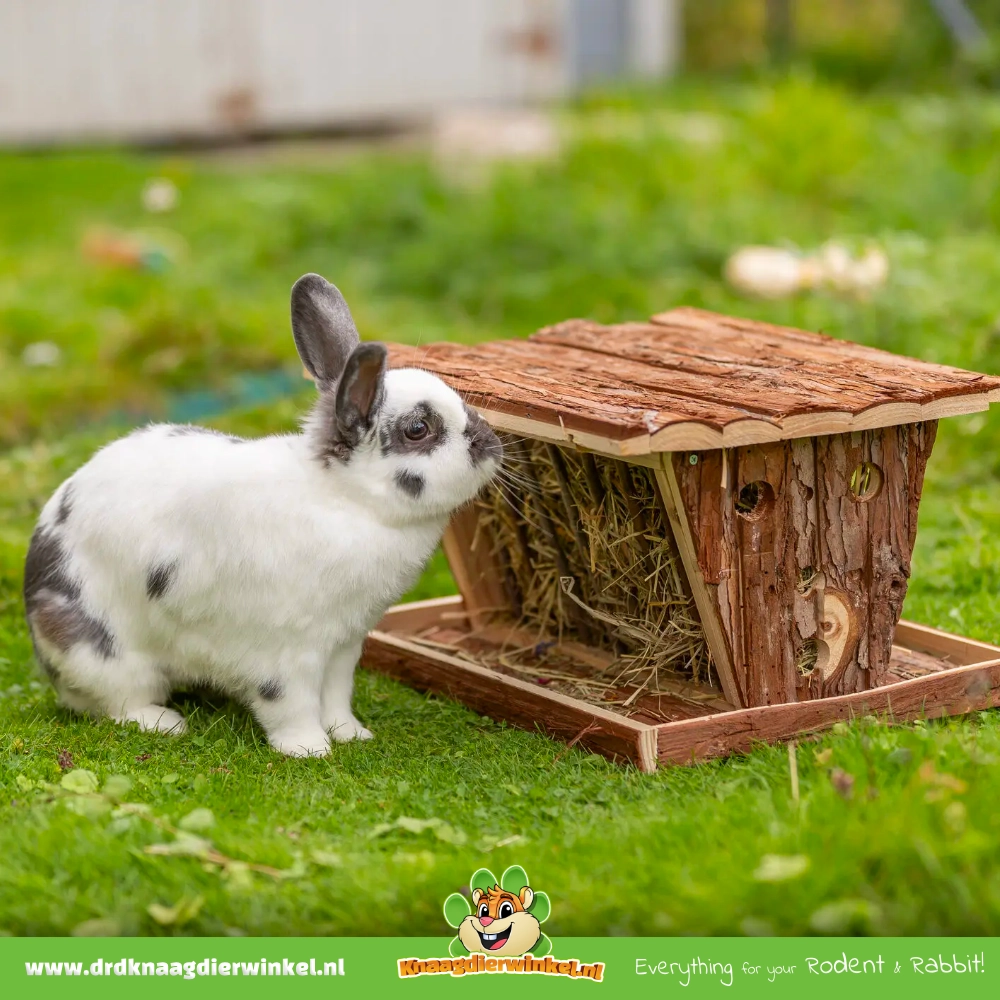
The Trixie Wooden Hay Rack with snack compartment and base 40 cm is a spacious, well-designed hay rack for animals that eat a lot of hay daily. Hay is an important part of daily care for guinea pigs, rabbits, chinchillas, and degus. With a spacious hay rack, the hay stays together better, is presented in an organized manner, and animals can eat from it more comfortably.
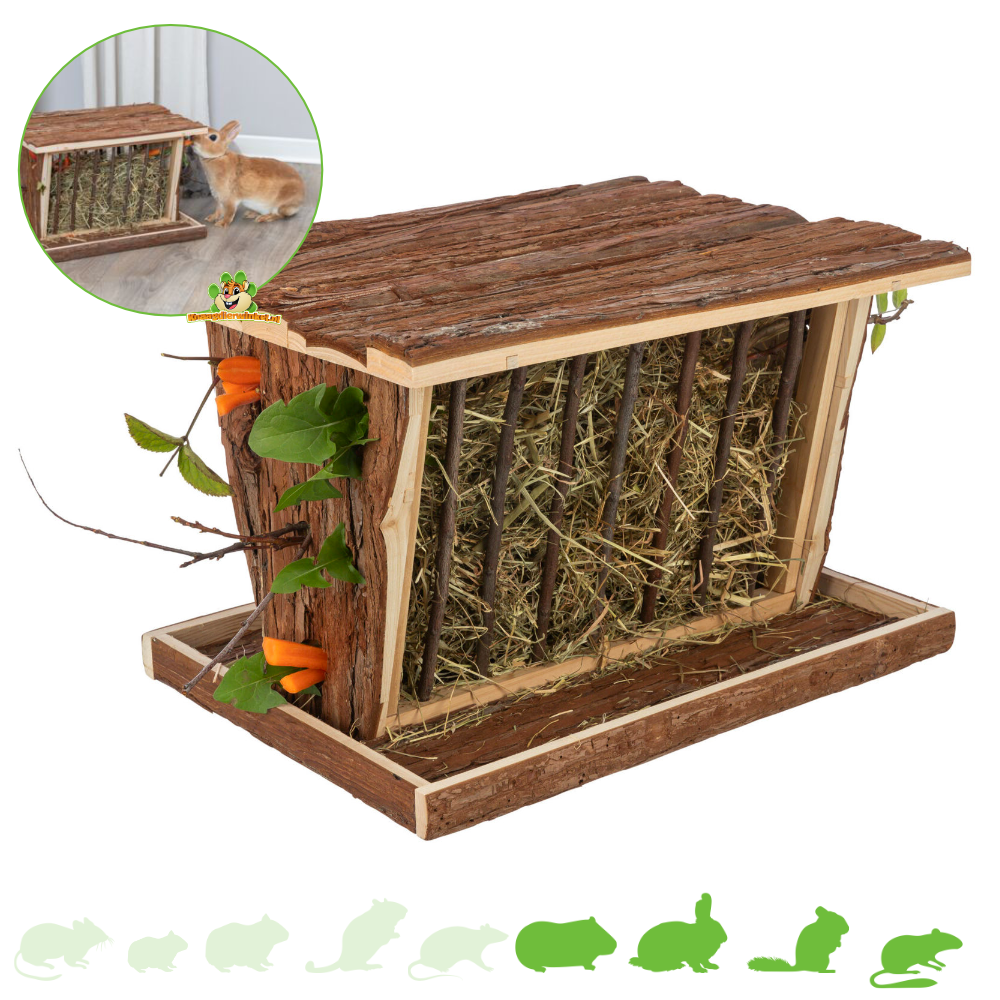
When it comes to hay racks, DRD opts not just for “put hay in and you’re done,” but primarily for ease of use, accessibility, and product fit. This wooden hay rack is accessible from two sides, has a lockable roof, and stands on a base/platform that catches many loose hay scraps. There are extra openings on the sides where you can insert vegetables, herbs, or another suitable snack, for example. This makes eating hay immediately more interesting and gives your animal more to discover.
In short
- Spacious wooden basic hay rack of approx. 40 × 30 × 22 cm.
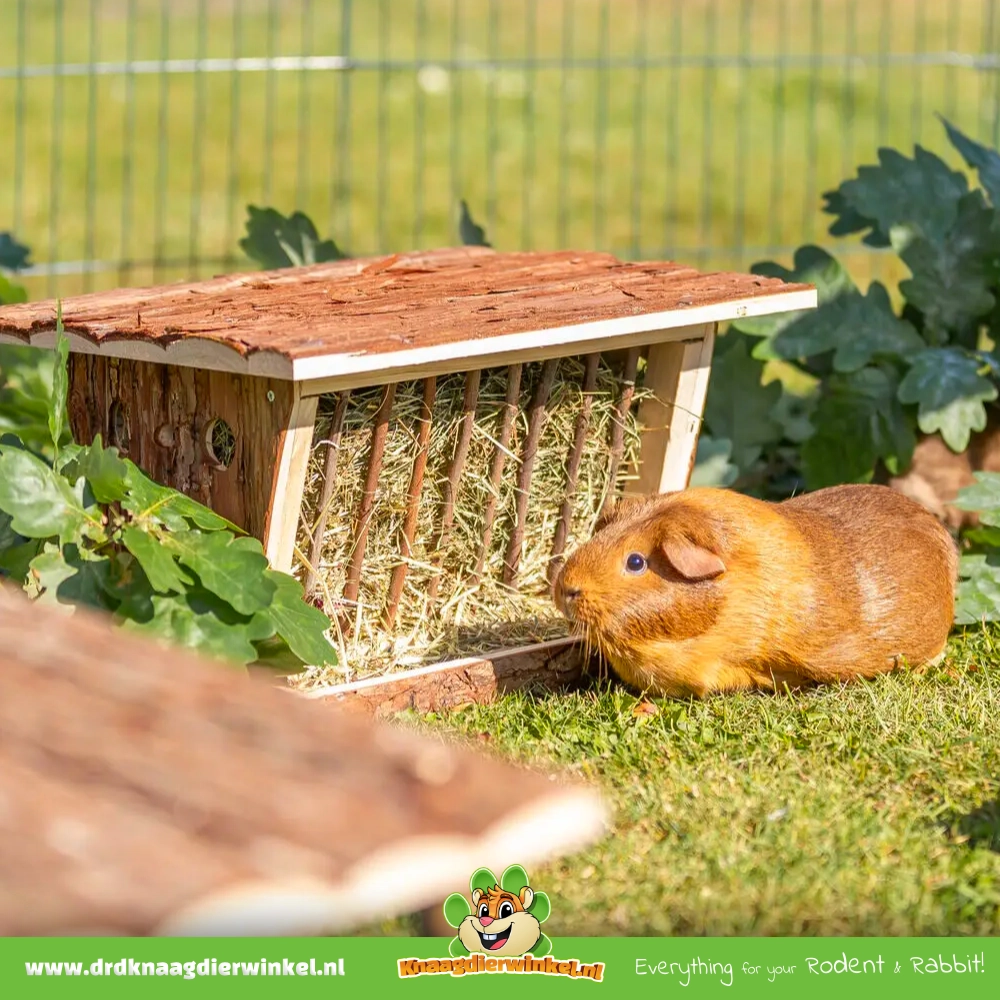
- Hay is accessible from two sides, handy for multiple animals.
- With a lockable roof, so that animals cannot simply sit in the middle of the hay rack.
- With a base/platform that catches loose hay scraps.
- Snack openings on the sides for vegetables, herbs, or matching snacks.
- Suitable for guinea pigs, rabbits, chinchillas, and degus.
Pros
✔ Spacious hay rack for daily use
✔ Accessible from two sides, nice with multiple animals
✔ With base/platform for collecting hay scraps
✔ Lockable roof for a neat and organized hay storage area
✔ Snack openings on the sides for extra foraging fun
✔ Wooden look that fits beautifully into a natural interior
Why choose this wooden hay rack?
A good hay rack makes feeding hay easier and more organized. With loose hay piles, some of the hay often ends up in the bedding, under urine spots, or among droppings. That is naturally part of having animals, but a spacious rack helps to present the hay more neatly and keep it attractive for longer.
This hay rack is particularly strong due to the combination of space, accessibility, and extra functionality. Animals can eat from two sides, meaning they do not all have to stand in one spot. This is pleasant for pairs or groups of guinea pigs and rabbits, but also for chinchillas and degus who like to be active at the same time. The bottom catches loose blades of grass, so that a lot of leftover hay does not immediately spread throughout the enclosure.
The roof makes the hay rack more visible and helps prevent animals from sitting in the middle of the hay. For animals that like to step onto low objects, the roof can also be used as an extra perch or lookout spot, as long as the rack stands firmly and level. In this way, the hay rack acquires not only a feeding function but also a small furnishing function within the enclosure.
Snacking and foraging
The snack openings on the sides make this hay rack extra fun. You can insert a piece of vegetable, herbs, leaf, or another suitable snack, for example. This requires your animal to put in just a little more effort than with a regular food bowl. This makes searching for food more enjoyable and aligns nicely with natural foraging behavior.
Use the snack box primarily as a small addition alongside the regular hay. The main idea remains that the hay rack offers sufficient space for hay; the snack box makes the hay area more interesting without the need to add extra toys.
Is this hay rack suitable as a basic hay rack?
Yes, this hay rack is very suitable as a basic hay rack for animals that eat a lot of hay daily. Thanks to its generous size, you can offer a good amount of hay and do not need to refill as often as with a small rack. That is convenient for you and pleasant for animals that like to eat hay several times a day.
For guinea pigs and rabbits, a spacious hay area is especially important, as hay forms the basis of their daily diet. Chinchillas and degus also benefit from an organized area where clean hay is available. This hay rack helps create a fixed, clear spot for this.
For which animals is this hay rack suitable?
- Guinea pig: very suitable as a spacious basic hay rack. Guinea pigs eat a lot of hay and can eat comfortably side by side thanks to the double accessibility.
- Rabbit: suitable as a spacious hay rack in an indoor enclosure, rabbit room, or safe run. Place the rack stably and ensure the hay remains easily accessible.
- Chinchilla: suitable for offering hay neatly and clearly. Regularly check chinchillas for gnawing damage to the wood.
- Degu: suitable as a spacious hay rack and as an enriching hay spot. Degus can also make use of the snack openings with suitable herbs or vegetables.
For mice, dwarf hamsters, hamsters, and gerbils, this hay rack is usually not a logical daily feeding spot. These animals do not eat hay as a staple food like guinea pigs and rabbits do. For small rodents, hay is more likely to serve as nesting material or natural landscaping material. Therefore, a large hay rack usually serves no practical purpose for these animals in their daily care.
For rats, a hay rack also has no clear function in daily care. Rats do not need a hay rack, and hay is not routinely recommended for rats due to their sensitivity to dust. For rats, it is better to look at low-dust bedding, digging boxes with suitable materials, tunnels, hammocks, and foraging toys.
What should you look out for regarding the bar spacing?
With any hay rack, it is important to check how your animal can reach it. An animal must be able to comfortably reach the hay, but not be able to get its entire head stuck between the bars. The correct distance depends on the animal species, head size, and how the animal eats from the rack.
The manufacturer does not specify the exact bar spacing for this hay rack. Therefore, always calmly observe how your animal uses the rack during the first use. If you notice that your animal is trying to get its entire head between the bars or cannot comfortably reach the hay, choose a different method of offering hay that suits your animal better.
- Your animal must be able to easily grab hay with its snout or teeth.
- The head must not be able to get stuck between the bars.
- Check extra carefully, especially with young, small, or very curious animals.
- Use the hay rack only when the animal can eat from it calmly and safely.
Animal welfare label
This hay rack bears the Tierschutz-Kennzeichen. This is an Austrian animal welfare label for products that have been positively assessed by the Fachstelle für tiergerechte Tierhaltung und Tierschutz. The assessment considers legal regulations, animal welfare, practical application, and the suitability of the product.
For you as an owner, this provides extra reassurance: the product is not only designed as a handy hay rack, but has also been evaluated from the perspective of animal-oriented use.

Placement and use
Place the hay rack on a flat, stable surface. Fill the rack with fresh hay and loosen the hay slightly so that your animal can easily reach it. Preferably, place the rack in a spot where your animal can eat peacefully, but where you can also easily refill and clean it.
- Fill the hay rack with clean, fresh hay.
- Optionally, use the sides for suitable vegetables, herbs, or snacks.
- Check daily whether there is still enough edible hay available.
- Remove wet, dirty, or trampled residual hay.
- Regularly check whether the hay rack is still standing firmly and is intact.
The floor catches many loose hay remnants, but it is still wise to clean the hay area regularly. This keeps the rack fresh and the hay appealing to eat.
Assembly and sturdiness
Take your time when assembling and check after assembly that all parts are securely fastened. Then place the hay rack in a stable spot in the enclosure. Because this is a wooden product, regular checks are important: verify that the joints are still strong and that no loose or damaged parts have developed due to use or gnawing.
For animals that like to sit on the roof, stability is especially important. If the hay rack is sturdy and level, the roof can also serve as a nice low lookout spot. If the hay rack is not stable, move it to a better location or use it only as a feeding area.
Dimensions and material
Dimensions: approx. 40 × 30 × 22 cm
Material: wood
Rack type: basic hay rack
Bars: rounded
Roof: lockable
Composition: wood
Good to know
- Offer only under supervision.
- Check regularly for wear, gnawing damage, loose parts, and sharp edges.
- Check upon first use whether your animal can eat from the hay rack comfortably and without the risk of entrapment.
- Do not use the hay rack if your animal's head could get stuck between the bars.
- Place the hay rack stably and level, especially when animals also sit on the roof.
- Remove wet or dirty hay in time.
Frequently Asked Questions
Is this hay rack suitable as a basic hay rack?
Yes, this hay rack is spacious enough to use as a basic hay rack for guinea pigs, rabbits, chinchillas, and degus. Due to its size, you can offer a good amount of hay and need to refill it less often than with a small rack.
Why is it convenient that the hay rack is accessible from two sides?
With multiple animals, each animal can more easily choose its own side. This makes the hay area quieter and prevents all animals from having to eat at one small spot.
What are the snack openings intended for?
You can use the snack openings on the sides for vegetables, herbs, or suitable snacks. This immediately makes the hay spot a bit more challenging and encourages calm foraging behavior.
Is this hay rack suitable for small rodents such as hamsters or gerbils?
Usually not as a daily feeding spot. Hamsters and gerbils do not eat hay as a staple food like guinea pigs and rabbits. For these animals, hay is used more as nesting material or natural landscaping material. A large hay rack therefore usually has no clear function.
Is this hay rack suitable for rats?
For rats, a hay rack has no clear function in daily care. Rats do not need a hay rack, and hay is not recommended as standard for rats due to their sensitivity to dust. For rats, it is better to choose low-dust bedding, tunnels, digging boxes, hammocks, and foraging toys.
Can my pet sit on the roof?
This is possible provided the hay rack stands firmly and level and the animal uses it calmly. However, do check regularly that the hay rack remains stable and that all parts are securely attached.
How do I keep this hay rack clean?
Remove wet or dirty hay daily and tap loose remnants from the platform. If necessary, dry clean the wood or gently wipe it with a slightly damp cloth. Allow the hay rack to dry thoroughly before offering hay again.
Useful shopping links
- All hay racks
- Guinea pig hay racks
- Rabbit hay racks
- Chinchilla hay racks
- Degoe hay racks
- Hay for rodents and rabbits
- Guinea pig hay
- Rabbit hay
- Ask DRD for personal advice.
✓ Specialist since 2011 • personal & expert advice • delivered from our own stock
| Feeder Type: | Base Hay Feeder |
| Material: | Wood |
| Dimensions (approx): | 40 x 30 x 22 cm |
| Bars: | Rounded |
| Distance bars (approx): | - |
| Coverable roof: | Yes |
| Suitable for: | Rodents, Guinea Pig, Rabbit, Chinchilla, Degu |
| Particularities: | - |
| Safety Information: | Offer only under supervision. Check regularly for wear and tear |


De hooiruif zelf is prima, maar het in elkaar zetten is echt een hel. Het was fijn geweest als de gaten voorgeboord zouden zijn. Het is nauwelijks in elkaar te schroeven daardoor en daar baal ik van.