 Polski



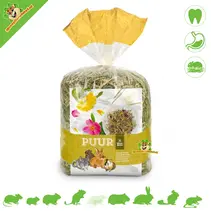
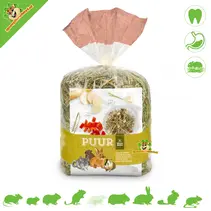
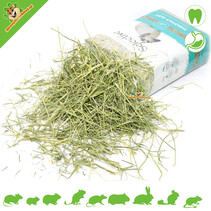
PURE Timothy Hay 500 grams


- Dispatched from our own stock
- Personal & expert advice
- Always 100% rodent-friendly
- Ordered before 5 p.m., shipped the same day!
Witte Molen PUUR Timothy Hay 500 grams
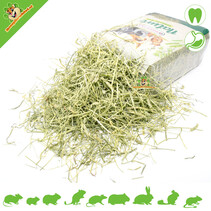
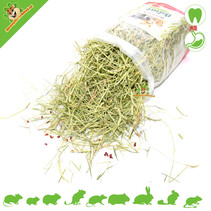
Witte Molen PUUR Timothy Hay is a high-fiber, long-fiber hay for guinea pigs, rabbits, chinchillas, degus, and small rodents. Timothy hay is known for its firm texture, making it a great choice when you are looking for a type of hay that encourages chewing, sniffing, and activity.
DRD always considers the role of hay within the enclosure. For herbivores such as guinea pigs, rabbits, chinchillas, and degus, hay is an important part of their daily diet. For small rodents such as mice, dwarf hamsters, hamsters, and gerbils, hay is particularly interesting as nesting material, landscaping material, and foraging structure.
Hay in a nutshell
- Timothy hay with long fibers
- Contents: 500 grams
- With 32% crude fiber
- Supplementary feed
- For guinea pigs, rabbits, chinchillas, and degus as a fiber-rich hay variation.
- For mice, dwarf hamsters, hamsters, and gerbils as nesting, scaving, and foraging material.
- Without artificial colors and preservatives
- Hay is a natural product; color, smell, and texture may vary per harvest.
Pros of Witte Molen PUUR Timothy Hooi
✔ Long-fiber Timothy hay
✔ With 32% crude fiber
✔ Stimulates prolonged chewing and natural eating behavior
✔ Nice as a hay variation for guinea pigs, rabbits, chinchillas, and degus
✔ Also suitable as nesting and scaving material for small rodents
✔ Combines well with timothy hay , hay racks , and rodent and rabbit herbs
Why choose Timothy hay?
Timothy hay is popular due to its firm fiber structure. This is beneficial for guinea pigs, rabbits, chinchillas, and degus, as these animals need to chew a lot daily. Hay adds structure to their diet and helps to effectively support their natural eating rhythm.
Witte Molen PUUR Timothy Hay contains long fibers and has a crude fiber content of 32%. This makes it a great hay choice for owners looking for a fiber-rich hay variation to supplement their daily diet. You can offer it in a hay rack, hay bag, hay corner, or feeding area.
For small rodents, this hay is particularly valuable as enrichment. Mice, dwarf hamsters, hamsters, and gerbils can use hay for nesting, dragging, incorporating into bedding, or as part of a natural scape. It does not need to be the basis of their daily diet, but it can add a great deal to their enclosure.
For which animals is this hay suitable?
- Mouse: suitable as nesting material, foraging material, and natural structure in the enclosure. Offer small tufts and check regularly to ensure it remains clean and dry.
- Dwarf hamster: suitable as nesting and landscaping material. You can mix it with bedding or use it around a house, tunnel, or foraging area.
- Hamster: suitable as natural decor, nesting material, and hamsterscaping material. Hay can help add more structure to the bedding.
- Gerbil: suitable as nesting, gnawing, and landscaping material. Gerbils can actively drag and process hay in their digging area.
- Guinea pig: suitable as a fiber-rich hay variation. Guinea pigs need unlimited hay daily; timothy hay can be a good choice due to its firm fiber structure.
- Rabbit: suitable as a daily hay variation. Rabbits need unlimited hay and can be further stimulated to continue chewing properly with timothy hay.
- Chinchilla: suitable as a hay variation alongside an appropriate hay base. Keep the total diet dry, high in fiber, and tailored to chinchillas.
- Degu: suitable as a fiber-rich hay variation. Give it as part of a simple, fiber-rich diet suitable for degus.
For rats, hay is not a daily staple like it is for guinea pigs or rabbits. For rats, primarily use low-dust bedding, tunnels, hammocks, foraging toys, and suitable Ratscaping materials. A small amount of hay can optionally be used as sniffing material if your rats enjoy it, but it is not a main product for rat care.
How do you use Witte Molen PUUR Timothy Hay?
For guinea pigs, rabbits, chinchillas, and degus, you can offer this hay in a hay rack, hay bag, hay corner, or feeding area. Always provide sufficient hay and refresh it regularly, especially when the hay is damp, trampled, or soiled.
For mice, dwarf hamsters, hamsters, and gerbils, you can use small tufts in the bedding, near a house, in a tunnel, or around a foraging area. For example, mix hay in layers through the bedding to add extra structure to hamsterscaping or gerbilscaping.
Do not use this hay as a substitute for a complete diet. It is a complementary feed and, depending on the animal species, should be used alongside appropriate main feed, water, hay/basic fibers, and other equipment.
Usage & consumption
How long a 500-gram bag lasts depends on the animal species, the number of animals, and how you use the hay. Rabbits and guinea pigs consume hay more quickly because it is eaten daily as a fiber-rich base. For small rodents, you usually use smaller tufts as nesting, scaving, or foraging material.
- As a daily hay variation: especially suitable for guinea pigs, rabbits, chinchillas, and degus in addition to their normal hay base.
- For an extra attractive haymaking moment: handy in a hay rack, hay sack, or hay corner.
- As aquascaping material: use small tufts in layers throughout the substrate.
- As nesting material: offer small amounts and replace when it becomes dirty or damp.
A 500-gram bag is particularly nice as a fiber-rich hay variation. For heavy daily use, you can combine this with a regular hay base.
Beautiful for hamsterscaping and gerbilscaping
Hay can help add more structure to the bedding in hamsterscaping and gerbilscaping. By alternating thin layers of hay with bedding, tunnels and digging zones can take shape better. Additionally, the color difference creates a beautiful, natural look.
Use small tufts for this and distribute the hay loosely. Combine with hamster bedding , gerbil bedding , cork, bamboo , or natural tunnels. This way, the hay becomes part of an enclosure where your animal can search, drag, nest, and explore.
Analysis & specifications
- Contents: 500 grams
- Analysis: crude protein 7%, crude fat 1.5%, crude fiber 32%, crude ash 5.2%, calcium 0.6%, phosphorus 0.4%, moisture 15%
- Type: complementary feed
- Promotes foraging: yes
- Not intended for: food-producing animals
Hay is a natural product. Color, smell, texture, and coarseness may vary slightly from harvest to harvest. That is part of hay. Store the product in a dry, dark, and well-ventilated place to preserve the smell and quality as much as possible.
Easy to combine with
Witte Molen PUUR Timothy Hay combines beautifully with a good hay area, appropriate main feed, and natural enrichment. This way, you turn hay into not only food but also an active part of the enclosure.
- view Timothy hay
- View all hay types
- view hay racks
- View rabbit hay
- view guinea pig hay
- view Witte Molen products
Good to know
- Hay for guinea pigs, rabbits, chinchillas, and degus should remain clean, dry, and fresh.
- Remove hay that is wet, musty, dusty, or soiled.
- For small rodents, you use hay primarily as nesting, scaving, and foraging material.
- Do not use long, stringy fibers in nesting material in which animals can become entangled.
- Store hay in a dry, dark, and well-ventilated place.
- At DRD, we store hay in a dark and cool place, out of direct sunlight. This way, the aroma, color, and quality are preserved as well as possible.
Frequently asked questions about Witte Molen PUUR Timothy Hooi
For which animals is Witte Molen PUUR Timothy Hooi suitable?
This hay is suitable for guinea pigs, rabbits, chinchillas, and degus as a hay variation. For mice, dwarf hamsters, hamsters, and gerbils, it is especially nice as nesting, landscaping, and foraging material.
Is this timothy hay suitable for rabbits?
Yes, timothy hay is suitable for rabbits. It has long fibers and can be offered daily as a hay variation alongside the full rabbit diet.
Is this timothy hay suitable for guinea pigs?
Yes, guinea pigs can use Witte Molen PUUR Timothy Hay as a fiber-rich hay variation. Hay should be readily available to guinea pigs daily.
Can I give this hay to hamsters?
Yes, for hamsters, this hay is primarily suitable as nesting material, hamsterscaping material, and foraging structure. It is not a hamster's main food.
Can I use this hay for gerbils?
Yes, gerbils can use hay to drag, gnaw, and incorporate into the bedding. It is fun as part of gerbilscaping and natural decor.
How much crude fiber does this hay contain?
Witte Molen PUUR Timothy Hay contains 32% crude fiber.
What is the difference between timothy hay and meadow hay?
Timothy hay is a specific type of hay with a firm fiber structure and long fibers. Meadow hay is often a mixture of various grasses and herbs from the meadow. Which one suits best depends on your animal's preference.
Can the quality of hay vary from bag to bag?
Yes, hay is a natural product. Color, smell, texture, and coarseness may vary slightly from harvest to harvest. Store hay in a dry and dark place and always check that it smells fresh.
Is this hay the main food?
This product is a complementary feed. While hay is an important daily source of fiber for herbivores, the overall diet must be appropriate for the species and supplemented with suitable food.
Useful shopping links
Witte Molen PUUR Timothy Hay 500 grams is a fine choice when you want to offer fiber-rich hay with a long structure. It is a nice hay variety for guinea pigs, rabbits, chinchillas, and degus; for small rodents, it is especially suitable as nesting, landscaping, and foraging material in a naturally furnished enclosure.
| Content (approx): | 500 grams |
| Composition: | Crude protein 7%, Crude fat 1.5%, Crude fiber 32%, Crude ash 5.2%, Calcium 0.6%, Phosphorus 0.4%, Moisture 15% |
| Analysis: | - |
| Promotes Foraging: | Yes |
| Suitable for: | Rodents, Mouse, Hamster, Gerbil, Guinea Pig, Rabbit, Chinchilla, Degu |
| Type: | supplementary pet food |
| Particularities: | The quality of the hay depends on the harvest |
| Disclaimer: | Not for food producing animals |

Altijd goed hooi. Mijn konijnen zijn niet echt hooi eters en krijgen onbeperkt groenvoer en grassen enz dus je zou bijna denken dat het niet wordt gegeten omdat ze het niet lekker vinden, maar heb zoveel hooi geprobeert en dit gaat er ondanks bijna niet toch het beste in haha
- Mooi van kleur
- Grote stengels
Super goede hooi lekker vers en knapperig cavia’s zijn er dol op. Beter dan oud bruin hooi
Mijn wat oudere dwergkonijn is hier gek op. Ik koop dit al langere tijd speciaal voor hem gezien leeftijd en hij wat darmproblemen heeft. Ziet er heel goed en vers uit,lange stengels
Super Krokant Groen
goed krokant en groen