Polski



Climbing rope 50 cm for birds and small climbers
- Dispatched from our own stock
- Personal & expert advice
- Always 100% rodent-friendly
- Ordered before 5 p.m., shipped the same day!
- Customer service from 09:00 to 18:00
Trixie Spiral Climbing Rope 50 cm for Birds and Small Climbers
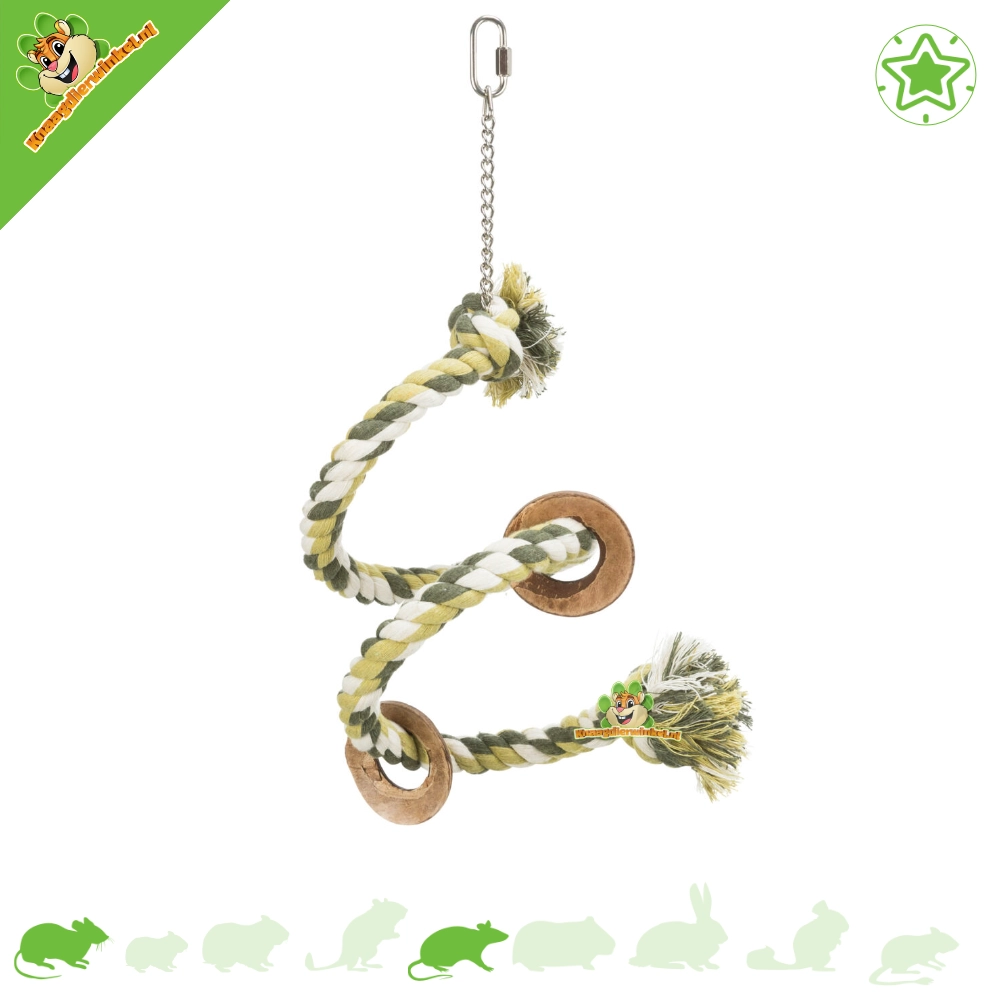
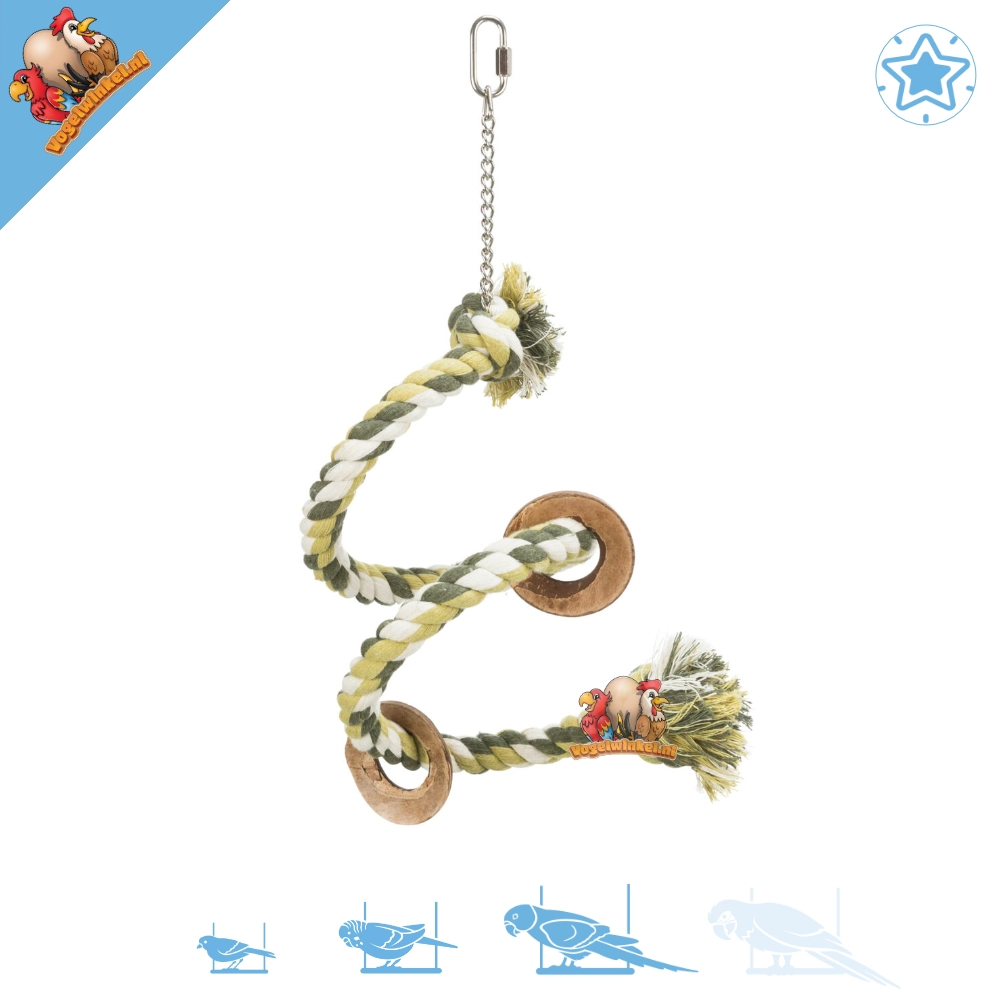
The Trixie Spiral Climbing Rope 50 cm is a flexible cotton climbing rope for birds that enjoy scrambling, balancing, and actively exploring their surroundings. The spiral shape creates a playful, slightly moving route in the cage or aviary, giving your bird more variety than with only straight perches.
DRD selects this climbing rope primarily for canaries, finches, small parakeets, and large parakeets. The rope provides grip for their feet, encourages movement, and makes their enclosure more interesting. While a climbing rope can sometimes be interesting for small climbing rodents such as mice or rats, the specifications of this product are primarily aimed at birds. Therefore, use it with rodents only deliberately, at a low level, and under close supervision.
In short
- Flexible spiral climbing rope from Trixie.
- Material: cotton.
- Dimensions: approx. 50 cm long.
- Diameter: approx. ø 2.1 to 2.5 cm.
- Suitable for birds, finches, canaries, small parakeets, and large parakeets.
- Provides extra climbing, scrambling, and balancing opportunities.
- Can be hung horizontally, at an angle, or slightly curved.
- Not intended for large parrots or strong destroyers.
- Regularly check for wear, loose fibers, and secure fastening.
Pros
✔ Made of cotton
✔ Flexible spiral shape for an extra challenge
✔ Great for climbing, balancing, and scrambling
✔ Suitable for canaries, finches, and parakeets
✔ Provides variety alongside regular perches
✔ Easy to combine with other bird toys
! Check regularly for loose fibers and wear
Why choose a spiral climbing rope?
Birds use their cage or aviary not only to sit, but also to climb, turn, move, and explore their surroundings. A spiral climbing rope provides a different experience than a straight perch. The rope moves slightly, requires balance, and gives the feet a different surface.
Variety is valuable in a bird enclosure. By offering different perching and climbing structures, you make the layout more interesting and encourage natural movement. This climbing rope, for example, can be used as a connection between perches, as a playful route, or as an extra resting place.
Because the rope is flexible, you can decide for yourself how to hang it: horizontally, at an angle, diagonally, or slightly curved. This allows you to adjust the difficulty and the route to the bird species and the available space.
For which animals is the 50 cm Spiral Climbing Rope suitable?
- Canary: suitable as an extra perch and climbing spot. Hang the rope calmly and stably so that canaries can easily land and balance on it.
- Chaffinch: suitable as an alternative to regular perches. Especially nice when the rope is not hanging too high or too crowded in the route.
- Small parakeet: suitable for budgies and similar small parakeets that like to climb, explore, and move around.
- Large parakeet: suitable if the bird matches this rope in terms of size and gnawing behavior. Check larger parakeets extra carefully for wear.
- Mouse: potentially interesting as a climbing route in a suitable wire enclosure, but not as the primary target group according to the specifications. Use low, safely, and under supervision.
- Rat: can be used as an extra climbing route for calm rats, but rats can damage fabric and fibers more quickly. Therefore, check very carefully and do not use it with active destroyers.
For hamsters, guinea pigs, rabbits, gerbils, chinchillas, and degus, this climbing rope makes less sense. These animals need other forms of enrichment, such as digging, gnawing, foraging, tunnels, platforms, sand baths, or more spacious running and hiding opportunities.
Use for birds
For birds, this climbing rope is especially fun as an extra route in the cage or aviary. Hang the rope so that your bird can easily step onto or land on it. Do not place it too close to the wall, so that the bird has enough room to turn and move its tail freely.
- Hang the rope horizontally as a soft place to sit and balance.
- Hang it at an angle as a climbing route between two heights.
- Hang it diagonally for an extra challenge.
- Combine with natural perches for variation in leg load.
- Ensure that feeding and drinking areas do not become contaminated by placing them directly under the rope.
For parakeets, the rope can also become a playful element that they touch, balance, and climb on. However, do check regularly to ensure that no loose cotton threads form that their feet could get caught in.
For use with mice and rats
Mice and rats are good climbers. However, according to the specifications, this product is primarily classified as a bird accessory. If you wish to use it with mice or rats, do so only if the enclosure is suitable for this purpose and you can properly monitor how the animals interact with it.
For rodents, preferably do not hang the rope as a high, loose swinging element without a safe route. Use it low, between platforms, or as a short connection so that any potential fall is properly cushioned. Extra supervision is required for rats, as they can gnaw through fabric materials.
- Use only under supervision and check regularly.
- Do not use on animals that actively chew on cotton or loose fibers.
- Do not hang high without safe intermediate platforms or fall breakers.
- Check for loose threads, fraying, and damaged hooks.
- Replace the rope as soon as it starts to fray or becomes unsafe.
Why cotton can be nice as a climbing rope
Cotton provides more grip than a smooth plastic surface. Birds can easily place their feet around the rope and get a different surface than with a standard perch. This makes the rope a pleasant addition to the enclosure.
At the same time, cotton does require monitoring. When birds or small animals pull on the rope or start tearing it, loose fibers can form. Therefore, check the rope regularly and remove it when it starts to fray.
How do you hang the climbing rope?
Securely attach the climbing rope to the bars or to a suitable hanging point in the cage or aviary. After hanging, check that the rope is firmly secured and cannot unintentionally come loose.
- Choose a sturdy mounting location.
- Hang the rope so that your animal can easily step on or land.
- Prevent the rope from soiling food or water bowls.
- Do not place it directly above vulnerable parts of the enclosure.
- Check the hooks and fastening regularly.
- Adjust the position when you notice that your animal is not using the rope comfortably.
Tip: combine the spiral climbing rope with natural perches of different thicknesses. This gives your bird more variety in movement, grip, and posture.
Not for strong destroyers or large parrots
This climbing rope is suitable for canaries, finches, and parakeets, but less suitable for large parrots or birds that bite through rope quickly. Large, strong beaks can damage cotton rope more quickly, which can result in loose fibers or unsafe sections.
For large parrots, you would prefer a more robust climbing rope with a larger diameter and material that suits their strength and destructive behavior.
Cleaning and maintenance
Because a rope fiber structure can trap dirt and dust, regular inspection is important. Tap out dust and loose feathers and check that the rope remains dry, intact, and firm.
- Check regularly for fraying and loose threads.
- Check the metal hooks and attachment points.
- Remove the rope when it is wet, dirty, or damaged.
- Let the rope dry thoroughly if it has become damp.
- Do not use the rope anymore if loose fibers form.
- Replace the rope when it loses its shape or strength.
Dimensions and specifications
Product: Spiral Climbing Rope 50 cm
Brand: Trixie
Material: cotton
Dimensions: approx. 50 cm long | ø 2.1 cm
Diameter: approx. 2.5 cm
Use: climbing rope, seating area, balance route, and enrichment
Suitable for: birds, finches, canaries, small parakeets and large parakeets
Additional use: potentially for mice and rats as a low climbing route under supervision, provided the animal does not chew on the rope.
Good to know
- Check the rope regularly for fraying, loose threads, and wear.
- Do not use the rope anymore if loose fibers form.
- Check if the hooks are securely fastened.
- Position the rope so that your animal can safely step on and land.
- Not suitable for large parrots or strong destroyers.
- For mice and rats, only use under supervision and low in the enclosure.
- Do not use on animals that actively gnaw through cotton or fibers.
- Replace the rope when it becomes damaged, wet, frayed, or unstable.
Frequently Asked Questions
For which birds is the 50 cm Spiral Climbing Rope suitable?
The climbing rope is suitable for birds such as finches, canaries, small parakeets, and large parakeets.
How long is the climbing rope?
The rope is approximately 50 cm long.
What is the climbing rope made of?
The climbing rope is made of cotton.
What is the diameter of the rope?
The specifications mention approx. ø 2.1 cm and a diameter of approx. 2.5 cm. Due to the spiral shape and fiber structure, this may vary slightly in practice per measurement point.
Can this climbing rope be used by parakeets?
Yes, the climbing rope is suitable for small and large parakeets. However, do check regularly to make sure your parakeet doesn't bite through the rope.
Can this climbing rope be used by mice?
The product is listed in the specifications primarily as a bird accessory. It can potentially be used as a low climbing route for mice, but only if it is securely hung and the mice do not chew on the fibers.
Can this climbing rope be used by rats?
For rats, it can sometimes serve as an extra climbing route, but only under supervision and with regular monitoring. Rats can gnaw through fabrics and ropes more quickly. This rope is less suitable for active destroyers.
Is this climbing rope suitable for hamsters?
No, this climbing rope is not the most logical choice for hamsters. Hamsters benefit more from low, stable furnishings, tunnels, bedding, houses, a sand bath, and a suitable exercise wheel.
When should I replace the rope?
Replace the rope when it starts to fray, develops loose threads, remains wet, is heavily soiled, or when the attachment is no longer secure.
Useful shopping links
- DRD Bird Shop®
- Toys for canaries and finches
- Parakeet toys
- Climbing ropes
- Rope toys
- Mouse platforms & ladders
- Rat platforms & ladders
- Ask DRD for personal advice.
✓ DRD Vogelwinkel® • personal & expert advice • delivered from our own stock
| Material: | Cotton |
| Dimensions (approx.): | 50 cm | ø 2,1 cm |
| Diameter (approx): | 2,5 cm |
| Suitable for:: | Bird, Finches, Canaries, Small Parakeets, Large Parakeets |
| Safety information: | Observe the animal during initial use to see how it interacts with the bedding. Always check the bedding before use for possible irregularities. |