 Polski



Nail-Free Wall Hay Rack 20 cm


- Dispatched from our own stock
- Personal & expert advice
- Always 100% rodent-friendly
- Ordered before 5 p.m., shipped the same day!
Trixie Nail-Free Wall Hay Rack 20 cm
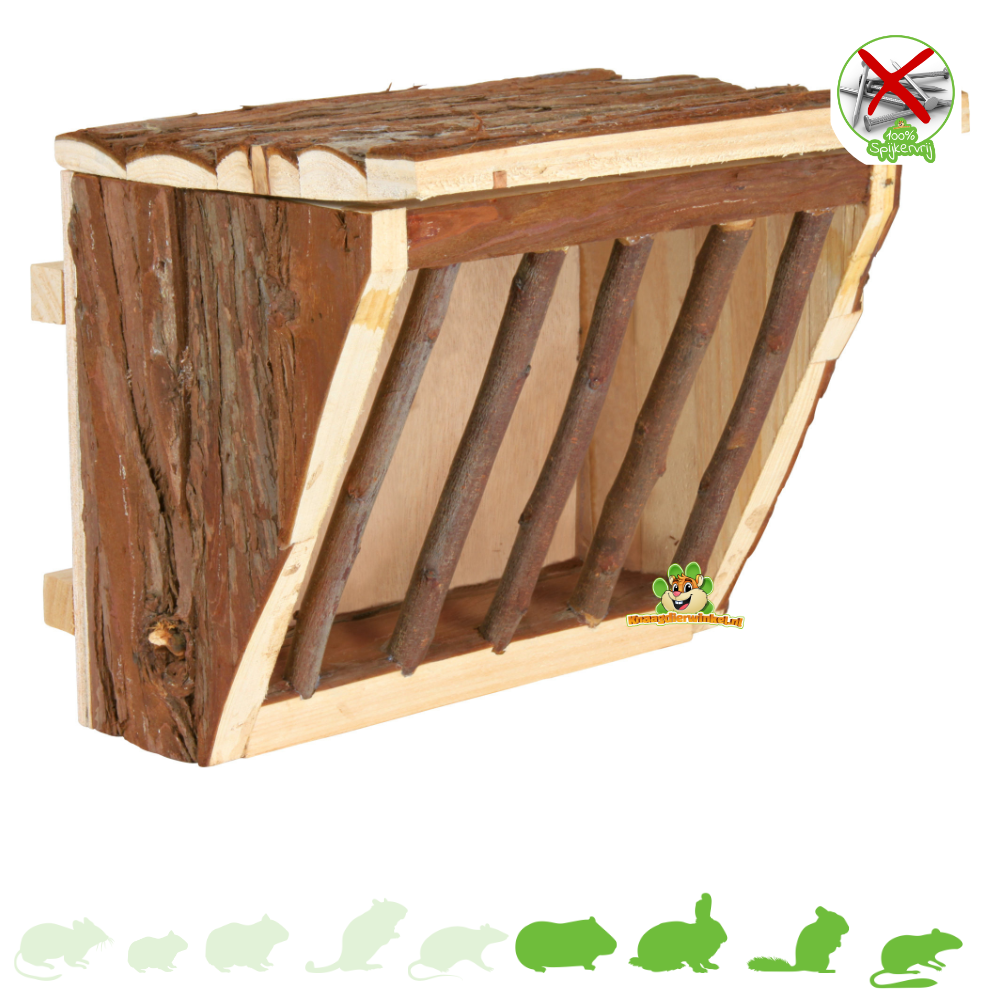
The Trixie Wall Hay Rack 20 cm is a compact wooden hay rack that you can easily attach to the wall or bars of the enclosure. Thanks to the lockable roof, the hay remains nicely shielded from above, preventing animals from simply jumping into the rack. This makes this rack a practical base for animals that eat hay daily, such as guinea pigs, rabbits, chinchillas, and degus.
When it comes to hay racks, DRD prioritizes safe and practical use: can the animal easily access the hay, does the rack remain neatly filled, are the bars rounded, and is the rack suitable for the size of the animal? This wall-mounted hay rack is made of wood, features rounded bars with a bar spacing of approx. 2 cm, and has a natural appearance due to the bark wood.
In short
- Compact wooden wall hay rack for daily hay.
- Dimensions: approx. 20 × 17 × 15 cm.
- Material: wood / bark wood.
- Rounded spindles with a spindle spacing of approx. 2 cm.
- With a lockable roof, so that animals cannot jump into the hay rack.
- Nail-free design.
- Suitable for guinea pigs, rabbits, chinchillas, and degus.
- Beautiful for a natural hay corner or a more quietly arranged feeding area.
Pros
✔ Made from untreated certified natural wood
✔ Nail-free design
✔ Lockable roof to prevent jumping into the hay rack
✔ Rounded bars with approx. 2 cm spacing
✔ Easy to refill from the top
✔ Natural look thanks to bark wood
Why choose a wall hay rack?
A wall hay rack helps to offer hay in a fixed, recognizable spot. This is especially useful for guinea pigs, rabbits, chinchillas, and degus, as hay is an important part of their daily diet and activities. Placing the hay in a rack keeps things more organized than when everything is scattered loosely throughout the enclosure.
The lockable roof is a significant advantage. Animals cannot step or jump into the hay rack from above, keeping the hay cleaner and making the rack safer to use. Refilling is easy by lifting the lid and placing new hay in the rack.
The bark wood gives the hay rack a natural look. This makes it beautiful in a quiet hay corner, guinea pig enclosure, rabbit run, or as a natural setup for chinchillas and degus. It is a compact hay rack, so for multiple animals or large rabbits, an extra or larger hay rack might be more convenient.
For which animals is the Wall Hay Rack suitable?
- Guinea pig: suitable as a compact basic hay rack. Guinea pigs eat a lot of hay and enjoy using a designated hay corner. For multiple guinea pigs, an extra hay rack or a more spacious hay arrangement can be useful.
- Rabbit: suitable as a hay rack, especially for small to medium-sized rabbits or as an extra hay rack in a run or rabbit room. For large rabbits or multiple rabbits, a larger rack may be more practical.
- Chinchilla: suitable as a compact hay rack. Chinchillas need hay daily and can grab the hay via the rounded bars. However, check the wood regularly for gnawing damage.
- Degu: suitable as a hay rack for daily hay. Degus are active gnawers, so check the rack regularly for wear and sharp edges.
For small rodents such as mice, dwarf hamsters, hamsters, and gerbils, a hay rack usually has less practical use. They use hay more as nesting or landscaping material than as a daily staple, as guinea pigs and rabbits do. For rats, a hay rack has no clear function in daily care; for rats, it is better to choose dust-free bedding, tunnels, hammocks, digging boxes, and foraging toys.
Use for guinea pigs
A permanent hay corner is very practical for guinea pigs. Hang the hay rack at a comfortable height so that your guinea pigs can reach the hay with their snouts without having to stretch or climb. If necessary, place a pee pad, litter bedding, or an extra absorbent layer under or next to the rack, as guinea pigs often defecate and urinate in the spot where they eat a lot of hay.
With a group of guinea pigs, it is important that multiple animals can eat peacefully at the same time. Use this compact hay rack as one of the hay stations, or combine it with loose hay, a second hay rack, or a spacious hay corner.
Use for rabbits
For rabbits, this wall-mounted hay rack can help offer hay clean and within reach. Hang the rack at nose height so your rabbit can eat in a relaxed manner. A litter box under or next to the hay rack often works very well, as rabbits like to eat and defecate in the same spot.
For larger rabbits or multiple rabbits, this hay rack is compact. You can use it as an extra hay rack or opt for a larger hay solution in addition. Hay must remain readily available, so the rack must be suitable for the amount of hay your animals need daily.
For use with chinchillas and degus
Chinchillas and degus need fiber-rich hay daily. This compact wall-mounted hay rack can help present hay neatly and create a designated feeding spot. The rounded bars allow the animals to grab the hay without the rack being fully open.
Always watch out for gnawing behavior in chinchillas and degus. Wood suits their enclosure well, but can also be actively worked on. Therefore, regularly check whether the hay rack is still sturdy, whether the bars remain clean, and whether any sharp edges are forming.
Bar spacing of the hay rack
The bars of this wall-mounted hay rack are rounded and spaced approximately 2 cm apart. A good hay rack should be designed so that animals can easily reach the hay but do not have to put their entire head through the bars. This helps to make feeding more pleasant and safer.
Always check how your animal eats from the hay rack after installation. Every animal differs in build and behavior. If you notice that your animal tries to stick its head through openings, eats restlessly, or cannot access the hay comfortably, choose a different hay solution that better suits its body size and eating habits.
Lockable roof and refilling
The lockable roof prevents animals from jumping into the hay rack from above. This is beneficial for the hygiene of the hay and for safe use. Furthermore, the roof provides a beautiful finish to the hay rack and gives the whole piece a calm, wooden appearance.
Refilling is done from the top. Push the lid up, fill the hay rack with hay, and then close the lid neatly again. Do not fill the rack too tightly, so that the hay remains easily accessible and your animal can comfortably pull out tufts.
Bark wood and natural appearance
The hay rack is made of bark wood. This gives it a natural, calm appearance that fits beautifully in an enclosure with wood, hay, herbs, bedding, and natural furnishings. Each wooden product may be slightly different, giving the hay rack its own unique character.
With bark wood, it can occasionally happen that a small piece of bark comes loose. This is characteristic of this natural material and usually does not affect the function of the hay rack. However, do check the product regularly for loose pieces, sharp edges, and wear.

Resin-free and nail-free
This wall hay rack is made of untreated certified natural wood and features a nail-free design. The wood has been carefully dried so that it is free of resin and natural sap that you do not want in a rodent or rabbit enclosure.
Nail-free is especially desirable for wooden products that may be examined or gnawed on by animals. However, do check the hay rack regularly, as wood remains a natural product in the enclosure.
Animal welfare label
This hay rack bears the Tierschutz-Kennzeichen. This is an Austrian animal welfare label for products that have been positively assessed by the Fachstelle für tiergerechte Tierhaltung und Tierschutz. The assessment considers legal regulations, animal welfare, practical application, and the suitability of the product.
For you as an owner, this provides extra reassurance: the hay rack is not only practical as a hay rack, but has also been evaluated from the perspective of animal-friendly use.

Placement and use
Hang the hay rack securely on a wall or bars. Choose a height where your animal can comfortably reach the hay without having to climb or jump. After hanging, check that the rack hangs stably and cannot tip over or come loose when your animal pulls on the hay.
- Hang the hay rack at a comfortable eating height.
- Do not fill the hay rack too tightly, so that the hay remains easily accessible.
- Closes the lid neatly again after filling.
- Regularly check that the fastening remains secure.
- Remove old, wet, or contaminated hay in a timely manner.
- For guinea pigs and rabbits, if necessary, use a toilet area or pee mat under the hay rack.
Cleaning and maintenance
It is best to clean wooden hay racks as dry as possible. Remove old hay residue and wipe the rack clean when necessary. Use moisture only when absolutely necessary and allow the wood to dry thoroughly before adding new hay.
- Remove wet or soiled hay daily.
- Check the hay rack regularly for gnawing damage and wear.
- Watch out for loose bark, sharp edges, or damaged bars.
- Preferably clean wood dry.
- Let the hay rack dry thoroughly if it has become damp.
- Replace the hay rack when it becomes too damaged or unstable.
Dimensions and specifications
Type: basic hay rack
Dimensions: approx. 20 × 17 × 15 cm
Material: wood / bark wood
Bars: rounded
Bar spacing: approx. 2 cm
Lockable roof: yes
Special features: nail-free, untreated certified natural wood, natural bark appearance
Suitable for: guinea pigs, rabbits, chinchillas, and degus
Good to know
- Offer only under supervision.
- Check regularly for wear, gnawing damage, loose bark, and sharp edges.
- Hang the hay rack securely and at a suitable eating height.
- Do not fill the hay rack too tightly, so that the hay remains accessible.
- Do not use the hay rack if the bars or fastenings are damaged.
- For multiple animals or large rabbits, an extra or larger hay rack may be necessary.
- For small rodents and rats, a hay rack is usually not a logical daily grooming product.
Frequently Asked Questions
For which animals is this wall hay rack suitable?
This wall-mounted hay rack is suitable for guinea pigs, rabbits, chinchillas, and degus. For large rabbits or multiple animals, a larger or extra hay rack might be more convenient.
How big is the Trixie Wall Hay Rack?
The hay rack is approx. 20 × 17 × 15 cm. The bars are rounded and the bar spacing is approximately 2 cm.
Why does this hay rack have a roof?
The roof prevents animals from jumping into the hay rack from above. It also makes refilling easy, as you can lift the roof to add new hay.
Is this hay rack nail-free?
Yes, this hay rack has a nail-free design. That is convenient for wooden products that can be examined or gnawed on by animals.
Is this hay rack suitable for rats?
For rats, a hay rack has no clear function in daily care. Rats do not eat hay as their main staple like guinea pigs and rabbits. For rats, it is better to choose low-dust bedding, digging boxes, tunnels, hammocks, and foraging toys.
Is this hay rack suitable for hamsters or gerbils?
For hamsters and gerbils, a hay rack is usually not necessary. Hay can be used as nesting or landscaping material for these animals, but for this purpose, a loose tuft of hay or a natural setup is often more practical than a hay rack.
Can bark peel off?
With bark wood, a small piece of bark may occasionally come loose. This is characteristic of this natural material. However, do check regularly to ensure that no sharp edges or loose parts develop.

Useful shopping links
- All hay racks
- Guinea pig hay racks
- Hay rack for rabbits
- Chinchilla hay racks
- Degoe hay racks
- Hay for rodents and rabbits
- Bark wood products
- Nail-free products
- Ask DRD for personal advice.
✓ Specialist since 2011 • personal & expert advice • delivered from our own stock
| Feeder Type: | Base Hay Feeder |
| Material: | Wood |
| Dimensions (approx): | 20 × 17 × 15 cm |
| Bars: | Rounded |
| Distance bars (approx): | 2 cm |
| Coverable roof: | Yes |
| Suitable for: | Rodents, Guinea Pig, Rabbit, Chinchilla, Degu |
| Particularities: | - |
| Safety Information: | Offer only under supervision. Check regularly for wear and tear |



Mijn cavia’s slapen er ook onder
- Ideaal om het hooi vers te houden
- Heb ik niet