 Polski

Furnishing & Rabbit-Proofing the Rabbit Room – Everything for Indoor Rabbits

- Voor 17 uur besteld, dezelfde dag verzonden!
- Rodent specialist since 2011
- Dispatched from our own stock

- Voor 17 uur besteld, dezelfde dag verzonden!
- Rodent specialist since 2011
- Dispatched from our own stock







Furnishing a rabbit room – rabbit-proof indoor space for rabbits
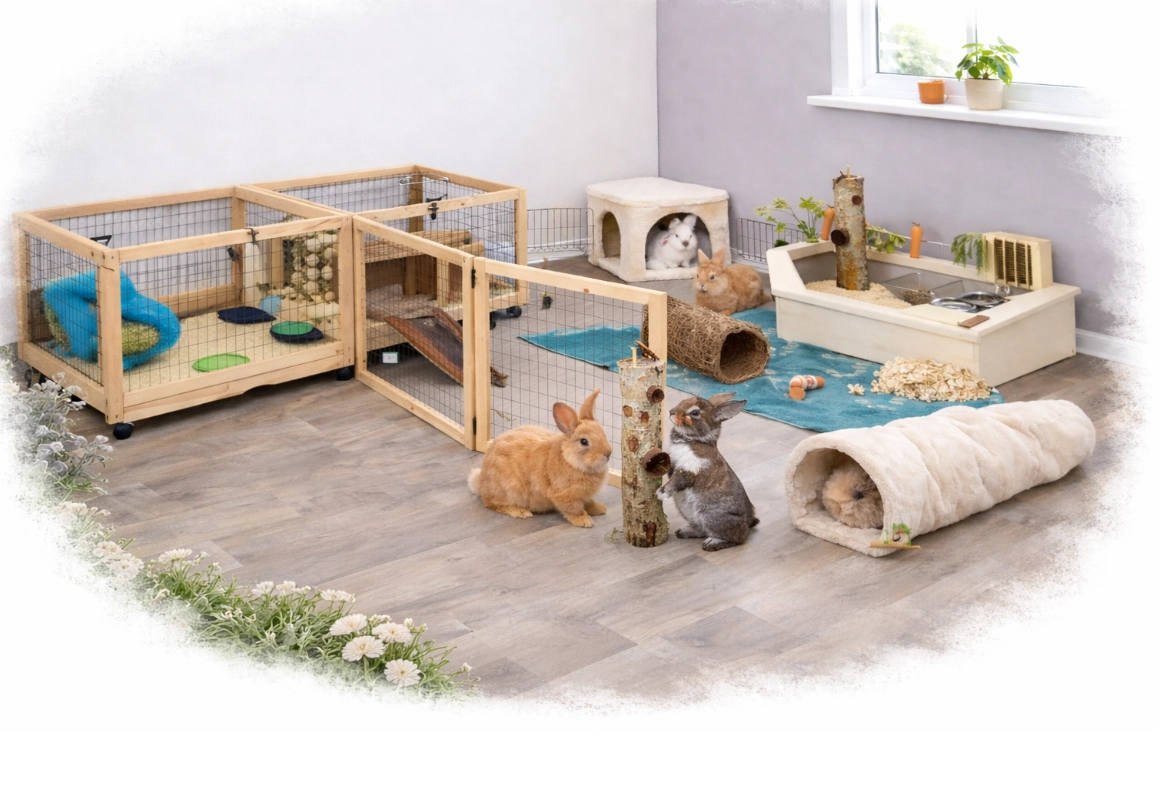 A rabbit room is an indoor space that you furnish specifically for your rabbits. Instead of just a cage or a separate run, you create a safe living space with grip, a designated litter box, a hay corner, drinking water, hiding places, tunnels, gnawing material, and plenty of free-roaming space. This gives your rabbits more room indoors to move, rest, eat, explore, and live together.
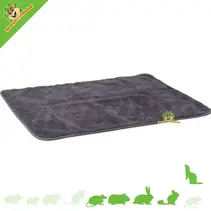
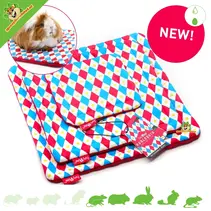
At DRD Knaagdierwinkel®, you will find products to make a room, corner, or indoor run practically rabbit-proof. Think of bedding mats , pee pads, vet beds, C&C panels and runs , rabbit toilets , hay racks , houses, tunnels, and enrichment. This category helps you turn individual products into one logical indoor space.
✓ In short: a good rabbit room has grip, safe fencing, a litter box, hay, hiding places, exercise space, and enrichment.
✓ Indoors, pay extra attention to slippery floors, cables, plants, baseboards, furniture, floor protection, and cleaning.
✓ Arrange the room for your rabbits together: with enough space to rest together, but also to pass each other quietly.
Quick links:
Why a rabbit room? · What can you find in this category? · Flooring & grip · Fencing & C&C panels · Toilet & hay corner · Hiding & resting · Enrichment · Useful shopping routes · FAQ
Grip on the floor
Floor mats, vet beds, and pee pads help make slippery floors more practical and comfortable.
Safe drop-off
With a run, C&C panels, or a wire cube arrangement, you can safely define a room, corner, or walkway.
Logical zones
A good rabbit room has zones for hay, toilet, water, rest, exercise, hiding, and enrichment.
Why furnish a rabbit room?
A rabbit room gives your rabbits more room to move around than a traditional cage. Indoors, you can create a permanent living space where your rabbits can walk, rest, eat, drink, use the litter box, hide, and use enrichment. This makes care more manageable and gives your rabbits more freedom of choice.
A rabbit room doesn't always have to be an entire room. It can also be a large partitioned corner, part of the living room, or an indoor run that you furnish smartly with bedding, a litter box, hay, houses, tunnels, and gnawing material. What is important is that the basic space itself is right and does not depend solely on a few hours of free running.
A rabbit room helps with
✓ More permanent living space for indoor rabbits.
✓ Better layout of hay, toilet, resting area, and walking space.
✓ More grip and comfort on slippery floors.
✓ Reduced risk of gnawing on cables, plants, baseboards, and furniture through smart fencing and offering alternatives.
✓ Make daily care more organized.
Read more: Keeping rabbits indoors · Setting up a rabbit room · How much space do rabbits need?
What can you find in this Rabbit Room category?
This category has been curated for owners who want to create a safe and practical living space indoors. Here you will find products for floor protection, fencing, toilet training, hiding, lying down, gnawing, and enrichment. This way, you can build a rabbit room step by step that suits both your home and your rabbits.
Assortment in this category
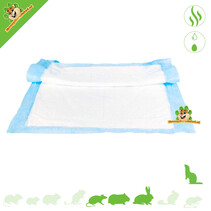
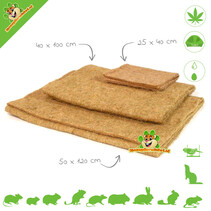
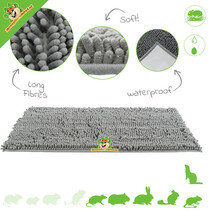
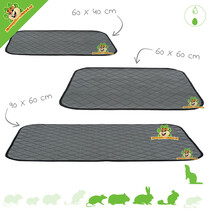
✓ Bottom mats, vet beds, and pee pads: for grip, comfort, floor protection, and practical cleaning.
✓ C&C wire cube runs and panels: to flexibly partition or expand an interior space.
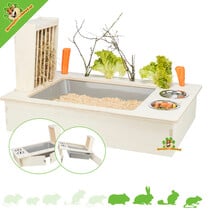
✓ Rabbit toilets and toilet products: for a clearly defined toilet zone in the room or run.
✓ Hay racks and hay solutions: for a tidy hay corner by the toilet.
✓ Huts, tunnels, and resting places: for rest, shelter, and safe routes.
✓ Chewing material and enrichment: to safely give your rabbits something to do in the house.
Floor and grip in the rabbit room
Many floors in the home are slippery for rabbits. Laminate, PVC, tiles, and smooth wood often provide little grip. As a result, rabbits may move uncertainly, have difficulty pushing off, or make less use of the available space. Grip is therefore one of the most important features of a rabbit room.
Floor mats, vet beds, and pee mats can help clearly mark walking routes, resting areas, and toilet zones. Choose materials that are easy to keep clean and check regularly for gnaw marks, loose threads, or shifting.
Floor check for indoor rabbits
✓ Can your rabbits walk, turn, and push off without slipping?
✓ Are there designated walking routes with sufficient grip?
✓ Do mats, vet beds, or pee pads stay in place well?
✓ Is the surface easy to keep clean?
✓ Do you check for gnaw marks, loose threads, and wear?
View now: Floor mats for rabbits .
Enclose rabbit room with run or C&C panels
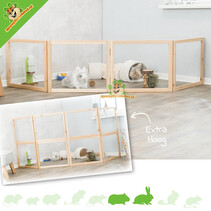
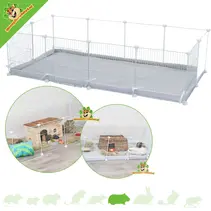
Not every room needs to be fully accessible. With an indoor run, C&C wire cube panels, or separate racks, you can create a safe zone. This is useful when you want to shield cables, plants, furniture, or specific corners, or when you want to start with a smaller but manageable enclosure.
C&C panels are flexible because you can adapt the setup to your space. You can section off a corner, create an indoor run, or expand an existing area. However, pay attention to stability, height, and connections, especially with active or larger rabbits.
Sell off and expand
✓ Use panels to keep cables, plants, and furniture out of reach.
✓ Create a permanent indoor run or flexible rabbit corner.
✓ Check if panels remain stable.
✓ Ensure that your rabbits cannot jump, push, or crawl where they are not supposed to.
✓ Make the space spacious enough to move, rest, and move aside.
View now: Rabbit runs · Choose a rabbit run
Toilet area and hay corner in the rabbit room
A clear toilet area makes a rabbit room much more practical. Place the rabbit toilet in a spot where your rabbits already like to urinate or defecate. Many rabbits enjoy eating hay on or near the toilet, which is why a hay rack or hay feeder above or next to the litter box often works well.
Use suitable toilet bedding in the toilet and keep the rest of the room's flooring distinctly different. This makes the toilet area recognizable and makes the room easier to keep clean.
Practical toilet and hay corner
✓ Choose a spacious litter box where your rabbits can sit comfortably.
✓ Use absorbent toilet bedding in the toilet bowl.
✓ Place hay at or above the toilet area.
✓ In a large room, create multiple toilet or hay areas if necessary.
✓ Check daily for wet spots, odor, and abnormal droppings.
View now: Rabbit toilets · Rabbit toilet bedding · Hay racks · Potty training a rabbit
Shelter, resting, and resting places
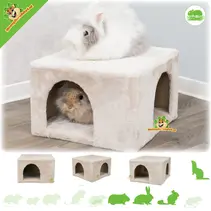
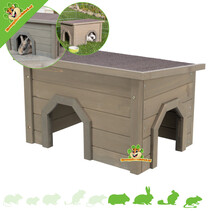
Rabbits are prey animals and feel more comfortable when they have sheltered spots. Therefore, houses, tunnels, baskets, cushions, and sheltered routes are important in a rabbit room. They give your rabbits choices: lying in the open, resting together, retreating, or walking through a tunnel to another spot.
When keeping multiple rabbits, ensure there is sufficient space and escape routes. Houses or tunnels with multiple openings are often more practical, as your rabbits will not get trapped in a dead-end corner.
Setting up rest areas
✓ Place houses and tunnels along edges or walkways.
✓ Ensure that both rabbits have access to resting places.
✓ Leave free movement space in the middle of the room or run.
✓ Check soft materials for gnaw marks and loose threads.
✓ Only alternate if your rabbits react calmly to it.
View now: Rabbit houses · Rabbit tunnels · Rabbit cushions, beds & baskets
Enrichment in the rabbit room
Indoor rabbits need safe activities. A rabbit room should not just be an empty space, but it doesn't need to be completely full either. Think in terms of functions: something to gnaw on, something to walk through, something to hide in, something to search for, and a place to lie down quietly.
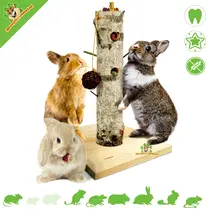
Chewing material, cardboard products, tunnels, foraging toys, snuffle mats, and herbs can make the room more interesting. When providing food-related enrichment, preferably use a portion of the normal daily ration so that the extras do not displace the base of hay and food.
Enrichment without filling the room
✓ Tunnels along walkways or edges.
✓ Chewing material in places where your rabbits like to be active.
✓ Foraging with herbs, hay, or a portion of the daily pellets.
✓ Cardboard products or sniffing materials as a temporary activity.
✓ Regularly check products for wear, moisture, and loose parts.
View now: Rabbit play & foraging · Rabbit gnawing material · Rabbit herbs
Making your room rabbit-proof
A rabbit room must be safe before your rabbits can move around freely. Tuck away cables, remove poisonous plants, cover vulnerable furniture and baseboards, and ensure your rabbits cannot get stuck behind cabinets, under sofas, or in narrow openings.
In addition, do offer good alternatives. Rabbits want to gnaw, explore, and follow routes. With safe tunnels, gnawing material, hay, and foraging areas, you make the room more interesting and shift their attention to products intended for these activities.
Rabbit-proof checklist
✓ Cables, chargers, and power strips are concealed or shielded.
✓ Poisonous plants are out of reach.
✓ Cleaning products and small items are safely stored away.
✓ Skirtings, furniture, and carpet edges are protected where necessary.
✓ There are no narrow openings where rabbits can get stuck behind or under.
✓ There are safe alternatives for gnawing, hiding, walking, and exploring.
Handy shopping routes for a rabbit room
A rabbit room works best when the components work together logically. Combine floor protection, fencing, litter box, hay, water, hiding places, and enrichment into one well-organized living space.
Learn more about indoor rabbits and rabbit rooms
Do you want to determine the best layout of the space first? Then read our information pages on indoor keeping, space, choosing a run, litter training, and rabbit rooms. This way, you don't just choose individual products, but build a living space that truly works logically.
Setting up a rabbit room · Keeping rabbits indoors · How much space do rabbits need? · Choosing a rabbit run · Litter training a rabbit
Frequently asked questions about a rabbit room
What do you need for a rabbit room?
For a rabbit room, you need grip on the floor, a safe enclosure, a litter box, a hay corner, drinking water, hiding places, tunnels, gnawing material, and enrichment. Additionally, the room must be made rabbit-proof.
How do you make a room rabbit-proof?
Tuck away cables, remove poisonous plants, screen baseboards and furniture where necessary, and ensure your rabbits cannot get stuck behind or under furniture. Use safe alternatives such as tunnels, houses, and gnawing material.
Which flooring is suitable for a rabbit room?
A floor must provide sufficient grip and be easy to keep clean. On smooth floors, floor mats, vet beds, or pee mats are often useful for walkways, resting areas, and toilet zones.
Can you make a rabbit room with C&C panels?
Yes, C&C panels are useful for flexibly partitioning or expanding an interior space. Pay attention to stability, height, connections, and whether the space remains large enough to move around.
Where do you place the rabbit toilet in a rabbit room?
Preferably place the litter box in a spot where your rabbits already like to urinate or defecate. Place hay by or above the litter box, as many rabbits enjoy eating hay on or near the toilet area.
Is a rabbit room better than a cage?
A rabbit room usually offers much more space and layout possibilities than a cage. A cage can potentially serve as a base or resting area, but rabbits also need sufficient room to move around.
What do you put in a rabbit room for enrichment?
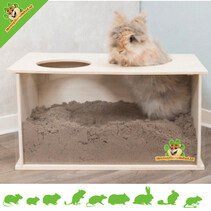
Think of tunnels, houses, gnawing material, foraging toys, sniffing mats, cardboard products, hay in multiple places, and possibly a digging or sniffing area.
What do you pay attention to on a daily basis in a rabbit room?
Check food, hay, water, droppings, litter box, coat, behavior, floor, mats, panels, and gnaw marks. Remove wet, broken, or heavily soiled materials in a timely manner.
Rabbit room products at DRD Knaagdierwinkel®
At DRD Knaagdierwinkel®, you will find products to furnish a rabbit room safely, practically, and pleasantly. From floor mats, vet beds, pee pads, and C&C runs to rabbit toilets, hay racks, houses, tunnels, gnawing material, and foraging products: every item plays a clear role in the indoor space.
✓ Everything for indoor rabbits and rabbit-proof furnishing conveniently together
✓ Products for grip, floor protection, fencing, toilet, hay, rest, and enrichment
✓ Practical to combine with rabbit runs, floor mats, toilets, hay racks, houses, and tunnels
✓ Keeping internal routes inside, space, litter training, and rabbit room information
✓ Specialist since 2011
✓ Delivered from our own stock
