 Polski


Fancy Mouse Cage Selection Guide: Size, Bar Spacing, and Setup for Pet Mice
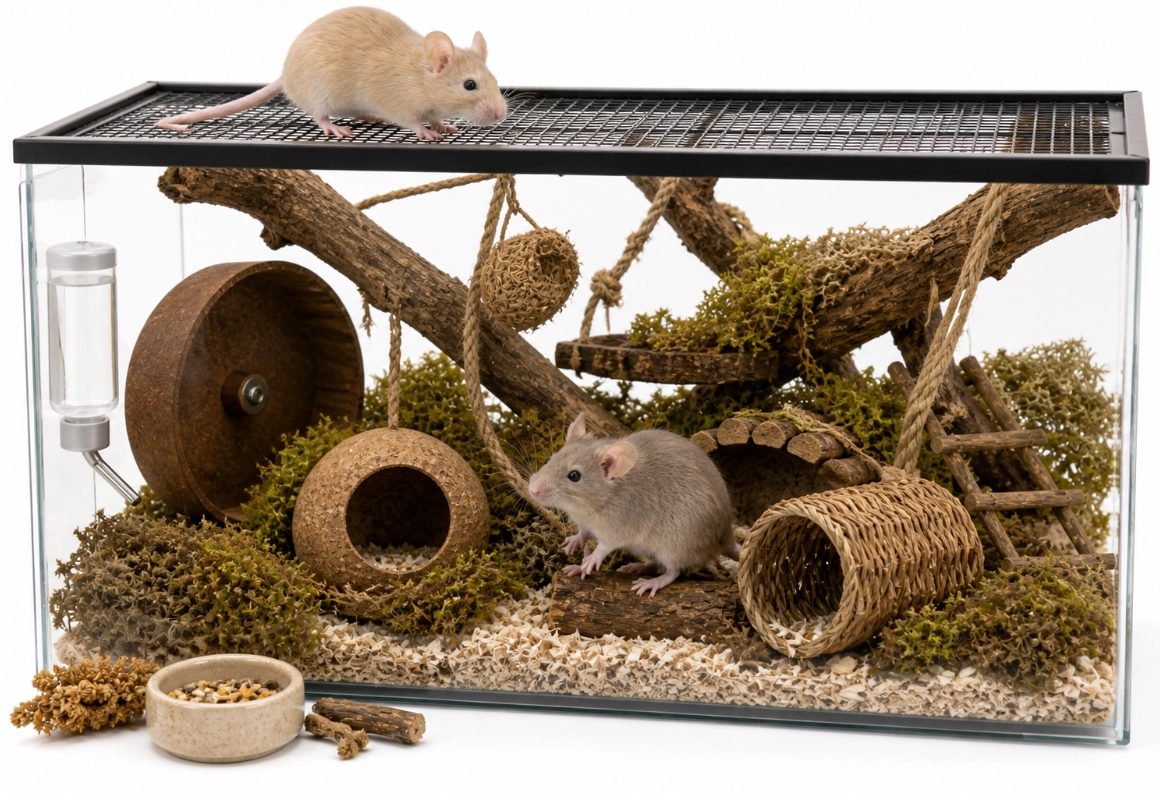 Are you looking for a good cage for fancy mice? This buying guide is intended for tame mice, also known as fancy mice. A good mouse cage is not only “big enough,” but also safe, well-ventilated, escape-proof, and practical to furnish with bedding , nesting material , houses, tunnels, platforms, a running wheel, a feeding area, and a drinking area.
When it comes to a fancy mouse cage, DRD looks for real, usable living space. Fancy mice want to shelter, climb, nest, run, sniff, gnaw, create routes, and live together. A bare, large box is therefore not enough; the cage must be large enough and designed as a network of sheltered paths, resting spots, climbing routes, and foraging opportunities.
Answer first: how to choose a good fancy mouse cage
✓ Adhere to the LICG guideline as a practical lower limit: a minimum of 75 × 40 × 40 cm for 2–4 fancy mice.
✓ For each additional animal, calculate at least 20% extra floor area on top of this base.
✓ For wire cages, choose a very small bar spacing: practically speaking, a maximum of approx. 0.7 cm, especially for young or slender fancy mice.
✓ A glass or plastic container/terrarium with a fine-mesh, well-ventilated lid is often easier to make escape-proof than a standard wire cage.
✓ Always choose the cage together with the interior: the base, nest, houses, running wheel, tunnels, food, and water must fit together logically.
Quick links
Size & LICG guideline | Bar spacing | Type of enclosure | Ventilation & location | Substrate | Setup | Group of fancy mice | Cleaning | DRD tip | Shopping routes | Checklist | FAQ
1. How big should a fancy mouse cage be?
LICG guideline as a lower limit
According to the LICG, an enclosure of at least 75 × 40 × 40 cm is quickly required for two to four mice. For each additional animal, the LICG advises calculating 20% extra surface area . Therefore, use this size as a practical lower limit, not as a luxury limit.
| Number of fancy mice | Practical guideline | DRD pays extra attention to |
| 2–4 fancy mice | Minimum 75 × 40 × 40 cm | Usable floor, ventilation, routes, running wheel and hiding places |
| 5 fancy mice | At least 20% extra floor area | More cottages, more routes, and multiple feeding/drinking points |
| Larger group | Calculate additional surface area again for each extra animal. | Peace within the group, alternative options, and ease of maintenance |
A larger cage is usually better, but only if the space is also usable. Fancy mice use open, empty space less effectively than space with cover. So don't just look at centimeters, but also at the question: can I fit a bedding layer, nesting zone, exercise wheel, tunnels, houses, feeding area, drinking area, and sheltered routes in here?
For DRD, the LICG size is therefore the starting point. A larger size is preferable when keeping multiple fancy mice, wanting to use extensive furnishings, or providing a group with more escape routes. A cage that is just at the lower end of the limit must be set up very cleverly to work really well.
2. Bar spacing: why 0.7 cm is a safe practical standard
Fancy mice are small, slender, and surprisingly good at escaping. The LICG indicates that few wire cages are suitable for mice, as the bars are often spaced too far apart. Therefore, we adhere to the practical DRD standard: for wire cages, preferably choose a bar spacing of no more than approximately 0.7 cm .
Pay attention not only to the straight bars, but also to the weak points of the cage:
- doors and latches;
- corner joints and connections;
- space at the bottom tray;
- ventilation slots;
- openings for drinking bottles;
- space around lid or cover;
- possible cutouts for accessories.
A cage with a neat bar spacing can still be prone to escape if the gaps in the door or corner openings are larger. Therefore, check the entire cage, not just the distance between the bars.
3. What type of enclosure is suitable for fancy mice?
Glass or plastic container
Often practical for fancy mice, as bedding, nesting material, and furnishings remain well contained within the enclosure. Ensure a well-ventilated, fine-mesh lid.
Terrarium
Beautiful for a natural setup with a ground layer, tunnels, and hiding places. Ventilation remains important, especially with taller or denser models.
Bar cage
Only suitable when bar spacing, gaps, doors, and bottom tray are truly escape-proof. Practical maximum: approximately 0.7 cm bar spacing.
A standard hamster or rodent cage is therefore not automatically suitable for fancy mice. Many cages have bars that are too wide, bottom trays that are too shallow, or gaps that mice exploit. Therefore, always look at the complete design.
4. Ventilation, temperature, and location in the house
A fancy mouse enclosure must be well-ventilated but not placed in a draft. The lid is particularly important for glass tanks, plastic tanks, and terrariums. A closed enclosure without sufficient air circulation can become warm, humid, or stuffy more quickly.
Place the cage in a quiet place:
- not in direct sunlight;
- not next to the heater;
- not on a drafty floor;
- not right next to a television, speakers, or devices with loud noise or vibrations;
- not in a place where cats or dogs can constantly sit against the cage.
Fancy mice have good hearing and react strongly to stimuli. A quiet place where you can observe them well is often more pleasant than a busy place with constant movement, noise, or vibrations.
5. Substrate: not too shallow and not dusty
Fancy mice have sensitive airways. Therefore, choose low-dust bedding that absorbs well and does not have a strong odor. A shallow tray with a thin layer of bedding offers few opportunities. A thicker layer of bedding makes sniffing, dragging, working through nesting material, and light digging activity much more natural.
Therefore, when choosing a cage, pay attention to the height of the base or the possibility of using sufficient bedding. A cage with high bars but hardly any room for bedding is less practical for fancy mice than it seems.
Calculate ground cover
Do you want to know approximately how many liters of bedding you need? Use this simple formula:
length × width × layer thickness in cm ÷ 1000 = number of liters of bedding
| Accommodation size | 10 cm layer | 15 cm low | 20 cm low |
| 75 × 40 cm | 30 liter | 45 liter | 60 liter |
| 80 × 50 cm | 40 liter | 60 liter | 80 liter |
| 100 × 50 cm | 50 liter | 75 liter | 100 liter |
6. Setting up the cage: from bare box to living environment
A fancy mouse cage is only suitable when it is properly furnished. Start with bedding and nesting material. Then add multiple houses , tunnels , platforms, and ladders . Mice feel more comfortable when they do not constantly have to walk through open spaces.
The exercise wheel is an important point of attention. Choose a mouse exercise wheel with:
- a closed tread;
- no open bars;
- sufficient diameter, so that the back remains straight;
- stable placement;
- no structure in which tail or legs can get trapped.
Always place heavy houses, stones, ceramics, or other sturdy items stably on the bottom of the box, not loosely on top of a deep layer of bedding. This prevents anything from tipping over or sinking when your mice work their way through the bedding.
7. Fancy mice in a group: more routes, more choice
Fancy mice are social animals. The LICG states that it is not humane to keep a mouse alone. Females are often kept in groups. Males are more often intolerant of one another, and a mixed group is not advisable due to rapid reproduction.
When keeping multiple fancy mice, the enclosure must provide more choice: multiple houses, multiple routes, multiple hiding places, and preferably more than one access point to important areas.
Prevent one house, one feeding station, or one route from becoming too important. When there are multiple options, mice can avoid each other more easily, and the group often remains calmer.
8. Cleaning without removing all the smell
Fancy mice communicate strongly through scent. Constantly making the enclosure completely odorless can cause unrest. Therefore, focus on targeted cleaning: remove wet spots, old food remnants, and dirty nest parts, but do not always replace the entire setup and bedding at once when it is not necessary.
A practical cage is therefore not only safe and beautiful, but also easy to maintain. You must be able to easily access food, water, wet areas, and nesting zones without having to constantly dismantle the entire enclosure.
Practical DRD tip
Always test a fancy mouse cage against three questions: can my mouse get out, does the LICG minimum suit my group, and does my mouse dare to walk everywhere inside? A cage is only well chosen when it is large enough, escape-proof, and richly furnished.
Useful shopping routes for a colored mouse cage
Accommodation & basics
Start with a safe cage, bedding, and nesting material.
Shelters & routes
Create sheltered paths with small houses, tunnels, platforms, and hanging spots.
Movement & activity
Add movement, searching, and gnawing to daily behavior.
Feed & care
Complete the basics with food, water, and practical care.
Mouse food
Feeding bowls
Drinking bottles & water bowls
Transport boxes
Checklist: choosing a fancy mouse cage
✓ Is the cage at least 75 × 40 × 40 cm for 2–4 fancy mice?
✓ Do you calculate at least 20% extra floor area for each additional animal?
✓ Is the bar spacing a maximum of approx. 0.7 cm, or is the enclosure completely escape-proof in another way?
✓ Have doors, gaps, lid, vents, and drinking bottle holes been checked?
✓ Is the enclosure well ventilated without being in a draft?
✓ Is there enough floor height for low-dust bedding and nesting material?
✓ Does a safe exercise wheel fit without making the rest of the setup too cramped?
✓ Are there multiple houses, tunnels, routes, and hiding places for a group of fancy mice?
✓ Can you easily check food, water, wet areas, and nesting zones?
✓ Is the enclosure out of direct sunlight, not next to the heater, and in a quiet spot?
Good to know about a fancy mouse cage
The LICG measure is a lower limit.
75 × 40 × 40 cm for 2–4 fancy mice is a clear practical lower limit. Larger is often preferable, especially when you want extensive furnishing, a group of animals, or more escape space.
A larger cage is not automatically better furnished.
Space is important, but bare space offers little security. Fancy mice need cover, routes, hiding places, and activity to truly utilize the space.
Bar spacing remains critical
With fancy mice, escape is a significant risk. Therefore, check not only the bar spacing, but also all cracks, doors, edges, and connections.
Do you want to view the complete basics first?
Also read the checklist "What do you need for fancy mice?" and then check which cage and setup best suits your group.
Frequently asked questions about a fancy mouse cage
How big should a fancy mouse cage be?
According to the LICG, an enclosure of at least 75 × 40 × 40 cm is quickly required for 2–4 mice. For each additional animal, calculate at least 20% extra floor space. Larger is often more pleasant if you want to use a lot of furnishing.
What bar spacing is safe for fancy mice?
If you use a wire cage, keep the bar spacing practically to a maximum of about 0.7 cm. Also check doors, cracks, corners, and openings near water bottles or the lid, as this is precisely where mice often escape.
Is a wire cage suitable for fancy mice?
A wire cage is only suitable if the openings are small enough and there are no gaps that fancy mice can squeeze through. Many standard rodent cages have bars that are too wide for mice.
Is a terrarium suitable for fancy mice?
A terrarium or container enclosure can be suitable provided the ventilation is good and the lid closes securely. The advantage is that substrate, nesting material, and decorations remain better contained within the enclosure.
How many fancy mice can you keep in one cage?
That depends on the size, layout, and group composition. For 2–4 mice, a minimum of 75 × 40 × 40 cm applies as the lower limit. For each additional animal, you account for extra surface area and more hiding places, routes, and feeding/drinking options.
How do you properly set up a fancy mouse cage?
Furnish the cage with low-dust bedding, nesting material, multiple houses, tunnels, platforms, a safe running wheel, gnawing material, and foraging areas. Prioritize creating sheltered routes rather than an open, bare space.
Do fancy mice need height?
Fancy mice enjoy using height, but only when it is safe and logically accessible. Use platforms, ladders, tunnels, and hanging spots to make height usable without unnecessary tripping hazards.
Where do you put a fancy mouse cage?
Place the cage in a quiet spot, out of direct sunlight, out of a draft, and not directly next to the heater. Also, do not place the cage right next to a television, speakers, or devices with loud noise or vibrations.
What is more important: a large cage or extensive furnishings?
Both are important. A large cage offers possibilities, but the space only becomes usable with proper furnishing. Fancy mice need cover, routes, hiding places, nesting opportunities, and activity.
Buy a fancy mouse cage at DRD Knaagdierwinkel®
At DRD Knaagdierwinkel®, you will find mouse cages and mouse furnishings for pet mice and fancy mice. We help you choose not only based on size, but especially on safety, ventilation, escape vulnerability, usable space, and layout. This way, you build an enclosure that is right for your fancy mice and remains practical for you.
Want to continue shopping right away? Then check out mouse cages , mouse bedding , mouse houses , mouse tunnels , mouse exercise wheels , andeverything for fancy mice .
✓ Specialist since 2011 in fancy mice, mouse cages, and species-specific setup
✓ Selection aid with concrete guidelines: size, bar spacing, ventilation, base, routes, and daily use
✓ Delivered from our own stock and shipped from the Netherlands to the Netherlands, Belgium, Germany, and other EU countries
