 Polski

Guinea pig food selection guide: hay, guinea pig food, vitamin C, vegetables, and snacks explained
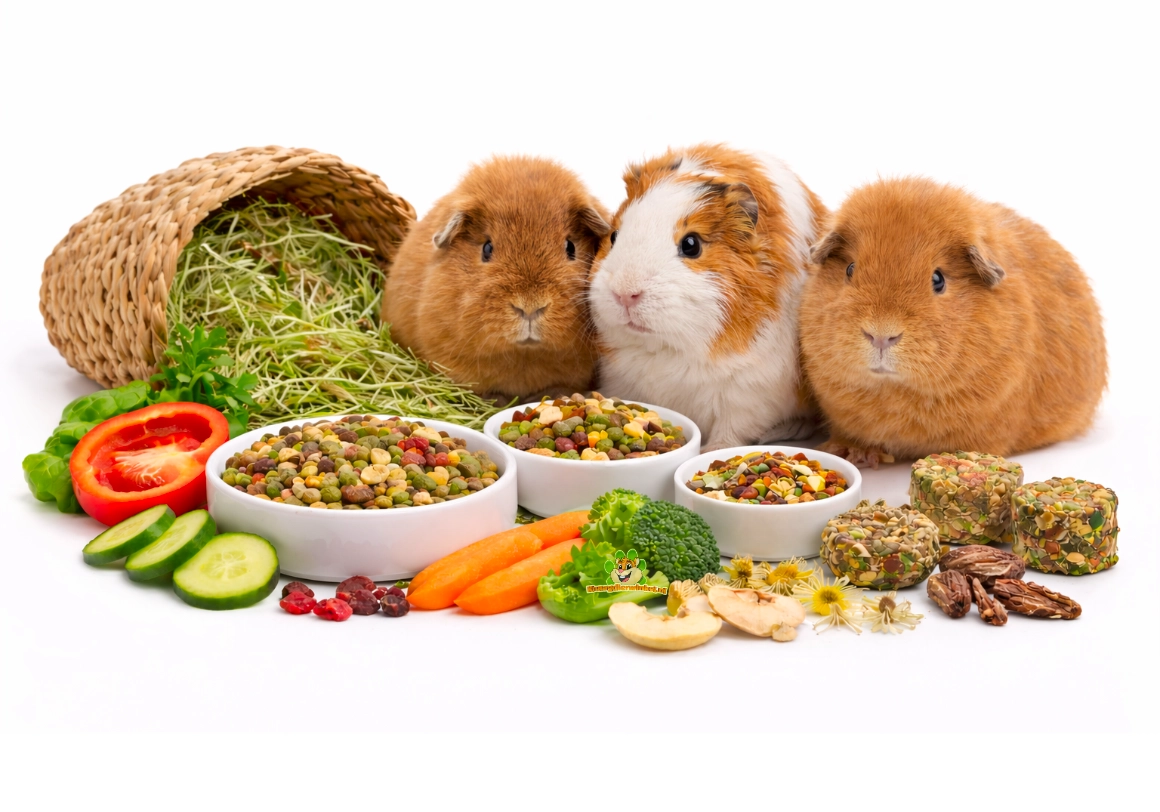 Guinea pig nutrition revolves around a clear foundation: plenty of guinea pig hay , appropriate guinea pig food , daily attention to vitamin C, and small amounts of suitable vegetables or herbs as a supplement. Guinea pigs are herbivores with continuously growing teeth. Therefore, fiber-rich food, especially hay, is so important in their daily routine.
This guinea pig food selection guide helps you choose step by step. You will read what a guinea pig needs daily, why vitamin C is so important, the difference between pellets, all-in-one kibble, and mixed food, how to gradually introduce vegetables, and when you need to pay extra attention to droppings, appetite, and teeth.
At DRD Knaagdierwinkel®, we view nutrition as part of the entire guinea pig enclosure. Hay should be easily accessible, food must suit eating habits, vitamin C requires daily attention, and extras such as herbs and snacks should support the basics. This way, you aren't just choosing a bag of food, but a feeding routine that truly works for your guinea pigs.
✓ Hay is the daily basis of guinea pig nutrition
✓ Guinea pig food should be intended specifically for guinea pigs
✓ Vitamin C must be part of the daily dietary routine
✓ Vegetables, herbs, and snacks are supplementary and are introduced gradually.
Quick links
In short • Daily diet • Hay as a base • Vitamin C • Choosing guinea pig food • Vegetables & herbs • Droppings & checks • Not eating • Shopping routes • FAQ
In short: what does a guinea pig eat daily?
A guinea pig eats primarily hay daily, supplemented with special guinea pig food, a daily vitamin C intake, and small amounts of suitable vegetables or herbs. Snacks, fruit, and extras are not a staple diet, but small supplements.
✔ Always: ample, fresh, and easily accessible hay.
✔ Daily: special guinea pig food with a focus on vitamin C.
✔ Additional: suitable vegetables, herbs, leaves, or flowers.
✔ Occasionally: snacks or fruit as a small treat.
✔ If eating less: do not wait, but contact a veterinarian.
Daily guinea pig feeding: what goes when?
| Element | Role in nutrition | How often? |
|---|---|---|
| Hay | Fiber base, chewing, being active, and daily bowel function. | Always available. |
| Guinea pig food | Targeted supplementation with nutrients and vitamin C. | Daily, dosed. |
| Vegetables | Variety, fluids, and additional nutrients. | Build up gradually and dose appropriately. |
| Herbs, flowers and leaves | Sniffing, variety, and quiet foraging. | As a supplement. |
| Snacks and fruit | Small treat or reward. | Occasionally, small. |
View now: Guinea pig hay • Guinea pig food • Guinea pig herbs • Guinea pig snacks
Hay as the base: the most important part of guinea pig nutrition
Hay is not a treat, but the basis of the daily diet. Guinea pigs eat throughout the day and need fiber to keep their digestive system active. Additionally, chewing hay extensively provides prolonged activity.
Choose hay that smells fresh, feels dry, and is eaten readily. One guinea pig may prefer softer hay, while another finds coarser or stemmy textures more appealing. The best hay is therefore not just “the finest hay,” but above all the hay that your guinea pigs continue to eat well.
Read more: Buying and choosing guinea pig hay and also check out guinea pig hay racks for a practical hay corner.
Vitamin C for guinea pigs: important daily
Guinea pigs cannot produce vitamin C themselves. Therefore, vitamin C must be obtained daily through their diet. Special guinea pig food contains vitamin C, but the amount can decrease if the food is left open for a longer period. Therefore, store the food tightly sealed, in a dry, and cool place.
For healthy adult guinea pigs, a guideline of approximately 10 to 20 mg of vitamin C per kg of body weight per day is often used. Young, pregnant, sick, or recovering guinea pigs may have different needs. Always consult a veterinarian in case of doubt, illness, recovery, or reduced appetite.
| Guinea pig weight | Vitamin C per day as a guideline | What do you look out for? |
|---|---|---|
| 800 grams | approximately 8–16 mg | Look at growth, condition, and feed intake. |
| 1 kg | approximately 10–20 mg | Useful basic direction for many adult guinea pigs. |
| 1.2 kg | approximately 12–24 mg | Watch out for selective eating and the freshness of the food. |
| 1.5 kg | approximately 15–30 mg | For overweight, it is better to calculate with ideal weight. |
Read more: Vitamin C in guinea pigs and view Vitamin C Guinea Pig products .
Choosing guinea pig food: pellets, all-in-one, mixed, or grain-free?
You choose the right guinea pig food based on eating behavior, age, condition, and your goal. Some guinea pigs eat everything neatly. Others mainly pick the tastiest pieces from a mixture. In that case, an all-in-one kibble or pellet can be useful, because every piece has the same composition.
All-in-one kibble and pellets
Great for picky eaters, because every kibble has the same composition.
Supreme Selective guinea pig food
Popular choice for owners looking for a recognizable, consistent pellet.
Mixed and natural food
Great for variety, aroma, and texture when your guinea pig eats the mixture well and in a balanced way.
Calculation aid: how much guinea pig food do you give?
The exact amount depends on the product, your guinea pig's condition, and the rest of its diet. Therefore, always follow the product information on the packaging. As a practical starting point for many guinea pig pellets, you can aim for approximately 20 grams per kg of ideal body weight per day.
| Ideal weight for a guinea pig | Starting point per day | Practical advice |
|---|---|---|
| 800 grams | about 16 grams | Check if your guinea pig continues to eat hay properly. |
| 1 kg | about 20 grams | A useful starting point for many adult guinea pigs. |
| 1.2 kg | about 24 grams | Adjust to condition and product advice. |
| 1.5 kg | about 30 grams | Do not calculate with excessive weight in case of overweight. |
Use this as a starting point, not as a fixed rule. Always look at hay intake, body condition, droppings, appetite, and the advice on the packaging.
Vegetables, herbs, flowers, and snacks: supplementing the basics
Vegetables, herbs, flowers, leaves, and snacks make food more interesting, but they do not replace hay or guinea pig food. Use them primarily as a supplement: a little mixed into the hay, in a snuffle mat, on a snack plate, or distributed across several small foraging spots.
Introduce new vegetables gradually. Give one new type at a time and start with a small piece. This way, you can clearly see how your guinea pig reacts and whether the droppings remain normal.
Guinea pig vegetable list
Which vegetables can a guinea pig eat, what should you give in moderation, and what is it better not to give?
Guinea pig herbs
Dried herbs, leaves, and flowers as a fragrant supplement to hay and foraging.
Guinea pig snacks
Snacks are small extras. Use them consciously and always let hay remain the foundation.
Droppings as a daily dietary check
Guinea pig droppings provide a lot of practical information. Normal droppings are usually firm, dry, oval to elongated, and fairly uniform in shape. Are the droppings becoming noticeably smaller, softer, wetter, or conversely much fewer? Then it is wise to pay extra attention to hay intake, appetite, vegetables, water, teeth, and behavior.
Read more: Guinea pig droppings: what is normal? . Do you see less eating, fewer droppings, or no droppings? Then also check out Guinea pig not eating .
Guinea pig not eating or eating less: do not wait
A guinea pig that is not eating or is clearly eating less requires immediate attention. Guinea pigs should not go without food for long. Eating less is often also reflected in fewer or smaller droppings, quieter behavior, weight loss, or altered chewing.
Specialty food or force-feeding can provide support when supplementary feeding is necessary, but it does not automatically resolve the underlying cause. Therefore, always have an assessment done to determine why your guinea pig is not eating, taking less hay, losing weight, is lethargic, or chewing differently.
✔ Not eating or eating much less is an important warning signal in guinea pigs.
✔ Pay attention to hay eating, droppings, weight, posture, and behavior.
✔ In case of dental problems, pain, abdominal problems, or illness, prompt action is important.
✔ Contact a veterinarian if your guinea pig is not eating or is clearly eating less.
Read more: Guinea pig not eating and Guinea pig teeth .
Common mistakes in guinea pig feeding
✓ Offer too little hay or place hay in a spot where it gets dirty quickly.
✓ Use general rodent food instead of special guinea pig food.
✓ Forgot Vitamin C or relied on food that has been open for a long time.
✓ Giving too many pellets or snacks, making hay less attractive.
✓ Failing to notice that a guinea pig leaves certain parts behind when eating selectively.
✓ Waiting too long when a guinea pig eats less or stops eating.
Smartly combine guinea pig food with the enclosure
Guinea pig food works best when diet and setup complement each other. Hay belongs in a place where your guinea pigs like to go, but where it remains as clean as possible. Water must be easily accessible. Food bowls must stand firmly. You can scatter herbs and snacks so that the guinea pigs can search for them at their leisure.
Useful accessories: Guinea pig hay racks • Guinea pig food bowls • Drinking bottles and water bowls • Guinea pig play and foraging
DRD makes the choice: first the basics, then the variation
At DRD, we view guinea pig nutrition as a system. Hay, guinea pig food, vitamin C, vegetables, herbs, snacks, water, and foraging belong together. If the foundation is right, you can use variety much more strategically.
The power lies in making conscious choices. A guinea pig doesn't just need a treat, but a feeding routine that supports hay consumption, provides vitamin C, and suits your guinea pigs' eating habits.
Handy shopping routes for guinea pig food
Basic nutrition
Guinea pig hay • Guinea pig food and nutrition • All-in-one kibble and pellets
Supplement & variation
Guinea pig herbs • Fresh guinea pig herbs • Guinea pig snacks • Playing and foraging
Information & control
Vitamin C in guinea pigs • Vitamin C Guinea Pig • Guinea pig vegetable list • Guinea pig droppings • Guinea pig not eating
Checklist – choosing the right guinea pig food
✓ Is hay always plentiful and easily accessible?
✓ Do you choose special guinea pig food instead of general rodent food?
✓ Do you pay attention to vitamin C daily via food, vegetables, or supplements?
✓ Do you feed pellets in moderation, so that eating hay remains the basis?
✓ Does the type of food suit your guinea pig's eating habits?
✓ Do you use herbs, flowers, leaves, and snacks as a supplement?
✓ Do you check daily if your guinea pig is eating, pooping, and is active normally?
Good to know
Guinea pigs need vitamin C daily and should continue to eat well. Is your guinea pig not eating, eating much less, leaving hay untouched, losing weight, drooling, chewing differently, or becoming lethargic? Then contact a veterinarian.
This selection aid helps you choose food and supplementary products, but does not replace a veterinarian for health issues.
FAQ – frequently asked questions about guinea pig nutrition
What does a guinea pig eat daily?
A guinea pig eats primarily hay daily, supplemented with special guinea pig food, vitamin C, and suitable vegetables or herbs. Snacks and fruit are small extras and not a staple diet.
Why is hay so important for guinea pigs?
Hay provides fiber, offers plenty of chewing time, and supports daily digestion. Therefore, hay should always be readily available.
Why does a guinea pig need special guinea pig food?
Guinea pigs cannot produce vitamin C themselves. Special guinea pig food is tailored to guinea pigs and contains vitamin C, whereas general rodent food does not provide a good basis for this.
How much guinea pig food do you give per day?
Always follow the product information. As a practical starting point for many guinea pig pellets, you can aim for approximately 20 grams per kg of ideal body weight per day.
What is better: pellets or mixed guinea pig food?
Pellets or all-in-one kibble are convenient for picky eaters, because every kibble is the same. Mixed and natural guinea pig food can be nice for variety, provided your guinea pig eats the mixture well and in a balanced way.
How much vitamin C does a guinea pig need?
For adult guinea pigs, a daily intake of approximately 10 to 20 mg of vitamin C per kg of body weight is often used. The requirements may differ during growth, pregnancy, illness, or recovery.
Which vegetables can a guinea pig eat?
Guinea pigs may eat various vegetables, such as bell peppers, chicory, endive, cucumber, and romaine lettuce. Introduce vegetables gradually and use the guinea pig vegetable list for guidance.
Can you give guinea pigs herbs?
Yes, suitable herbs, flowers, and leaves can be a nice addition. Use them in moderation, for example mixed into the hay or at a sniffing spot.
Why are guinea pig droppings important for nutrition?
Droppings provide practical information about eating, hay intake, and bowel function. Fewer, smaller, soft, or no droppings are signals to take a closer look.
What do you do if a guinea pig doesn't eat?
Don't wait. Check if your guinea pig is eating hay and food and contact a veterinarian immediately. Not eating is an important warning sign in guinea pigs.
When do you use force-feeding for guinea pigs?
Force feeding is used when supplementary feeding is necessary, preferably after advice from a veterinarian. It supports food intake but does not automatically resolve the underlying cause of the refusal to eat.
What do you combine with guinea pig food?
Combine guinea pig food with hay, hay racks, food bowls, water bowls or drinking bottles, herbs, snacks, snuffle mats, and a spacious, quiet environment.
✓ Guinea pig food selection guide with hay, guinea pig food, vitamin C, vegetables, herbs, snacks and supplements
✓ Practical choice between pellets, all-in-one kibble, mixed feed, grain-free feed, and specialty food
✓ With direct links to guinea pig hay, vegetables, droppings, vitamin C, guinea pig not eating, and guinea pig teeth
✓ Ordered before 5 PM, shipped the same day
✓ Specialist since 2011
✓ Delivered from our own stock
Unsure which guinea pig food, hay, or vitamin C product is best for your guinea pigs? Feel free to contact us via our contact page . We are happy to help you.
