 Polski

Cotton bedding – soft, dust-free & comfortable




- Voor 17 uur besteld, dezelfde dag verzonden!
- Rodent specialist since 2011
- Dispatched from our own stock
Cotton bedding – soft, dust-free & comfortable
 Looking for cotton bedding that feels soft, is comfortable, and makes your home comfortable? Cotton is popular as a comfort layer and nesting zone: warm, often dust-free, and easy on paws. In this category, you'll find various cotton varieties (such as fibers, blends, and pellets), so you can choose based on your needs: sleeping, nesting, hygiene, and practical cleaning. DRD Rodent Shop® has been a specialist since 2011—so you can choose with confidence and with help.
Cotton bedding feels pleasant and is ideal as a comfort layer or nesting zone — especially for animals that like to lie warm and soft.
Use cotton wisely in designated areas: a soft resting/nesting area and an absorbent toilet area. This way, you'll keep the area fresh for longer.
Cotton often works best when combined with other substrates. Also consider hemp , flax , and paper/cardboard .
Why choose cotton ground cover?
Cotton bedding is often chosen for its comfort and pleasant, warm texture . It is particularly suitable for:
- Comfort layer for rest areas and under houses.
- Nesting zone (soft, movable material that animals like to “furnish”).
- Supplement to a base layer with more structure/absorption.
Looking for a material that's particularly absorbent for toilet or pee areas? Then also check out our mats & pee mats or combine it with an absorbent base from the main category "bedding & nesting materials ."
Types of cotton bedding: fibers, mixes & pellets
Cotton comes in different textures. This will help you choose based on its use (softness, volume, toilet zone, blending):
- Cotton fibres (fluffy/comfort) – extra soft, ideal as a nest or comfort layer.
- Cotton blends – for example with hemp, flax or cardboard for more structure and variety.
- Cotton pellets – a firmer base that can absorb a lot of moisture, often useful for toilet areas or as a base layer.
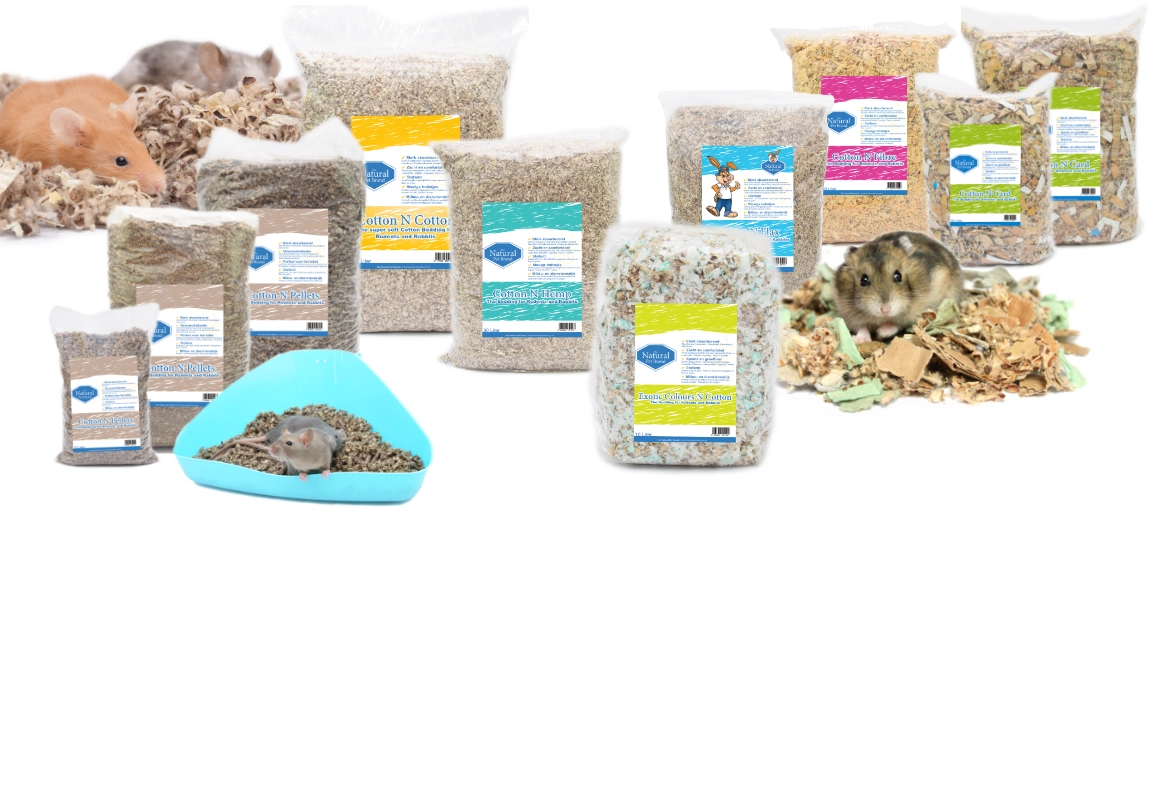
In this category, you'll often find varieties like Cotton N Cotton, Cotton N Fibre, Cotton N Hemp, Cotton N Pellets, Cotton N Card, Cotton N Flax, and (decorative) color mixes. This allows you to choose precisely what suits your pet and your cleaning routine.
Cotton bedding per animal: where does it work well?
Cotton has a wide range of applications, but the best application varies by animal species and behavior:
- Hamsters and dwarf hamsters – great as a comfort/nesting zone; combine for more structured digging zones.
- Mice – good as nesting material/comfort layer (especially in a fixed nesting corner).
- Rats – often chosen for comfort in hammocks/sleeping areas or as a soft layer; pay attention to hygiene/damp patches.
- Guinea pigs – especially useful as a comfort layer or in zones; combine practically with absorbent solutions for wet areas.
- Rabbits – often do best in toilet or comfort zones; work with clear "pee/poo" areas and dry layers.
Want to compare more broadly with other materials? Also see: flax , hemp , paper & cardboard , and wood .
Smart combinations: how to create zones in the living area
Cotton often works best as part of a smart soil structure:
- Toilet area : choose a highly absorbent underlay (e.g. pellets) and make this area easy to spot-clean.
- Resting/nesting zone : Use cotton fibers or a soft blend that animals like to sleep and settle in.
- Activity/digging zone : combine with materials that provide more stability and structure (such as hemp, flax, wood).
Bonus tip: Want to encourage "building and dragging" in addition to cotton? Then check out our nesting materials .
How much ground cover do you need?
Want to quickly know how many liters of ground cover you need? This calculator will help you calculate it in seconds – useful for both a base layer and a deep excavation layer.
Formula
(length × width × layer thickness in cm) ÷ 1000 = liters
✔ Preferably measure the internal dimensions of the accommodation (L × W).
✔ Choose your layer thickness in cm (depending on animal, behaviour and layout).
✔ When spreading deeply, always allow a little extra: ground cover sinks after application.
✔ Number of bags: required litres ÷ content per bag .
Example: 100 × 50 cm with 20 cm layer → (100 × 50 × 20) ÷ 1000 = 100 liters .
Want to compare all the materials? View: bedding & nesting materials .
| Base size | 10 cm | 15 cm | 20 cm | 30 cm |
|---|---|---|---|---|
| 80 × 40 cm | 32 L | 48 L | 64 L | 96 L |
| 100 × 40 cm | 40 L | 60 L | 80 L | 120 L |
| 100 × 50 cm | 50 L | 75 L | 100 L | 150 L |
Checklist: Using cotton ground cover correctly
Before you create your base structure, please review this list:
✔ You use cotton as a comfort layer or nesting zone
✔ Wet toilet areas are a fixed zone (easy spot cleaning)
✔ You combine with structure where necessary (e.g. hemp/flax/wood)
✔ You have calculated the required liters with the calculation tool
✔ You regularly check for damp spots under houses/platforms
Maintenance & hygiene
- Daily : remove wet spots (spot clean), check food remains, change the water.
- Weekly : change some of the bedding (more restful for the animal than changing everything at once).
- Toilet area : keep this extra tight; cotton is most comfortable when it stays dry.
- Pay attention to places where animals like to sleep: heat/moisture can build up more quickly there.
Safety warnings
- Always use ground cover as intended and check regularly that the material remains dry .
- Avoid strongly perfumed products; animals have sensitive noses.
- When intensively “dragging” is carried out, check that no areas arise where the material becomes compact and damp.
- Do you notice shortness of breath, lethargy, or a suddenly dirty coat? If in doubt, contact a veterinarian.
FAQ – Frequently Asked Questions about Cotton Bedding
Is cotton bedding suitable for hamsters?
Yes, cotton is often used as a comfort or nesting zone. For digging, it usually works better as part of a soil structure (with extra structure in the digging zone).
Is cotton bedding also useful for rabbits or guinea pigs?
Often primarily in zones: a comfortable resting place or a practical, easy-to-maintain layout with a clearly defined toilet area. This keeps the space fresh for longer.
Can I combine cotton bedding with other materials?
Definitely. For example, combine cotton (comfort) with flax , hemp , or paper/cardboard (absorbency/structure).
How many liters of cotton bedding do I need?
Use the calculator at Calculation tool liters . When spreading deeply, often add a little extra, as ground cover can settle after application.
Where can I find all the ground covering (all materials)?
View the full main category: Bedding & Nesting Materials .
Why buy cotton bedding from DRD Rodent Shop®?
✔ Specialist since 2011
✔ Ordered before 5 PM = shipped the same day
✔ Delivered from our own stock
✔ Smartly selected range for well-being & safety
