 Polski

What do you need for rats? Complete checklist for pet rats
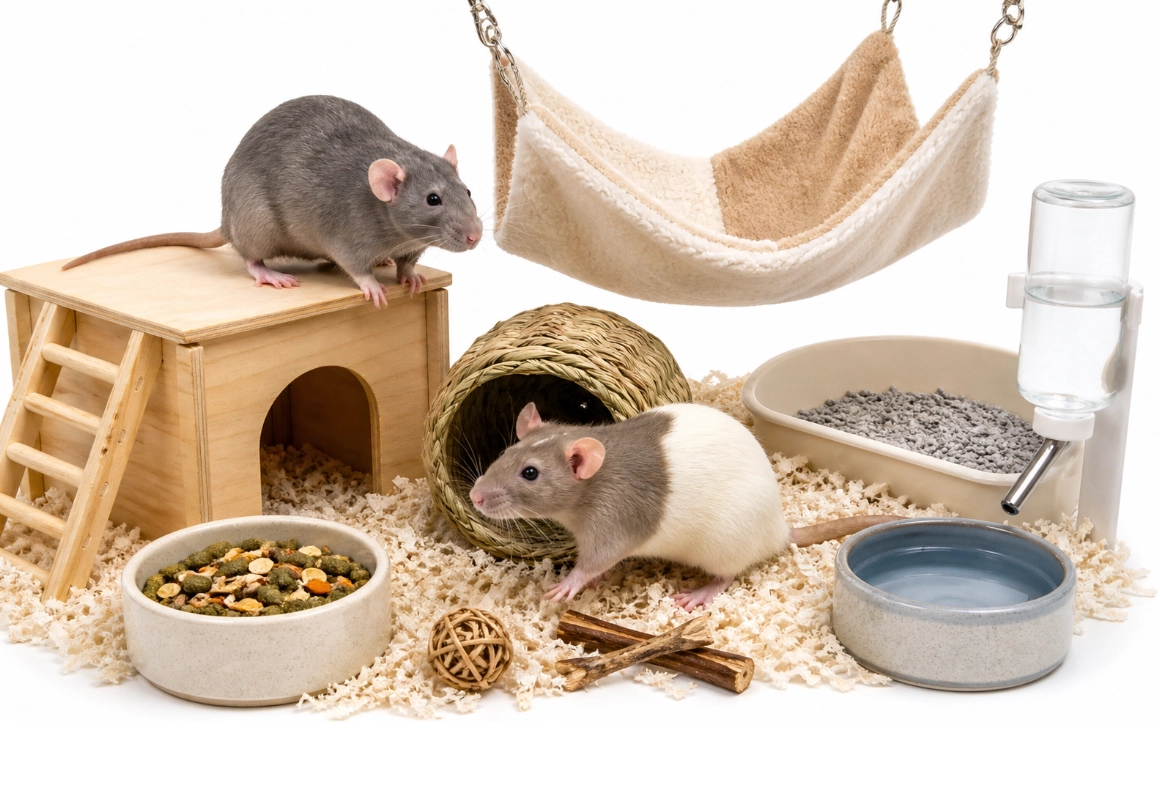 If you want to keep pet rats, you need more than just a cage and a food bowl. Rats are intelligent, social, and curious animals. They need companions, a spacious and well-furnished cage, dust-free bedding, multiple sleeping areas, appropriate food, drinking water, litter boxes, safe routes, toys, and daily enrichment.
At DRD Knaagdierwinkel®, we view rat supplies as one logical whole. DRD selects products and advice not just based on "this is part of the package," but primarily on product fit: does it suit social rats, sensitive airways, climbing, sleeping, grooming, foraging, and daily contact? This checklist helps you choose what you need step by step, with direct routes to rat cages , rat bedding , rat food , hammocks , litter boxes , and Ratscaping .
✓ In short: rats need at least a suitable rat companion or group, a spacious cage, low-dust bedding, food, water, sleeping areas, and enrichment.
✓ For two rats, the LICG recommends a minimum of 100 × 50 × 70 cm; additional floor space is required for each extra rat.
✓ Do not use chinchilla sand or fine sand as a sand bath for rats; rats do not need a sand bath and their airways are sensitive.
Quick links:
Basic necessities · Rat cage · Bedding · Sleeping & hiding · Food & water · Enrichment · Hygiene · Transport & care · Complete checklist · Handy shopping routes · FAQ
Social animals
Rats should live with other rats. A suitable duo or small group provides contact, safety, and natural social behavior.
Space and routes
A rat cage works best with height, runways, platforms, hammocks, tunnels, and multiple resting places.
Something to do every day
Foraging, climbing, gnawing, destroying suitable materials, sniffing, and exploring are all part of a pleasant rat routine.
Basic necessities for rats
For rats, you start with functions, not individual products. Your rats must be able to live together, sleep, eat, drink, move, climb, forage, gnaw, stay clean, and be transported safely. If those functions are right, choosing becomes much easier.
This checklist is primarily intended as a starting point. Once you have the basics in place, you can expand later with more Ratscaping, extra foraging products, digging boxes, various hammocks, and play materials. This way, the setup grows along with your rats and your experience.
Rat checklist in one overview
✓ At least two rats or a suitable group.
✓ A spacious rat cage with height, ventilation, and multiple levels.
✓ Low-dust bedding and a practical toilet corner.
✓ Hammocks, houses, baskets, and nesting material for sleeping and sheltering.
✓ Suitable rat food, food bowls, and drinking bottles or water bowls.
✓ Tunnels, platforms, ladders, foraging products and gnawing material.
✓ Transport box, grooming products, and daily checks on behavior and health.
Which rat cage do you need?
A good rat cage offers space, height, ventilation, and safe routes. Rats enjoy climbing, but they must also be able to move safely from place to place. Therefore, think in layers: base, platforms, hammocks, tunnels, ladders, resting places, and routes at different heights.
For two rats, the LICG recommends a minimum size of 100 × 50 × 70 cm (length × width × height). Additional floor space is required for every extra rat. Consider this a lower limit: larger is preferable, especially for active rats or a larger group. Pay attention not only to the external dimensions, but particularly to the usable layout. A tall, empty cage without routes is less practical than a well-designed cage with safe stations.
Pay attention to a rat cage
✓ Minimum 100 × 50 × 70 cm for two rats, preferably larger.
✓ Extra space for more than two rats.
✓ Good ventilation and a safe bar spacing.
✓ Multiple levels, platforms, and safe walking routes.
✓ Enough doors or openings to clean and furnish thoroughly.
✓ Space for hammocks, tunnels, food, water, toilets, and enrichment.
See also: Rat Cages · Rat Cage Accessories · Rat Cage Buying Guide
Bedding for rats: choose low-dust options
Bedding is especially important for rats because they have sensitive airways. Therefore, choose low-dust or dust-free bedding and be critical of materials that visibly release fine dust. Good bedding helps keep the enclosure more pleasant, fresher, and more practical.
Do not use chinchilla sand or fine sand as a sand bath for rats. Rats do not bathe in sand like chinchillas and degus, and fine dust can be irritating to their respiratory system. If you want to create a digging or sniffing area, choose a rat-suitable digging box with appropriate material and good control over dust, moisture, and hygiene.
For the base you need
✓ Low-dust rat bedding for the base of the enclosure.
✓ Optionally, a litter box for designated urination and defecation spots.
✓ Urine mats or absorbent zones in places where rats often lie or urinate.
✓ A digging bucket with suitable, low-dust material if you want to provide extra enrichment.
✓ A cleaning routine where you regularly remove soiled spots.
See also: Rat Bedding · Rat Toilets · Rat Pee Mats · Rat Bedding Selection Guide
Sleeping places, hammocks, little houses and tunnels
Rats like to sleep together, but they also want to be able to choose. Therefore, multiple sleeping spots are important. Think of hammocks, houses, baskets, cushions, tunnels, and nesting material. It is better to provide more resting spots than the number of rats, so that your group can rotate and there is less pressure on one favorite spot.
Hammocks are often real favorites with rats. Tunnels and tubes help create routes between levels or resting places. Houses and baskets provide shelter. Combine these so that the cage is not overcrowded, but still has several distinct zones.
For sleeping and sheltering
✓ Hammocks at different heights.
✓ Shelters or hiding places in quiet spots.
✓ Baskets, cushions, or soft resting places where appropriate.
✓ Tunnels and tubes as a route, hiding place, or play element.
✓ Nesting material that is suitable for rats and does not form long, stringy fibers.
See also: Rat Hammocks · Rat Houses · Rat Tunnels & Tubes · Rat Nesting Material, Cushions & Baskets
Food and water for rats
Rats require appropriate basic food that meets their nutritional needs. You can choose from rat food, pellets, or other suitable food, depending on your preference and the situation of your group. Snacks, herbs, seeds, dried vegetables, and fruit should be used supplementarily and judiciously.
Water must always be available. With a group of rats, it is practical to use multiple water sources or, at the very least, to thoroughly check daily that the water bottle or bowl is clean and working properly. You can offer food in a dish, but also use part of it for foraging.
For food and water
✓ Rat food or rat pellets as a daily basis.
✓ Food bowls that stand firmly and are easy to clean.
✓ Drinking bottles or water bowls with clean water daily.
✓ Snacks and herbs as a small reward or foraging moment.
✓ Check for leftovers, especially with fresh or perishable extras.
See also: Rat food · Rat pellets · Rat food bowls · Rat water bottles · Rat food selection guide
Enrichment, play and Ratscaping
Rats are intelligent animals that need something to do every day. Enrichment means enabling behaviors: searching, climbing, gnawing, destroying suitable materials, sniffing, exploring, and creating routes. This doesn't have to be complicated, but it must be done daily.
Ratscaping helps to make the cage more natural and functional. You create zones for sleeping, eating, drinking, toileting, routes, foraging, and optionally a digging or sniffing area. A rat digging box is not a sand bath, but a separate place to search, sniff, and dig with suitable material.
For enrichment you need
✓ Foraging toys, snack boards, or ways to hide food.
✓ Tunnels, tubes, and routes to walk through and discover.
✓ Gnawing and destructive material suitable for rats.
✓ A digging bucket or sniffing zone with suitable material.
✓ Variety, without making the cage too crowded or cluttered.
See also: Ratscaping · Rat Digging Box · Rat Play & Foraging · Rat Chewing Material · Ratscaping for Beginners
Hygiene, toilets and cleaning
Keeping a rat cage fresh is best achieved with a clear routine. Rats often have designated spots where they urinate. By using litter boxes, pee pads, and spot cleaning, you can reduce odor without having to completely turn the entire cage upside down every time.
Pay particular attention to wet bedding, urine stains on platforms, dirty hammocks, old food remnants, and ventilation. Textiles such as hammocks and baskets should be changed regularly and allowed to dry thoroughly before being returned to the cage.
For hygiene you need
✓ Rat toilets for designated urination and defecation spots.
✓ Pee pads on platforms or favorite resting spots.
✓ Low-dust bedding and a well-ventilated cage.
✓ Spare hammocks or washable resting places for swapping.
✓ Daily check for wet spots, food residue, and sources of odor.
See also: Rat Toilets · Rat Pee Mats · Litter Training Rats · Cleaning a Rat Cage
Transport, care and daily checks
A transport box is also part of the basics. You use it for pickup, vet visits, temporary separation, safe transport during cleaning, or the transport box method for rats that are not yet tame. Choose a box that closes securely, ventilates well, and is sturdy enough for rats.
In addition, daily check-ups are important. Pay attention to appetite, breathing, activity, coat, weight, wounds, bumps, porphyrin around the nose or eyes, and sudden changes in behavior. Health products can support care, but clear symptoms require the attention of a veterinarian specializing in rats.
For practical care
✓ Transport box for safe transport and temporary relocation.
✓ Grooming products suitable for rats.
✓ Daily check of appetite, breathing, behavior, and coat.
✓ A designated spot to quietly observe your rats and, if necessary, weigh them.
✓ Contact details of a rat-specialist veterinarian for emergencies or in case of doubt.
See also: Rat Transport Box · Rat Care · Rat Health · Rat Health Signs
Complete checklist: what do you buy first for rats?
Use this checklist when you get rats for the first time or when you want to check if your basics are complete. Start with the items needed daily and then expand with extra enrichment.
Starter checklist for pet rats
✓ At least two rats or a suitable group.
✓ Rat cage of at least 100 × 50 × 70 cm for two rats, preferably larger.
✓ Low-dust bedding for the base of the cage.
✓ Toilets and/or urinals for permanent wet areas.
✓ Rat food or rat pellets as basic food.
✓ Food bowls and drinking bottles or water bowls.
✓ Hammocks, houses, tunnels, and soft resting places.
✓ Platforms, ladders, and cage accessories for safe routes.
✓ Foraging products, gnawing material, and optionally a digging box.
✓ Transport box for pickup, vet visits, and safe moving.
✓ Basic knowledge of taming, bonding, cleaning, and health signs.
Good to know before you start
✓ Do not keep rats alone; they are social pack animals and need companions of their own kind.
✓ Choose a cage that is large enough and can be set up in a truly functional way with routes, resting places, and toilets.
✓ Use low-dust bedding and avoid sawdust, chinchilla sand, and fine sand for rats.
✓ Avoid long, fibrous nesting materials and regularly check fabric parts for loose threads or wear.
✓ Do you notice shortness of breath, wheezing, lethargy, loss of appetite, sores, or sudden changes in behavior? Contact a veterinarian specializing in rats.
Handy shopping routes for your rat checklist
Do you want to complete the checklist immediately? Follow these routes to find the most important product groups for a complete rat base.
Cage & furnishings
For the basics of the enclosure: cage, accessories, platforms, and routes.
Soil & hygiene
For dust-free floors, fixed toilet corners, pee mats, and cleaning.
Sleeping & resting
For co-sleeping, soft resting places, and safe hiding places.
Nutrition & water
For basic food, feeding stations, drinking points, and small treats.
Enrichment & Ratscaping
For smart rats who want to search, climb, gnaw, and explore.
Read more about keeping rats
This checklist is the starting point. If you want to make a deeper choice afterwards, use the selection aids and information pages below.
Rat as a pet · Rat cage buying guide · Rat bedding buying guide · Rat food buying guide · Taming rats · Litter training rats · Cleaning a rat cage
Frequently asked questions about what you need for rats
What is the minimum you need for rats?
You need at least a suitable rat companion or group, a spacious cage, dust-free bedding, sleeping areas, rat food, water, food bowls, a drinking solution, a litter box, hammocks, tunnels, gnawing material, and daily enrichment.
Can you keep one rat?
Rats are social pack animals. Keeping a single rat alone does not suit their social behavior. Therefore, choose at least two rats or a suitable group with sufficient space.
Which cage do you need for rats?
A rat cage must be spacious, well-ventilated, and safe to set up with height, platforms, hammocks, tunnels, and multiple resting places. For two rats, the LICG recommends a minimum of 100 × 50 × 70 cm.
Which bedding is suitable for rats?
For rats, preferably choose a low-dust or dust-free bedding. Rats have sensitive airways, so heavily dusty materials are unpleasant for daily use.
Do rats need a sand bath?
No, rats do not need a sand bath like chinchillas or degus. Do not use chinchilla sand or fine sand for rats, as this can be taxing on their sensitive airways.
What do rats like in their cage?
Rats particularly enjoy variety: hammocks, tunnels, platforms, foraging, gnawing material, shredding material, digging or sniffing areas, and safe routes through the cage.
Do rats need hammocks?
Hammocks are not a mandatory item, but they are very pleasant for many rats. They provide soft resting places, safe staging posts, and extra elevated resting spots.
What do you feed rats?
Start with suitable rat food or rat pellets as a base. Use snacks, herbs, seeds, dried vegetables, and fruit as a supplement and in small quantities.
How do you keep a rat cage fresh?
Use low-dust bedding, litter corners, pee pads where necessary, and daily spot cleaning. Remove wet spots and old food residue, and wash hammocks regularly.
What is the first thing you buy for rats?
Start with the basics: rat cage, bedding, food, water, food bowl, water bottle or bowl, hammocks, houses, tunnels, litter box, transport box, and enrichment. Then you can expand with Ratscaping, digging boxes, foraging products, and extra sleeping areas.
Rat checklist at DRD Knaagdierwinkel®
At DRD Knaagdierwinkel®, we help you not only with individual rat products, but with a complete foundation that is right for pet rats. From cages, bedding, food, and water to hammocks, tunnels, litter boxes, transport, Ratscaping, and daily checks: we help you choose what suits your rats and your care routine.
✓ Complete checklist for new rat owners
✓ Direct routes to cage, bedding, food, sleeping, hygiene, and enrichment
✓ Concrete size advice for rat cages and attention to low-dust bedding
✓ No sand bath, chinchilla sand, or fine sand positioning for rats
✓ Specialist since 2011
✓ Delivered from our own stock
