Polski

Chinchilla food in the Chinchilla Webshop


- Voor 17 uur besteld, dezelfde dag verzonden!
- Rodent specialist since 2011
- Dispatched from our own stock

- Voor 17 uur besteld, dezelfde dag verzonden!
- Rodent specialist since 2011
- Dispatched from our own stock
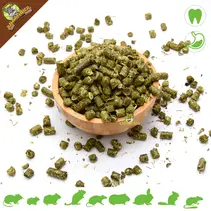
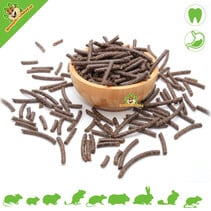
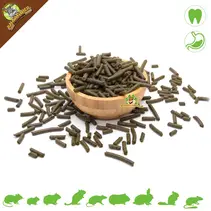

You can order chinchilla food quickly and easily at DRD Rodent Shop ®
Want to feed your chinchilla truly well? Then it's all about fiber, constant availability, and a calm gut. Chinchillas have a sensitive digestive system and teeth that grow continuously throughout their lives. That's why you'll find primarily species-appropriate chinchilla food (pellets/chunks) in this category, supplemented with fiber-rich additives and herbs/botanicals for variety and enrichment. We carefully select based on appropriate composition, practicality, and species safety. Specialist since 2011 – fast delivery from our own stock.
Chinchilla food product groups
The daily core: balanced, stable and easy to dose.
Read more →
For those who consciously choose fiber-rich compositions and clear ingredients.
Read more →
Variation and enrichment within a good basic diet (in moderation).
Read more →
Handy for dosing: timothy, meadow grass and herb pellets, among others.
Read more →
Force-feeding and support mixes: handy to have at home.
Read more →
The basics of the chinchilla diet
- Unlimited hay: hay is the basis for fiber, intestinal function and natural tooth wear.
- Chinchilla food (pellets) as a supplement: daily in appropriate quantities, tailored to age and condition.
- Variation with care: herbs/botanicals are enrichment, not a replacement for hay or basic feed.
- Avoid long feeding breaks: chinchillas prefer to eat at different times, so make sure hay is always available.
- Balance in the menu: don't change food too often; always gradually increase feed changes.
Checklist: How to choose the right chinchilla food
- Fiber-oriented: choose a basic food that fits a high-fiber diet (hay always remains #1).
- Limit “extras”: Snacks/supplements are fun, but keep the basic diet leading.
- Stable menu: don't change too often; always switch food gradually.
- Observe: pay attention to appetite, stool, weight, and activity. If in doubt, consult a veterinarian experienced with small rodents.
- Store correctly: store food dry, cool and closed for quality and taste.
Practical tips 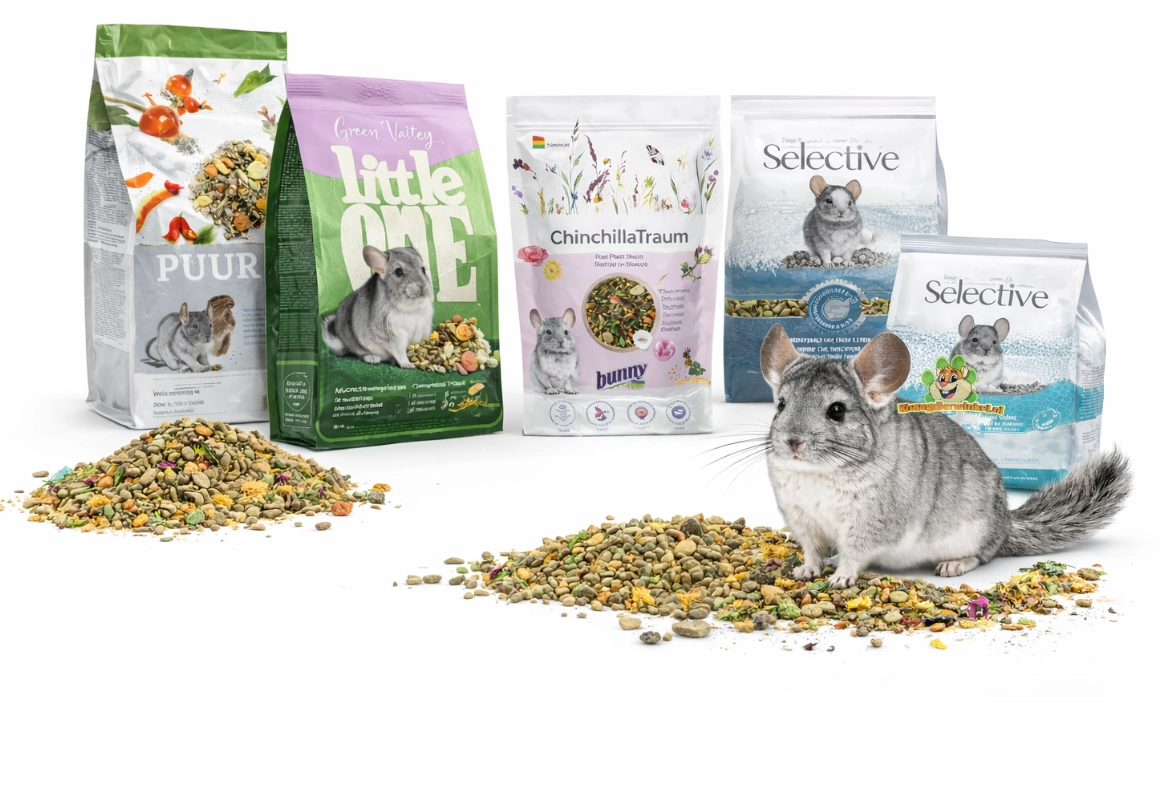
1) Basic food (pellets / complete chunks)
- Why pellets are often useful: less selective eating behaviour than with mixed muesli.
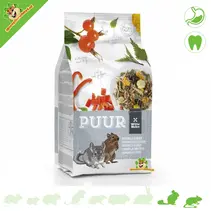
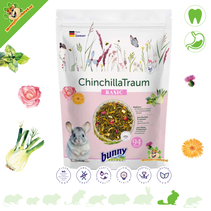
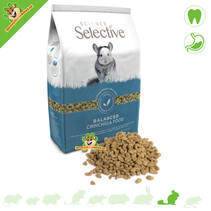
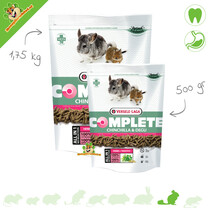
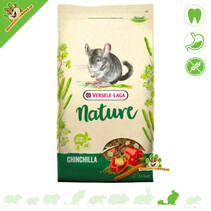
- Examples in this category: PURE Chinchilla & Degu, Bunny Nature ChinchillaDroom Basic, Supreme Selective Chinchilla, Beaphar Care+, Versele-Laga Complete, Versele-Laga Nature.
- Tip: measure out a fixed daily portion and always provide unlimited hay.
2) Grain-free & fiber-oriented
- For whom: Owners who opt for a clear composition and fibre-oriented nutrition.
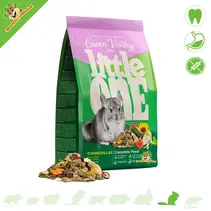
- Examples: Little One Green Valley Chinchilla Food Grain-Free, JR Farm Grainless Mix Chinchilla & Degu.
- Tip: don't just look at "grain-free", but especially at the total picture: hay + stable basic feed + small supplement.
3) Herbs, botanicals & fiber supplementation
- Think of it as enrichment: sprinkle a small amount through the hay or in a foraging area.
- Examples: Mr Crumble Chinchilla Herbs, Meadow Dream, Bunny Nature BOTANICALS (mixes), Flower & Herb Mix (if available).
- Tip: Start small, observe and build up slowly – chinchillas like routine.
4) Herb/grass pellets (additional)
- Easy to use: easy to dose and neatly serve in a feeding bowl.
- Examples: Timothy Pellets, Meadow Grass Pellets, Lucerne (Alfalfa) Pellets, Dandelion Pellets, Walnut Leaf Pellets, Thyme/Rosemary/Basil/Spinach Pellets, Hemp Pellets, Linseed Pellets.
- Tip: Pellets are a supplement; keep hay and a suitable basic feed the main role.
5) Support nutrition & recovery
- For emergencies: Force-feeding may be useful when advised by a veterinarian or if temporary support is needed.
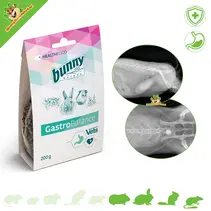
- Examples: JR Farm Force Feeding for Herbivores, Bunny Nature GoVet Health (including UroVital / Gastro Balance).
- Important: This is not a replacement for diagnosis or treatment; if your dog is not eating or is lethargic, always contact a veterinarian immediately.
Hygiene & storage
- Dry & sealed: store food airtight and dry (prevents loss of quality and vermin).
- Cool and dark: especially with herb mixes and botanicals, this helps preserve the aromas.
- Work clean: use a scoop and clean food bowls regularly.
- Always check: food should smell fresh and look dry; don't use products that smell musty or have become damp.
Safety
- Hay remains the foundation: chinchilla food is a supplement, not a replacement for unlimited hay.
- Change food gradually: build up over at least 7–14 days to protect the digestion.
- Add extras in moderation: herbs/botanicals/pellets are supplementary; introduce new products gradually.
- Observe your pet: changes in stool, appetite, or behavior are signs that you need to simplify the diet. If in doubt, consult a veterinarian.
- No medical claims: Supportive products are intended as supplements; they do not replace veterinary advice or treatment.
FAQ Chinchilla Food
What is the basic diet for a chinchilla?
Hay is the foundation and should be available in unlimited quantities. Chinchilla food (pellets/chunks) should be supplemented with an appropriate daily ration.
Are muesli mixes suitable?
Many chinchillas select for mixed feed. Therefore, many owners prefer pellets/complete kibble, which provides a more stable composition.
How often can I give herbs or botanicals?
Think of it as enrichment: small amounts and gradually increase the intake. Hay and basic feed remain the primary ingredients.
How do I switch to a different chinchilla food?
Gradually mix the new food into the old, building up over 7–14 days. Observe appetite and stool quality.
When is force-feeding or support feeding necessary?
Force-feeding and support products are intended for situations where additional support is needed, preferably in consultation with a veterinarian. If your chinchilla isn't eating, always contact them immediately.
✔ Fiber-oriented and species-appropriate – selected by specialists
✔ Basic food + enrichment: everything clearly presented in one category
✔ Specialist since 2011 – fast delivery from our own stock