 Polski




Have a question?
Have a question about this product? Please feel free to contact us, we will be happy to help you!

Have a question about this product? Please feel free to contact us, we will be happy to help you!
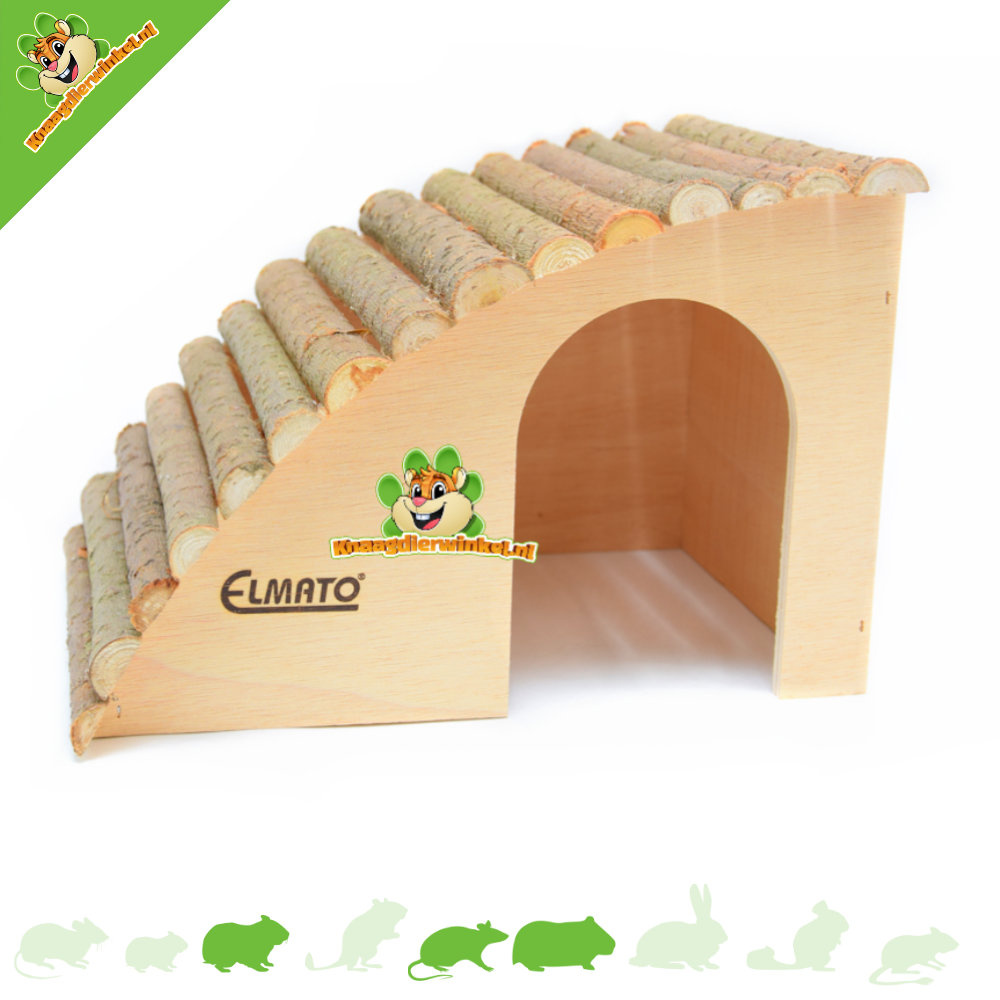
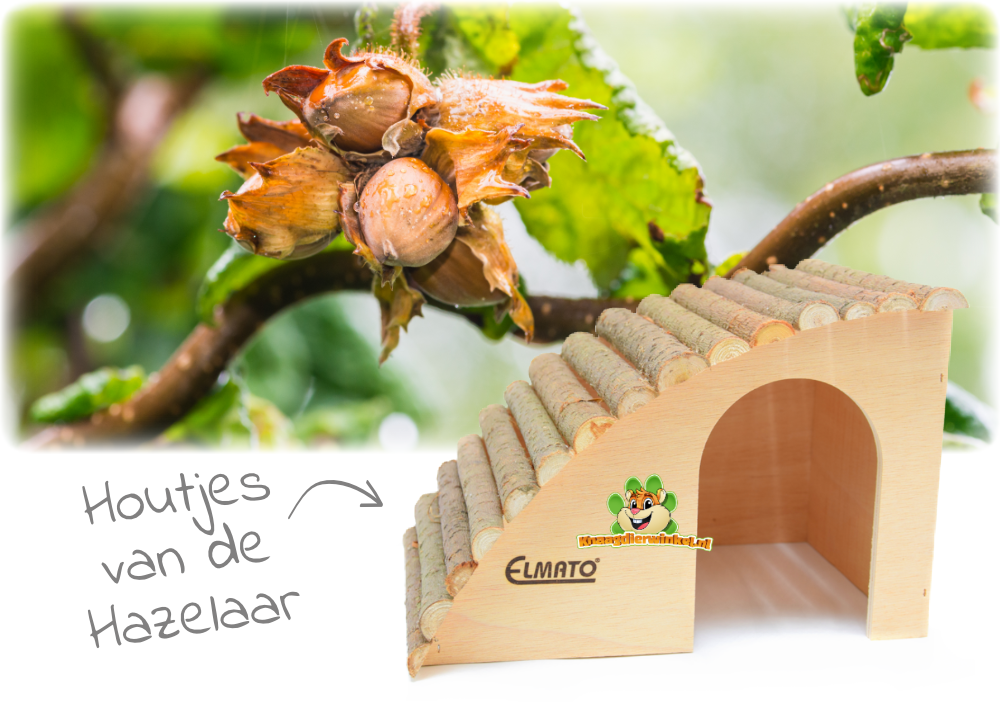
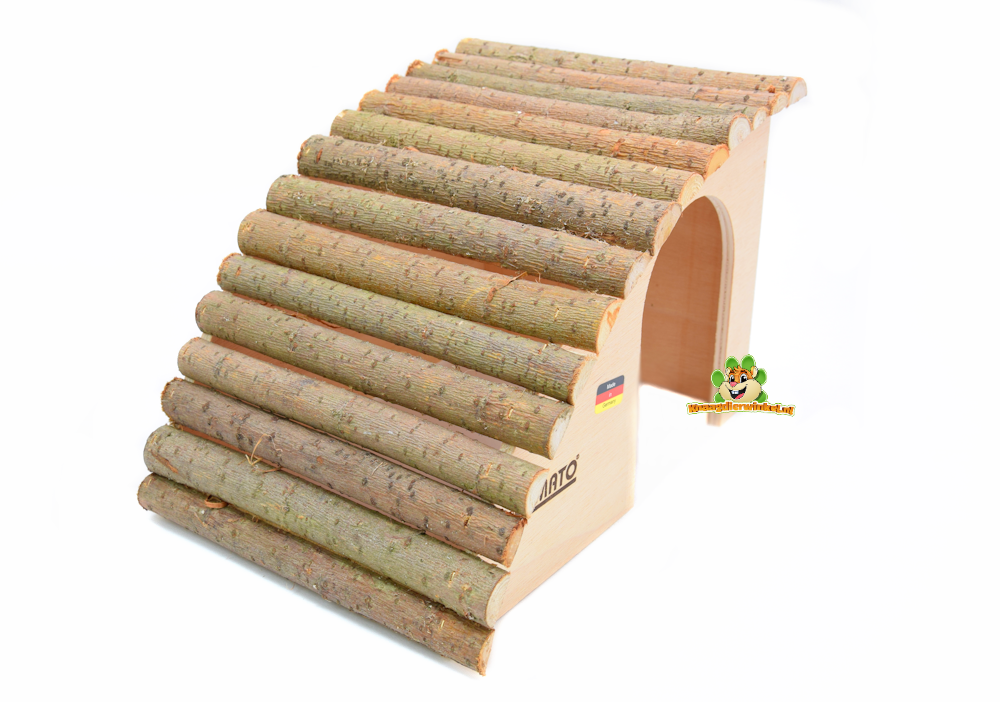
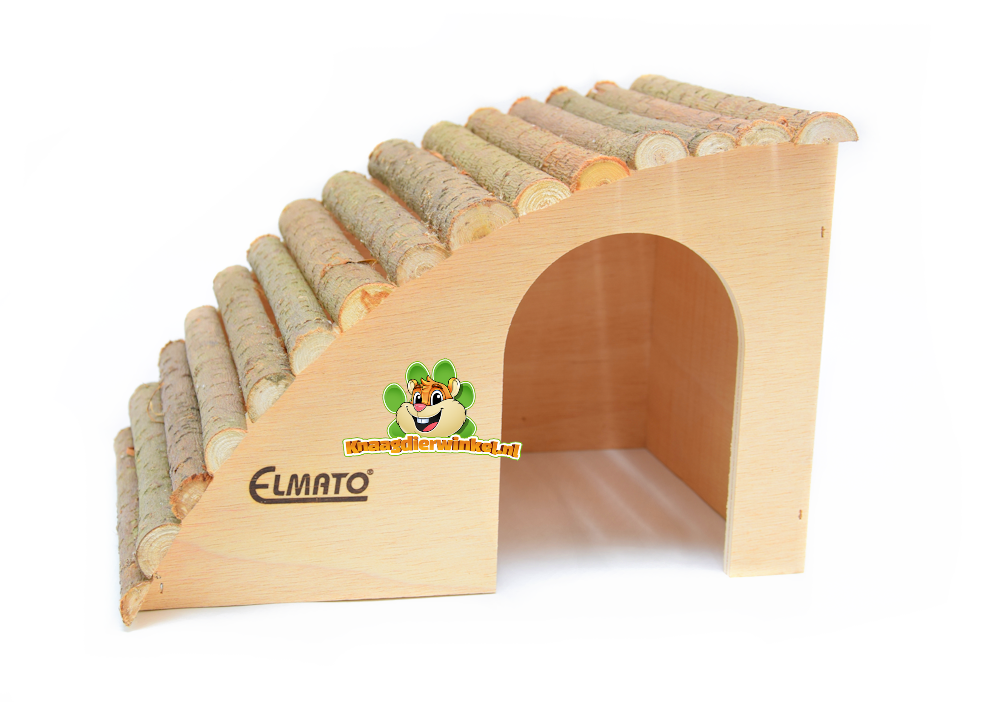
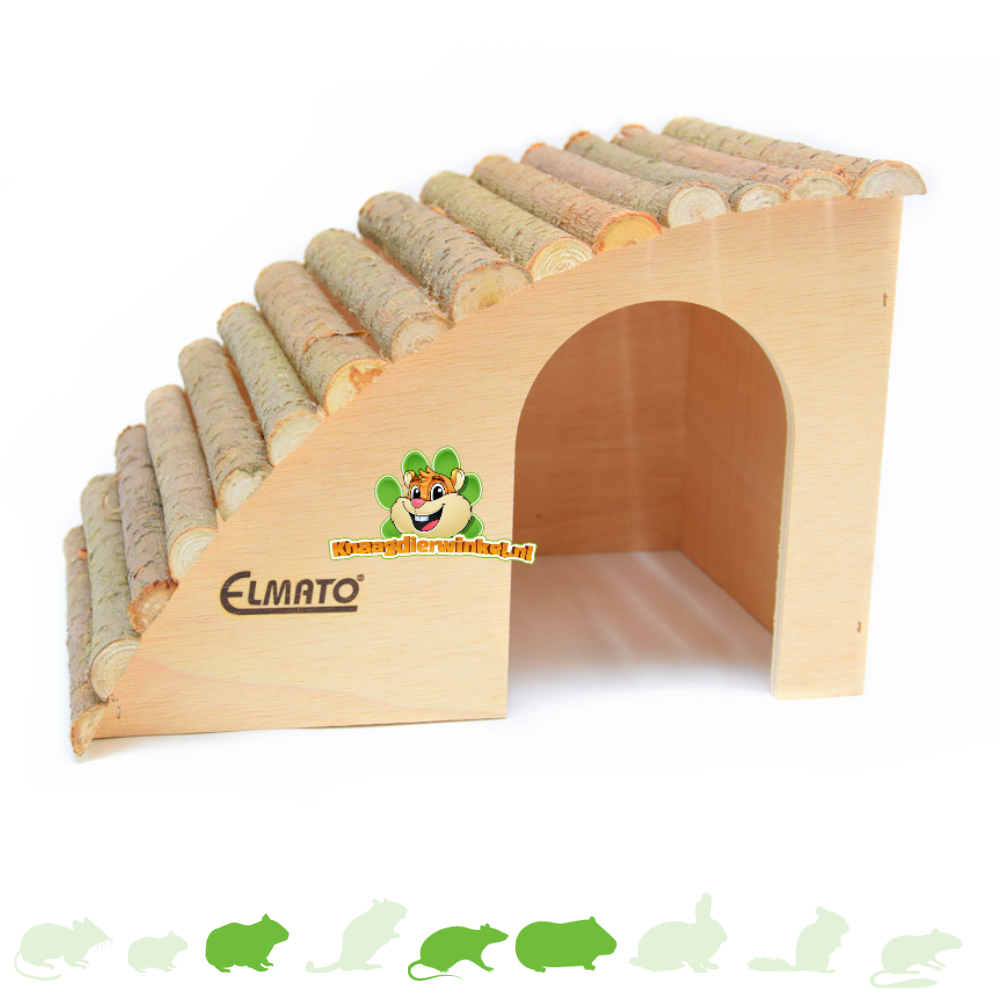
The Slanted Rodent Villa 29.5 cm is a spacious wooden house with an open base and a slanted branch roof. Thanks to the flattened back, you can place the house neatly against the wall of the enclosure, while still providing your animal with a sheltered sleeping spot. Additionally, the slanted roof offers an extra route or step, for example towards a higher platform in a rat enclosure.
For larger groups of rats, this is a very nice house: spacious enough to sleep in together and interesting to clamber over. For guinea pigs, it is a nice sheltered sleeping spot. Guinea pigs usually won't use the sloping roof as a ladder, as they aren't climbers, but the house itself fits well as a quiet resting and hiding place in the enclosure.
For hamsters, this house is gigantic. However, in a spacious hamsterscape, it can actually look very beautiful when you partially bury it in the bedding. This creates a large underground burrow, while the sloping roof remains visible above the ground as a runway or a natural transition to a higher area of the enclosure.
Product: spacious wooden house with a sloping branch roof
Dimensions: approx. 29.5 × 20 × 20 cm
Openings: approx. 10 × 15 cm
Material: plywood with natural branch roof
Bottom: open bottom
Especially suitable for: rats and guinea pigs
Also fun for: hamsters as a large buried cave
Less suitable for: gerbils, degus, and chinchillas due to the type of wood and intensive gnawing behavior; just too small for rabbits
✔ Spacious wooden house for rats and guinea pigs
✔ Open bottom, convenient for use on bedding
✔ A sloping branch canopy can serve as a climbing route or stepping stone for rats
✔ Nice for hamsters as a large buried cave
✔ Flattened back, allowing the house to be placed neatly against the wall
This house is particularly interesting if you are looking for a sheltered sleeping spot that also adds something to the interior. The slanted shape makes the house less massive than a standard log cabin and immediately provides a natural route upwards. Rats, in particular, can make good use of this, as they enjoy climbing, following routes, and using different levels.
At DRD, when it comes to houses, we look not only at the name of the animal species, but primarily at size, accessibility, material, and use. This villa is spacious for rats, practical for guinea pigs, and impressively large for hamsters. For true rodents such as gerbils, degus, and chinchillas, the type of wood is less optimal, as these animals often process wood much more intensively.
For a larger group of rats, this wooden villa is a great choice. Rats like to sleep together and often seek out sheltered spots where multiple animals can lie down. Thanks to its spacious shape, rats can use this house as a group home, resting place, and hiding place.
The sloping roof makes the house particularly useful in a rat setup. For example, you can place the house under or next to a raised platform, so that the roof acts as a step or route upwards. Combine it with tunnels, hammocks, platforms, foraging areas, and natural materials for a varied Ratscaping arrangement.
For guinea pigs, this rodent villa is particularly interesting as a sleeping house. The shape provides shelter, and the open bottom allows you to place the house directly on soft bedding. Guinea pigs can lie down quietly inside, retreat, and sit out of sight for a while.
The sloping roof is less functional for guinea pigs than for rats. Guinea pigs are not climbers and will usually not actively use the roof as a ladder. That is not a problem: for guinea pigs, the strength of this house lies primarily in the sheltered resting area and its quiet placement within the enclosure.
This villa is very large for hamsters. As a result, it may take up too much space in a standard hamster enclosure. However, in a spacious hamsterscape, it can work beautifully as a large, buried house. Thanks to the open bottom, you can place the house stably on the base and build up the bedding around it.
When you partially bury the house, a large hollow is created beneath the ground cover. The sloping roof then remains visible above the ground and can serve as a walkway, natural transition, or stepping stone towards a higher plateau. In this way, the house does not become just a standalone object, but a true part of the scape.
Always place the house low and stable. For rats, you can use the house as part of a route, for example towards a platform. In that case, check that the house cannot slide when multiple rats are walking on the roof at the same time.
For hamsters and dwarf hamsters, it is best to place the house directly on the bottom of the enclosure. Then, build up the bedding around it. This prevents the house from sinking if your animal digs underneath it. For guinea pigs, simply place the house low on the floor, with sufficient space around the entrance.
| Usage | Practical tip |
| Rat house | Use as a spacious group house and optionally position the sloping roof towards a higher plateau. |
| Guinea pig house | Use low to the ground as a sheltered sleeping house with free space around the entrance. |
| Hamsterscaping | Partially bury the house so that a large hollow is created and the roof remains visible as a route or transition. |
| Mouse enclosure | Use only in a spacious enclosure as a large group house or natural scaping element. |
The open bottom makes this house easy to incorporate into bedding. For rats and guinea pigs, this means the house can stand directly on their normal bedding. For hamsters, you can use the open bottom to create a large burrow that blends in with the rest of the hamsterscape.
Do check regularly that the house remains clean and dry. Animals that use the house as a permanent sleeping or toilet area can soil the floor more quickly. In that case, it is important to keep the area under and around the house well maintained.
You can clean the wood with a dry brush or a slightly damp cloth. Allow the house to dry thoroughly before putting it back. Because wood can absorb moisture, it is advisable to remove urine stains quickly and not leave the house wet for extended periods.
Regularly inspect the house for rodent damage, splinters, loose twigs, loose parts, and wear. Replace the house when it is no longer stable, develops sharp edges, or can no longer be kept clean properly.
Material: plywood with a natural branch roof.
Dimensions: approx. 29.5 × 20 × 20 cm.
Openings: approx. 10 × 15 cm.
Bottom: open bottom.
Use: sleeping shelter, group house, hiding place, route, stepping stone and scavenger hunt element.
This house is spacious for rats, nice for guinea pigs, and very large for small rodents. It is just a bit too small for rabbits. The type of wood is less optimal for gerbils, chinchillas, and degus, because these animals are true gnawers and will likely damage the house more intensively.
Offer the Slanted Rodent Villa under supervision and check regularly for wear and tear. Remove the house if sharp edges, loose parts, or unstable sections develop.
You use the house as a sleeping house, shelter, group home, route, or scaving element. For rats, it is a spacious house to sleep in together and climb over. For guinea pigs, it is primarily a sheltered sleeping house.
Yes, this house is very suitable for larger groups of rats. Rats can sleep in it together and use the sloping roof as a climbing route or stepping stone to a higher platform.
Yes, this is a nice sheltered sleeping house for guinea pigs. Guinea pigs usually won't use the roof as stairs, but the house itself is nice as a quiet resting place.
For hamsters, the house is gigantic. In a spacious hamsterscape, you can partially bury it so that a large burrow is created and the sloping roof remains visible above the ground as a runway.
Not as the first choice. Gerbils are true gnawers, and the type of wood is less than optimal for these animals. It is better to choose a house that is better suited for intensive gnawing and digging.
No, this house is just a bit too small for rabbits. For rabbits, you would prefer a larger house or a more spacious hiding place.
Not as a first choice. Chinchillas and degus are true gnawers, and the type of wood is less than optimal for these animals.
Yes, the house has an open bottom. This allows you to place it on bedding or partially bury it in a hamsterscape.
For rats, the sloping roof can be used effectively as a climbing route or a stepping stone to a higher platform. For guinea pigs, the roof is primarily part of the shape, as guinea pigs are not climbers.
Clean the house with a dry brush or slightly damp cloth and let it dry thoroughly. In case of heavy soiling, urine stains, or damage, replacement is often the best choice.
The Slanted Rodent Villa 29.5 cm is an especially nice choice for rats and guinea pigs. Rats get a spacious group house with a slanted climbing route, while guinea pigs get a sheltered sleeping area. For hamsters, the house can become an impressive buried burrow in a spacious scape, with a natural roof above the floor.

| Dimensions (approx): | 29,5 x 20 x 20 cm |
| Openings (approx): | 10 x 15 cm |
| Material: | plywood |
| Open Bottom: | Yes |
| Suitable for: | Rodents, Rat, Guinea Pig |
| Particularities: | - |
| Safety Information: | Offer only under supervision. Check regularly for wear and tear |
ik heb deze gehaald voor mijn ratjes maar ik had de maat compleet verkeerd ingeschat. hij is enorm dus onhandig is een wat kleinere kooi. wel is de kwaliteit super goed en hebben ze er plezier van
ik heb deze gehaald voor mijn ratjes maar ik had de maat compleet verkeerd ingeschat. hij is enorm dus onhandig is een wat kleinere kooi. wel is de kwaliteit super goed en hebben ze er plezier van
Mijn chinchillas zijn er gek op, Bovenop springen, als slaaphuisje, er aan knabbelen, ze gebruiken het super goed!,,,,,,
Super mijn chins gebruiken het om lekker in te slapen en ook bovenop p alles te kunnen bekijken sipper sipper echt een aanrader!!!!!!!!