 Polski


Taming a guinea pig – building trust without forcing it
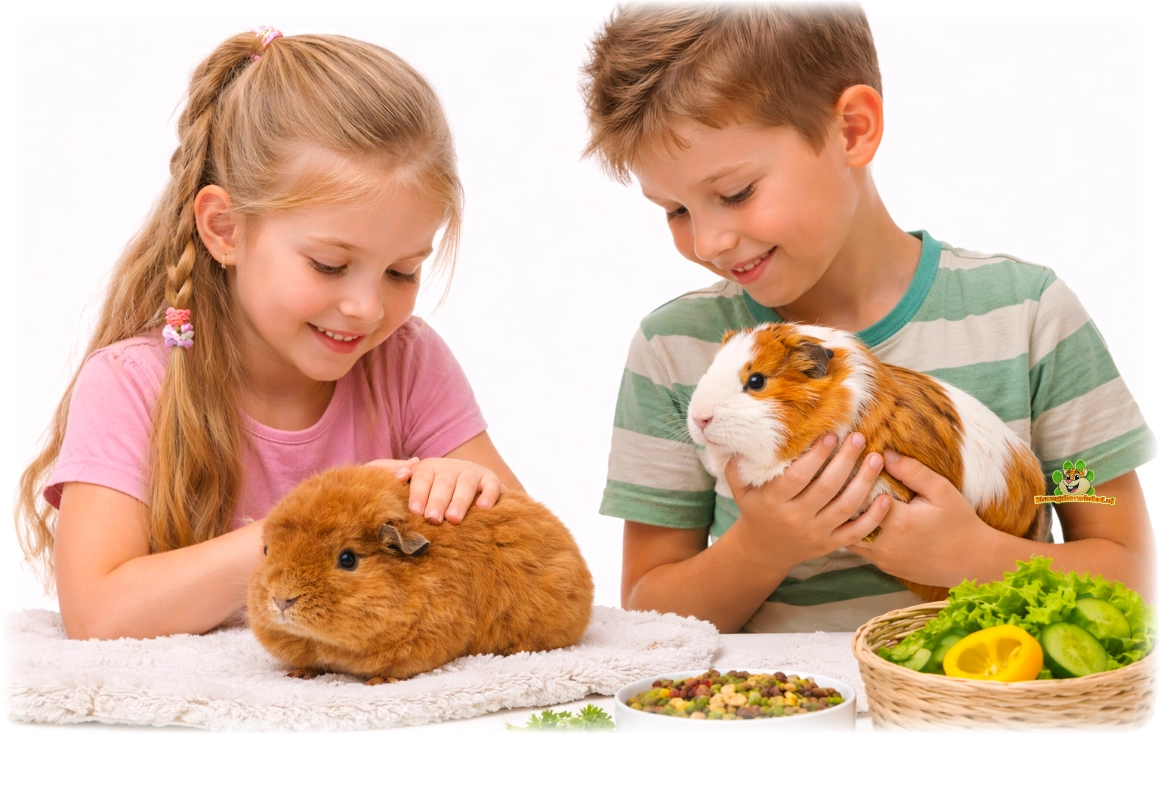 Taming a guinea pig primarily means: your guinea pig learns that you are a predictable, calm, and pleasant presence. Guinea pigs are prey animals. They can be startled by sudden movements, loud noises, and hands suddenly coming from above. Therefore, taming does not start with picking them up frequently, but with building trust in and around their enclosure.
On this page, you will read how to calmly acclimate a guinea pig, how to build bonding, when to pick them up and when not to, how children can interact safely with guinea pigs, and how to better read body language. A well-furnished enclosure, sufficient guinea pig houses , tunnels , hay, fixed routines, and small rewards all help with this.
At DRD Knaagdierwinkel®, we approach taming from the animal's perspective. A guinea pig doesn't need to become a cuddly pet to be trusted. Many guinea pigs actually relax when they are allowed to choose for themselves whether to come closer. This way, you build a bond that is more pleasant for your guinea pig and calmer for you. Specialist since 2011.
Quick links:
Answer First | Building Trust | Step-by-Step Plan | Reading Guinea Pig Language | Picking Up Safely | Children and Guinea Pigs | Common Mistakes | Checklist | FAQ
Answer first: how do you tame a guinea pig?
You tame a guinea pig through calm, repetition, and predictability. It is better to sit quietly by the enclosure daily than to constantly pick up your guinea pig. Let your guinea pig come closer on its own, use small rewards, and build contact step by step.
✔ Start with an enclosure where your guinea pig feels safe.
✔ Approach your guinea pig calmly, preferably from the front and not unexpectedly from above.
✔ Use fixed routines, such as refilling hay, speaking softly, and small rewards.
✔ Preferably make contact on the floor, so that your guinea pig can choose its own distance.
Only lift when necessary and always support both the chest and the hindquarters.
Trust begins during the stay
A guinea pig that feels safe is more likely to explore. That is why taming doesn't start with your hands, but with the environment. A spacious enclosure with hiding places, open routes, hay, and quiet spots gives your guinea pig more control. Control breeds confidence.
Do not remove hiding places to make your guinea pig “tame faster.” That often has the opposite effect. A guinea pig that can hide is usually more likely to come out, because it knows it can retreat if things get scary.
✔ Provide multiple hiding places, preferably with two exits.
✔ Keep walking routes clear so your guinea pig doesn't get stuck.
✔ Place hay, water, and feed low and within easy reach.
✔ Place the enclosure in a quiet spot without much unexpected movement.
Use fixed routines so that your guinea pig learns to predict what will happen.
Guinea pig cage → | Guinea pig runs and enclosures → | Guinea pig houses → | Guinea pig tunnels →
Step-by-step plan: taming a guinea pig at a guinea pig's pace
Every guinea pig is different. One guinea pig may come exploring quickly, while another needs weeks. Therefore, do not use this step-by-step plan as a rigid schedule, but as a ladder of trust. Only move on to the next step when your guinea pig remains relaxed during the previous step.
Step 1 – First get used to the house, sounds, and routine
Allow your guinea pig to get used to the enclosure, the smells, sounds, and fixed grooming times quietly for the first few days. Speak softly when giving hay or food.
Step 2 – Sit quietly by the enclosure
Sit quietly next to the enclosure at set times. Do not use your hands yet. Your guinea pig first learns that your presence does not mean pressure.
Step 3 – Put down something tasty
Place a small piece of vegetable, herb, or snack down and gently withdraw your hand. This way, your guinea pig associates your presence with something pleasant, without having to eat directly from your hand.
Step 4 – Eating from your hand
If your guinea pig remains relaxed, you can offer something from your hand. Keep your hand low and still. Let your guinea pig choose whether to come.
Step 5 – Briefly touch, only if your guinea pig remains relaxed
Start with a short, gentle touch. Stop before your guinea pig ducks away, stiffens, or shows clear signs of tension. Short and pleasant is better than long and too much.
Step 6 – Contact on the floor
Preferably sit on the floor in a safe run or enclosed area. This way, your guinea pig can come closer, sniff, and then step back.
Step 7 – Pick up only when necessary
Lifting is sometimes necessary for checking, grooming, or moving. Do this calmly, briefly, and with proper support. Do not make picking up the most important part of taming.
Guinea pig snacks → | Guinea pig herbs → | Snuffle mats → | Guinea pig play and foraging →
Reading guinea pig language during taming
Taming is more successful when you observe what your guinea pig is showing. Sitting still does not automatically mean that a guinea pig is relaxed. Some guinea pigs actually freeze when they are scared. Therefore, pay attention to the whole picture: eyes, posture, breathing, movement, sounds, and whether your guinea pig still wants to eat.
| Signal | What could it mean? | What are you doing? |
|---|---|---|
| Curious sniffing | Your guinea pig explores calmly. | Stay calm and let your guinea pig choose for itself. |
| Eating out of hand | Trust is developing | Keep it short and positive |
| Duck or dart away | Your guinea pig gets startled or finds it too exciting. | Step back and take a step back |
| Stiffen or stay very still | Could be tension or freezing | Do not force touching or lifting |
| Chattering teeth, pushing head away, or snapping | Clear boundary or rising tension | Stop immediately and allow rest |
More about guinea pig language → | Pairing guinea pigs →
Safely picking up a guinea pig: when and how?
Picking up is sometimes necessary, for example for weighing, checking nails, grooming, a health check, or moving to a transport box. But lifting doesn't have to be a daily cuddle moment. Many guinea pigs feel more comfortable with solid ground under their feet.
Do you need to pick up your guinea pig? Do this calmly and carefully. Approach your guinea pig from the front or the side, keep your hands in view, and always support the entire body.
This is how you pick up a guinea pig
✔ Approach calmly and avoid suddenly reaching from above.
✔ Use two hands: one hand supports the chest/forebody, the other hand supports the hindbody.
✔ Keep your guinea pig close to your body so that it cannot fall.
✔ Place your guinea pig on a surface with grip, such as a rug or towel.
Keep picking them up short and calm, especially with frightened or young guinea pigs.
Guinea pig transport box → | Guinea pig care → | Guinea pig nail trimming →
Children and guinea pigs: learning calm contact
Guinea pigs can be great fun for children to watch, feed, and handle gently. Nevertheless, supervision remains important. A guinea pig is fragile and can be seriously injured if it falls or gets startled while being held.
Teach children that a guinea pig is not a toy and that contact on the floor is often more pleasant than picking it up. For example, have a child sit quietly on the floor with a rug, while the guinea pig is allowed to come and sniff around on its own. This way, the guinea pig has a choice and the child learns to observe its behavior more closely.
✔ Let children talk quietly and move slowly.
✔ Do not let children chase guinea pigs in the enclosure.
✔ Contact on the floor is often better than holding on your lap.
✔ Pick up only under supervision and with two hands.
Stop when the guinea pig wants to get away, stiffens, chatters its teeth, or tries to flee.
Common mistakes when taming guinea pigs
Many guinea pigs do not become more fearful due to a lack of attention, but due to attention that is too quick, too direct, or too unpredictable. These are pitfalls you would rather avoid:
✔ Remove hiding places to tame your guinea pig “faster”.
✔ Pick up your guinea pig daily while he is still scared.
✔ Grab from above without warning.
✔ Confusing stiffening with relaxed cuddling.
✔ Let children be picked up without supervision.
Continuing for too long while your guinea pig already wants to leave or is showing signs of tension.
Smartly combining taming guinea pigs with enrichment
Taming becomes easier when your guinea pig has positive experiences. Small pieces of vegetables, herbs, hay, sniffing mats, or quiet foraging spots can help. Do not use rewards to lure your guinea pig and then suddenly grab it, but to build trust.
With multiple guinea pigs, it is nice to distribute the rewards. This prevents congestion around one hand or one bowl. For example, mix some herbs into the hay, use a snuffle mat, or offer small pieces in multiple places.
Guinea pig hay → | Guinea pig hay racks → | Guinea pig food bowls → | Guinea pig cushions and baskets →
DRD's choice: taming is trust, not a trick
At DRD, we view taming not as “making a guinea pig do what we want,” but as building trust. A guinea pig that dares to come and investigate on its own, eats calmly while you are nearby, and is less startled by daily care has already learned a great deal.
The strength lies in predictability: fixed routines, calm hands, contact on the floor, clear boundaries, and paying close attention to guinea pig language.
Checklist – taming a guinea pig
✔ Does your guinea pig have enough hiding places and open routes?
✔ Do you approach your guinea pig calmly, predictably, and not suddenly from above?
✔ Build your connection step by step, without forcing it?
✔ Do you use small rewards without unexpectedly grabbing your guinea pig afterwards?
✔ Do you make contact on the floor whenever possible?
✔ Do you only lift when necessary and support both your chest and lower body?
Do you stop when your guinea pig wants to get away, stiffens, chatters its teeth, or shows signs of tension?
Good to know
Not every guinea pig becomes a cuddly guinea pig, and that is normal. Trust can also mean that your guinea pig calmly comes to look at you, eats from your hand, is less easily startled, or remains relaxed during grooming.
Would you like to read up on general background information about handling guinea pigs? Then also check out the LICG guinea pig information at licg.nl.
FAQ – frequently asked questions about taming guinea pigs
How do you tame a guinea pig?
Tame your guinea pig with patience, routine, and small steps. Sit quietly by the enclosure, offer small rewards, let your guinea pig come closer on its own, and do not force contact.
How long does it take for a guinea pig to become tame?
That varies from guinea pig to guinea pig. Some guinea pigs adapt quickly, while others need weeks or longer. Age, temperament, previous experiences, living environment, and your routine all play a role.
Do you have to pick up a guinea pig often to tame it?
No, picking them up often is not the best foundation. Many guinea pigs find being lifted frightening. It is better to build trust with calm, predictability, contact on the floor, and positive experiences.
Why does my guinea pig run away when I try to catch him?
Guinea pigs are prey animals and can be startled by hands, especially when they come from above. Approach calmly, let your hands come into view, and give your guinea pig time to get used to it.
How do you pick up a guinea pig properly?
Use two hands: one hand supports the chest and forebody, the other hand supports the hindquarters. Hold your guinea pig close to your body and place it down on a surface with grip.
Does a guinea pig like to sit on your lap?
Not every guinea pig likes that. Contact on the floor is often nicer, because your guinea pig can choose whether to come closer or keep its distance.
Can you tame a scared guinea pig?
Yes, you can often build a fearful guinea pig's confidence with rest, predictable routines, plenty of hiding places, and small steps. Do not force touching or picking it up.
Do you have to remove hiding places to tame a guinea pig?
No, hiding places actually provide security. A guinea pig that can hide is often more likely to explore because it knows it can return to a safe place.
How do children learn to handle guinea pigs properly?
Let children talk quietly, move slowly, and preferably make contact on the floor. Pick them up only with supervision and always with full body support.
What do you combine with taming guinea pigs?
Combine taming with a spacious enclosure, houses, tunnels, hay, herbs, small snacks, snuffle mats, food bowls, and calm daily care.
✔ Tame a guinea pig with calm, routine, rewarding, guinea pig language, and picking it up safely
✔ Practical tips for trust, contact on the floor, children, and daily care
✔ Specialist since 2011, delivered from our own stock
Ordered before 17:00, shipped the same day | Delivered from own stock | Specialist since 2011
