 Polski

Rabbit tunnels: play and hiding tunnels for rabbits



- Voor 17 uur besteld, dezelfde dag verzonden!
- Rodent specialist since 2011
- Dispatched from our own stock

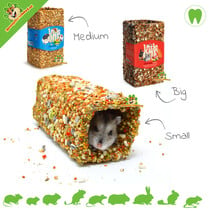
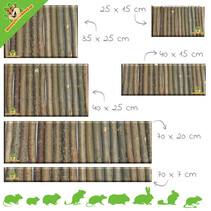

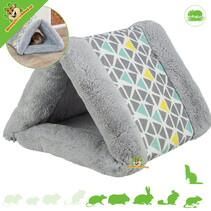
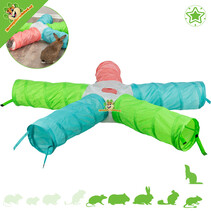

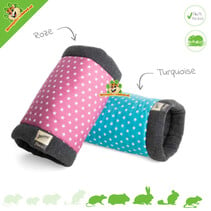
Buy rabbit tunnels – play and hiding tunnels for rabbits
 A rabbit tunnel provides your rabbits with a fun and useful place to walk through, shelter, play, and create routes within their enclosure. Rabbits enjoy moving along edges, under cover, and through recognizable passages. With a tunnel, you instantly make a rabbit room , run, or outdoor enclosure more interesting and logically laid out.
At DRD Knaagdierwinkel®, you will find various tunnels for rabbits: fabric play tunnels, fleece tunnels, plush tunnels, T-tunnels, natural tunnels, willow bridges that can be used as tunnels or passageways, and enriching tunnels with extra play or foraging functions. Always choose a tunnel that suits the size of your rabbits, the available space, and how you want to arrange the enclosure.
✓ In short: rabbit tunnels provide movement, shelter, route formation, and enrichment in the enclosure.
✓ For indoors, fleece, plush, and fabric tunnels are popular; for outdoors, pay extra attention to material, moisture, stability, and cleaning.
✓ Choose a tunnel with sufficient diameter so that your rabbits can pass through it comfortably without getting stuck.
Quick links:
Why a tunnel? · What can you find here? · Which tunnel fits? · Materials · Indoor or outdoor · Installation · Combining · Maintenance · Useful shopping routes · FAQ
Movement & routes
A tunnel makes walking routes more fun and gives your rabbits a reason to move actively through the room.
Shelter & rest
Rabbits often use tunnels as a sheltered passage or short resting place, especially in open runs or rooms.
Enrichment
A tunnel makes the stay more interesting without having to fill the entire walkway.
Why use a rabbit tunnel?
Rabbits are curious animals that enjoy moving, exploring, and seeking shelter. A tunnel aligns well with this behavior. Your rabbits can walk through it, take shelter inside, move around it, and use the tunnel as part of a regular route in the run or room.
A tunnel is especially valuable in an open space. In a rabbit room or run, an empty floor can be somewhat intimidating or boring for rabbits. By cleverly placing tunnels, houses, and sheltered spots, you make the space safer, more interesting, and better divided into zones.
A rabbit tunnel helps with
✓ More movement and activity in the enclosure.
✓ Create sheltered routes along edges or between zones.
✓ Make open spaces less bare and tense.
✓ Encourage hiding, playing, sniffing, and discovering.
✓ Logically connect shelters, resting areas, and foraging areas.
What can you find in this Rabbit Tunnels category?
This category contains various types of tunnels for rabbits. Some tunnels are soft and comfortable for indoors, while others are playful, foldable, natural, or suitable as part of a larger route. For each tunnel, pay close attention to diameter, length, material, stability, and ease of cleaning.
Assortment in this category
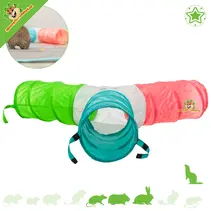
✓ Fabric play tunnels: lightweight tunnels for movement, play, and route building in the run or room.
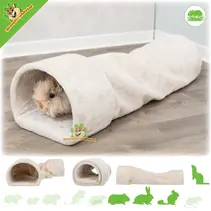
✓ Fleece and plush tunnels: soft tunnels for dry indoor spaces and rabbit rooms.
✓ T-tunnels and tunnels with a split: extra fun for rabbits who like to choose, turn, and use multiple routes.
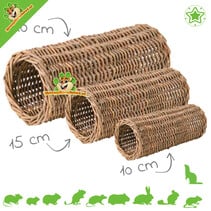
✓ Natural tunnels: tunnels made of natural materials that can also serve as a hiding place or chewable enrichment.
✓ Snack and foraging tunnels: tunnels where searching, nibbling, or exploring is combined with enrichment.
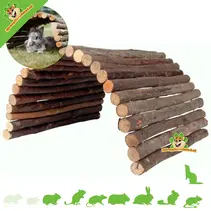
✓ Bridges and flexible elements: some products can be used as a bridge, tunnel, passageway, or sheltered route.
Which rabbit tunnel suits your rabbits?
The best rabbit tunnel suits the size of your rabbits and the location where you use it. Your rabbits must be able to walk through it comfortably without getting stuck. For larger rabbits, the diameter is particularly important. For multiple rabbits, it is preferable if the tunnel is not the only passage or hiding place.
Additionally, consider the intended use. Do you want a soft indoor tunnel, a playful tunnel for exercise, a natural tunnel to gnaw on, or a tunnel that creates routes between the house, toilet, hay corner, and resting area? By determining the function first, you can make a much more targeted choice.
Pay attention to when choosing
✓ Is the diameter large enough for your rabbits?
✓ Does the length fit the space in the run or room?
✓ Is the material suitable for indoors, outdoors, or a sheltered spot?
✓ Does the tunnel remain stable when your rabbits walk through it?
✓ Can you properly inspect and keep the tunnel clean?
✓ Does the tunnel match the rest of the furnishings, such as houses, ground mats, and hay corner?
Fabrics, fleece, plush and natural tunnels
The material determines where and how you use the tunnel. Fabric tunnels are often lightweight and flexible. Fleece and plush tunnels are soft and especially suitable for dry indoor spaces. Natural tunnels fit nicely into a natural interior and can be extra interesting for sniffing or gnawing.
Regularly check soft tunnels for loose threads, wet spots, and gnaw marks. Check natural tunnels for breakage, sharp pieces, or heavy soiling. A tunnel is intended as enrichment, but remains a product that requires daily monitoring.
Fabric tunnels
Lightweight, playful, and often easy to move. Handy for indoor runs, rabbit rooms, and temporary play setups.
Fleece and plush tunnels
Soft and comfortable for dry indoor areas. Especially suitable if your rabbits leave the material clean.
Natural tunnels
Made from natural materials such as willow, grass, or hay. Great as a hiding place, route, and chewable enrichment.
Tunnels with a split
Tunnels with multiple exits provide extra freedom of choice and make the route more interesting for your rabbits.
Rabbit tunnels for indoors and outdoors
For indoor use, you can use rabbit tunnels in a rabbit room, indoor run, or C&C setup. Pay particular attention to grip around the tunnel, sufficient free movement space, and ensuring the tunnel does not shift. Soft tunnels are usually most suitable for dry indoor areas.
Outdoors, use tunnels primarily in sheltered and dry areas. Not every material is suitable for prolonged outdoor use. Check outdoors for moisture, mold, dirt, wind, and wear. A tunnel in an outdoor run is enrichment, but not a substitute for a dry night shelter or safe hiding place.
For indoors
✓ Suitable for rabbit room, indoor run, and C&C enclosure.
✓ Combine with ground mats, houses, and foraging areas.
✓ Check soft tunnels for moisture, hair, loose threads, and chewing damage.
For outdoors
✓ Use tunnels outdoors, especially in dry and sheltered conditions.
✓ Check for moisture, dirt, mold, and wear.
✓ Bring non-weather-resistant materials indoors in time.
Read more: Keeping rabbits indoors · Keeping rabbits outdoors · Furnishing a rabbit room
Place rabbit tunnel in the enclosure
The location of the tunnel determines how much your rabbits use it. It is better not to place a tunnel randomly in the middle of the room, but rather as part of a route. Along an edge, between two houses, near a hiding place, or towards a foraging area, a tunnel is often used much more logically.
Ensure the tunnel is stable and that the openings remain clear. A tunnel should invite you to walk through it, not be in the way or block a passageway. Additionally, always leave sufficient free space to move around, especially with larger rabbits or a pair of rabbits.
Practical placement
✓ Place the tunnel along an edge or as a connection between zones.
✓ Ensure that both openings remain clear.
✓ Leave sufficient free walking space.
✓ Check that the tunnel does not slide or roll up too much.
✓ Combine the tunnel with houses, ground mats, and safe enrichment.
Combine rabbit tunnels with houses, foraging, and gnawing material.
A tunnel becomes even more valuable when combined with other features in the enclosure. Consider a small house at the end of the tunnel, a foraging area next to the tunnel, or gnawing material nearby. This creates a small route where your rabbits can walk, sniff, choose, and rest.
Keep the layout calm. Too many loose items can block the walking space. Therefore, use tunnels consciously: as a route, shelter, or activity, not as loose filler in the space.
Smart combination
✓ Tunnel + small house for a sheltered route.
✓ Tunnel + floor mat for grip around the passageway.
✓ Tunnel + foraging area for searching and moving.
✓ Tunnel + gnawing material for extra activity in the same zone.
✓ Tunnel + digging or sniffing box for more natural enrichment.
One tunnel or multiple tunnels?
Even a single tunnel can make a big difference to the layout, especially in a small run or rabbit room. In a larger space, multiple tunnels or a tunnel with a split can actually be fun, as they create multiple routes and passageways.
With two rabbits, it is important that a tunnel does not become the only passage where one rabbit can block the other. Multiple openings, multiple routes, or extra hiding places make the space calmer and more practical.
For rabbit couples
✓ Make sure a tunnel is spacious enough for your rabbits.
✓ Use multiple routes instead of one narrow passage.
✓ Tunnels with multiple exits are often practical.
✓ Combine tunnels with houses and open walking space.
✓ Check if both rabbits can use the tunnel calmly.
Maintenance and inspection of rabbit tunnels
A rabbit tunnel is often used intensively. Therefore, check regularly for hair, moisture, urine, droppings, gnaw marks, loose threads, sharp parts, and deformation. Fabric, fleece, and plush tunnels, in particular, require extra checking if your rabbits like to gnaw or dig.
Natural tunnels are more consumable products. They may be gnawed on, but replace them when they become too dirty, wet, sharp, or unstable. For outdoor tunnels, moisture is the most important factor to keep a close eye on.
Daily tunnel check
✓ Are the openings still clear and wide enough?
✓ Are there wet spots, urine, or strong odors?
✓ Are there loose threads, frayed edges, or sharp pieces?
✓ Is the tunnel still stable and practical?
✓ Does the tunnel still suit the size and behavior of your rabbits?
Good to know
Always use tunnels appropriate for the size of your rabbits. A tunnel must be spacious enough for them to walk through comfortably. Pay extra attention to checking soft tunnels for loose threads and natural tunnels for breakage or sharp parts.
Useful shopping routes at rabbit tunnels
A rabbit tunnel works best as part of a complete setup. Combine tunnels with houses, runs, ground mats, gnawing material, digging boxes, and foraging products.
Rabbit room
For a complete interior space with routes, tranquility, and enrichment.
Learn more about accommodation, space, and enrichment
Do you want to first determine how to logically use tunnels in a run or room? Then read our information pages on space, rabbit runs, keeping indoors, keeping outdoors, furnishing a rabbit room, and gnawing material. This way, you choose a tunnel as part of a complete living space.
How much space do rabbits need? · Choosing a rabbit run · Keeping rabbits indoors · Keeping rabbits outdoors · Furnishing a rabbit room · Chewing material for rabbits
Frequently asked questions about rabbit tunnels
Do rabbits need a tunnel?
A tunnel is not mandatory, but it is a valuable form of enrichment. Rabbits use tunnels to play, hide, create routes, and move more actively through their enclosure.
Which tunnel is suitable for rabbits?
A suitable rabbit tunnel is spacious enough, stable, easily accessible, and fits the enclosure. Pay particular attention to the diameter, length, material, and whether you can easily inspect the tunnel.
How big should a rabbit tunnel be?
The tunnel must be wide enough so that your rabbits can walk through it comfortably without getting stuck. Therefore, choose a larger diameter for larger rabbits.
Are fleece or plush tunnels suitable for rabbits?
Fleece and plush tunnels can be suitable for dry indoor areas, especially if your rabbits leave the material clean. However, do check regularly for gnaw marks, loose threads, moisture, and dirt.
Can you use a rabbit tunnel outdoors?
That depends on the material. When using outdoor tunnels, keep them dry and sheltered. Check frequently for moisture, dirt, mold, and wear, and bring materials that are not weather-resistant indoors in time.
Where do you place a tunnel in the rabbit run?
Preferably place the tunnel as part of a route, for example along an edge, between two shelters, or towards a foraging area. Always leave enough free walking space.
Are tunnels with multiple exits useful?
Yes, tunnels with multiple exits give your rabbits more choice and make a tunnel less of a dead end. That is especially nice for a pair of rabbits.
Can rabbits gnaw on tunnels?
Yes, some rabbits gnaw on tunnels. Therefore, check regularly for fraying, loose threads, sharp parts, or damage. Natural tunnels are more often intended to be gnawed on as well.
How do you combine a tunnel with other products?
Combine a tunnel with a small house, ground mat, digging box, gnawing material, or foraging area. This creates a logical route with rest, movement, and enrichment.
Rabbit tunnels at DRD Knaagdierwinkel®
At DRD Knaagdierwinkel®, you will find rabbit tunnels for various enclosures and situations: fabric play tunnels, fleece tunnels, plush tunnels, T-tunnels, natural tunnels, snack tunnels, and flexible elements that you can use as a passageway, hiding place, or part of a route.
✓ Play and hiding tunnels for rabbits conveniently grouped together
✓ Fabric, fleece, plush, natural and enriching tunnels for indoors and sheltered areas
✓ Practical to combine with houses, runs, rabbit rooms, ground mats, and foraging
✓ Selection guide for size, diameter, material, placement, maintenance, and multiple rabbits
✓ Specialist since 2011
✓ Delivered from our own stock
