 Polski

Ratscaping for beginners: how to create a natural rat enclosure
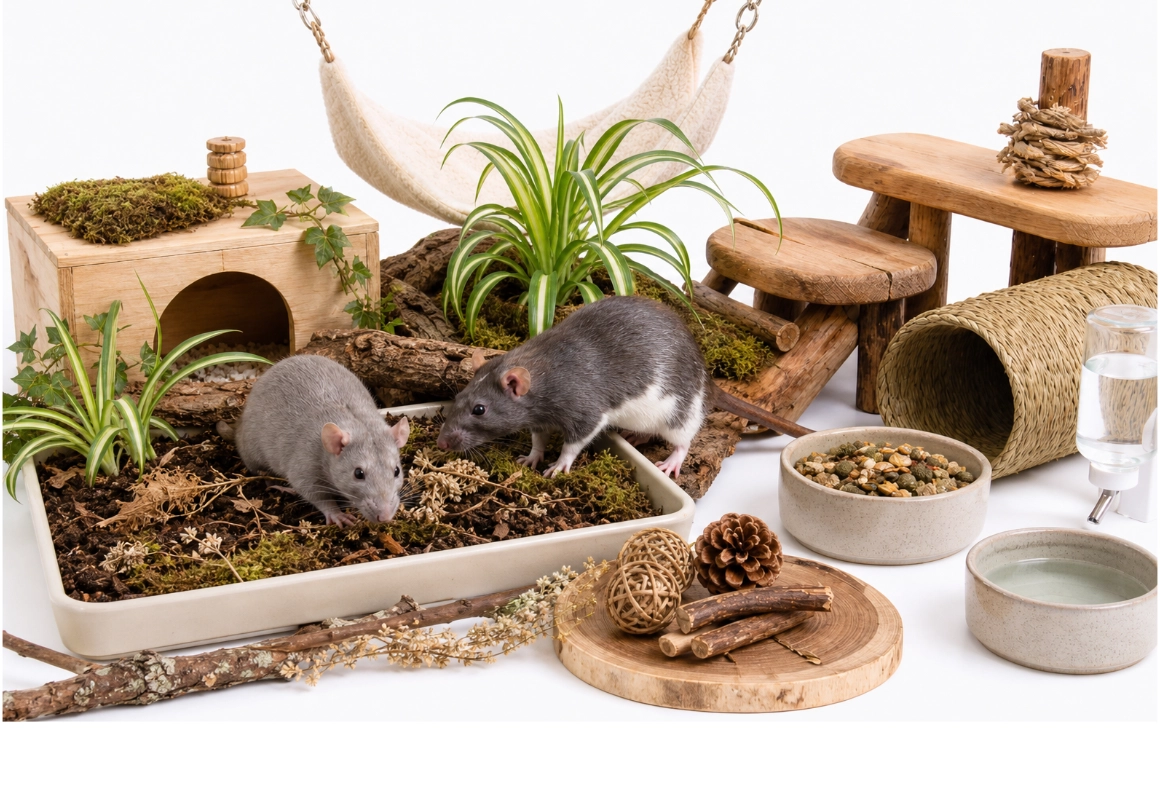 Ratscaping is the natural and behavior-oriented design of a rat enclosure. You don't just look at what looks nice, but primarily at what rats enjoy doing: climbing, sleeping, creating routes, lying together, sniffing, foraging, gnawing, destroying suitable materials, and exploring. With Ratscaping, you therefore don't make the cage more crowded, but smarter.
For pet rats, a good enclosure revolves around variety, safety, and a clear view. Rats are social, group animals with sensitive airways. Therefore, at Ratscaping, we prefer to combine low-dust bedding, safe digging zones, tunnels, hammocks, platforms, foraging products, and natural materials. A sand bath with chinchilla sand does not belong in this; rats do not need a sand bath, and fine sand can be taxing on their respiratory system.
✓ In short: Ratscaping is a way to make the rat cage more natural, challenging, and functional.
✓ Think in zones: sleeping, climbing, digging, foraging, gnawing, drinking, eating, toilet, and quiet routes.
✓ Do not use chinchilla sand or fine sand as a sand bath for rats; opt instead for low-dust bedding and rat-suitable digging materials.
Quick links:
What is Ratscaping? · How to get started? · Important zones · Choosing materials · Digging bucket · Foraging · Safety · Useful shopping routes · FAQ
More behavior
Ratscaping gives your rats more to do: climbing, searching, gnawing, making routes, and discovering together.
Smart zones
A good setup has clear areas for sleeping, the toilet, food, water, climbing, digging, and foraging.
Dust-free thinking
With rats, pay extra attention to dust, ventilation, and materials that are comfortable for sensitive airways.
What is Ratscaping?
Ratscaping means furnishing the rat cage or rat space based on the natural behavior of rats. You use the space not only to place items, but to create functions: sleeping routes, climbing routes, foraging areas, gnawing areas, digging zones, resting places, and social roosting spots.
The difference compared to “regular furnishing” lies primarily in the philosophy behind it. With Ratscaping, you constantly ask: what can my rats do with this? Can they go inside, on top of it, through it, gnaw on it, search inside, lie together, or move safely from place to place?
Ratscaping revolves around
✓ Stimulate behavior instead of just decorating.
✓ Create safe routes between different heights.
✓ Logically divide sleeping, playing, digging, foraging, and toilet zones.
✓ Offer variety without making the cage cluttered or unsafe.
✓ Choose materials that are suitable for rats and their sensitive airways.
See also: Ratscaping products · What do you need for rats?
How do you get started with Ratscaping?
Start simple. You don't have to rebuild the entire rat cage right away. First, choose a few basic features: a good base, multiple hammocks, a tunnel route, a toilet corner, a foraging area, and a safe place to gnaw or destroy. Then you can expand step by step.
Pay close attention to your own rats. Some rats climb a lot, while others enjoy shredding paper or cardboard. Some rats like to lie high up, while others prefer to forage in the substrate. A good scape grows with your group.
Beginner step-by-step plan
✓ Start with a spacious, well-ventilated rat cage.
✓ Choose low-dust bedding for the base.
✓ Create safe routes with platforms, ladders, tunnels, and hammocks.
✓ Add multiple sleeping spots and hiding places.
✓ Create a foraging spot where you can hide small rewards.
✓ Observe what your rats use and adjust the setup accordingly.
Important zones in a Ratscaping design
A good rat setup works best with zones. This prevents everything from being mixed up and keeps the cage practical to use. For example, you can create a quiet sleeping zone, a toilet zone, a feeding and drinking zone, a climbing route, a digging box, and a foraging area.
Zones do not need to be strictly separated. Rats use their enclosure flexibly. Nevertheless, it helps to consciously choose where to place wet spots, food, water, fabric hammocks, and digging material. This makes cleaning easier and keeps the setup pleasant for longer.
Sleeping zone
Hammocks, baskets, little houses, and soft resting places at multiple heights.
Route zone
Platforms, ladders, tunnels, and tubes that allow your rats to move safely through the cage.
Search zone
Foraging products, snack plates, demolition material, and small hiding places.
Excavation zone
A rat-suitable digging box with appropriate material, without fine sand or chinchilla sand.
Toilet area
A fixed location with a toilet bowl, absorbent filling, or pee-pads where convenient.
Feeding and drinking zone
An easily accessible place for a food bowl, drinking bottle, or water bowl, without wet spots on the ground.
What materials do you use for Ratscaping?
When Ratscaping, you choose materials that suit rats: sturdy enough, easy to keep clean, not unnecessarily dusty, and fit for purpose. Fabric hammocks and baskets are often nice for sleeping places. For routes, you use tunnels, tubes, platforms, and ladders. For searching and destroying, you can work with paper, cardboard, gnawing material, and foraging products intended for that purpose.
For substrates and digging areas, pay extra attention to dust. Rats have sensitive airways, so do not create a sand bath with chinchilla sand or fine sand. If you want to create a natural digging or sniffing area, use materials suitable for rats and check carefully for dust, moisture, mold, and contamination.
Materials per function
✓ Sleeping: hammocks, baskets, little houses, and soft resting places.
✓ Routes: tunnels, tubes, platforms, ladders, and safe intermediate stations.
✓ Search: snack plates, foraging toys, paper, cardboard, and hiding places.
✓ Gnawing: suitable gnawing and destructive material for rats.
✓ Soil: low-dust bedding and rat-suitable digging materials.
Excavator bucket at Ratscaping: no sand bath
A digging box can be a nice addition to Ratscaping, but it is important to distinguish between a digging box and a sand bath. Rats do not need a sand bath for grooming. Chinchilla sand and fine sand are therefore not a logical choice for rats, especially due to their sensitive airways.
You use a rat digging box primarily for enrichment: sniffing, searching, digging, and exploring. Choose a box that stands stably, does not tip over easily, and is easy to monitor. Use material suitable for rats, keep it clean, and remove wet or soiled parts promptly.
Bucket check
✓ Is the container stable and low enough?
✓ Is the material suitable for rats and not dusty?
✓ Can your rats search inside without the entire enclosure getting dirty?
✓ Do you regularly check for moisture, odor, mold, or old food residue?
✓ Do you not use chinchilla sand or fine sand as a sand bath?
See also: Rat Digging Box · Rat Bedding
Foraging in a Ratscaping cage
Foraging fits very well with Ratscaping. You don't let your rats eat everything from a single bowl, but provide small moments for them to search. This can be done with a treat plate, sniffing item, paper packet, food roll, tunnel, cardboard box, or by scattering part of the daily food portion throughout the enclosure.
Use small amounts. The goal is not to give more snacks, but to make the same food more interesting. A few kibbles, pieces of vegetables, rat-suitable snacks, or some herbs can be enough to create a foraging moment.
Foraging ideas for rats
✓ Hide part of the basic food in the cage.
✓ Use snack boards or puzzles for small rewards.
✓ Make simple packages with paper or cardboard.
✓ Place snacks at different heights or on different routes.
✓ Alternate easy and more difficult search moments.
See also: Rat Play & Foraging · Rat Snacks · Rat Food
Safety at Ratscaping
A beautiful scape must also remain safe. Rats are agile, curious, and can gnaw. Therefore, regularly check for loose strings, sharp edges, unstable parts, dirty hammocks, wet ground spots, and fall hazards. Ensure that routes are logical and that high places do not end in a hard fall.
Also pay attention to hygiene. Fabric parts, hammocks, and urine spots must be checked regularly and washed or replaced. In a busy rat cage, a nice setup can quickly become less fresh if wet spots are left behind.
Safety check for Ratscaping
✓ Are all parts securely attached or placed stably?
✓ Are there safe intermediate stations at elevation changes?
✓ Are there no loose strings, sharp edges, or broken parts?
✓ Are hammocks, tunnels, and potty areas clean enough?
✓ Is there sufficient ventilation and are you using low-dust materials?
Handy shopping routes at Ratscaping
Ratscaping works best when you combine various functions: sleeping, creating routes, bedding, digging, foraging, and hygiene. You can build the setup step by step using these routes.
Ratscaping
For natural furnishings, routes, materials, and landscaping products for rats.
Excavator bucket
For digging and sniffing zones without a sand bath or chinchilla sand.
Playing & foraging
For searching, puzzling, dismantling on suitable materials, and active snacking.
Read more about rat housing
Do you want to build up Ratscaping properly, step by step? Then also read the other rat information pages. This way, you combine a natural setup with a good foundation, suitable bedding, nutrition, hygiene, and daily care.
What do you need for rats? · Rat cage buying guide · Rat bedding buying guide · Rat food buying guide · Taming rats
Frequently asked questions about Ratscaping
What is Ratscaping?
Ratscaping is the natural and behavior-oriented design of a rat enclosure. You create zones for sleeping, climbing, routes, foraging, gnawing, digging, and resting.
Is Ratscaping suitable for beginners?
Yes, beginners in particular can get off to a good start with a simple Ratscaping basic. Begin with low-dust bedding, hammocks, tunnels, safe routes, a toilet area, and a short foraging time.
What do you need for Ratscaping?
You need a spacious rat cage, low-dust bedding, hammocks, tunnels, platforms, houses, gnawing material, foraging products, and optionally a rat-suitable digging box.
Can rats use chinchilla sand?
No, chinchilla sand and fine sand are not suitable as a sand bath for rats. Rats do not need a sand bath, and fine dust can be harsh on their sensitive airways.
Is an excavator bucket the same as a sand bath?
No, a digging box for rats is intended for sniffing, searching, and digging with suitable material. A sand bath, like for chinchillas or degus, is not part of rat care.
How do you make a rat cage more natural?
Work with multiple layers, hammocks, tunnels, platforms, hiding places, gnawing material, foraging products, and a low-dust substrate. Ensure your rats can move safely and have plenty of choice.
How often should you change Ratscaping?
You don't need to change everything constantly. Small changes in foraging spots, tunnels, hammocks, or shredding material are often enough. Keep favorite resting spots recognizable if your rats use them frequently.
What do you look out for regarding safety?
Pay attention to stable placement, safe heights, good routes, no loose ropes, no sharp edges, sufficient ventilation, and clean hammocks or urination spots.
Can you combine Ratscaping with toilets?
Yes, that is actually handy. A toilet zone helps to make pee and poop areas more organized, keeping the scape fresh and practical for longer.
Ratscaping at DRD Knaagdierwinkel®
At DRD Knaagdierwinkel®, we view Ratscaping as more than just a beautiful rat cage. It is about guidance in choosing, behavior, and practical use: where do your rats sleep, how do they move through the cage, where do they look for food, how do bedding and hammocks stay fresh, and which materials are suitable for sensitive airways?
✓ Ratscaping explained for beginners and advanced rat owners
✓ Clear routes to ground cover, digging buckets, tunnels, hammocks, and foraging
✓ Extra attention to low-dust materials and sensitive airways
✓ No sand bath or chinchilla sand positioning for rats
✓ Specialist since 2011
✓ Delivered from our own stock
