 Polski

Caring for a long-haired guinea pig – brushing, preventing tangles, and keeping the coat clean
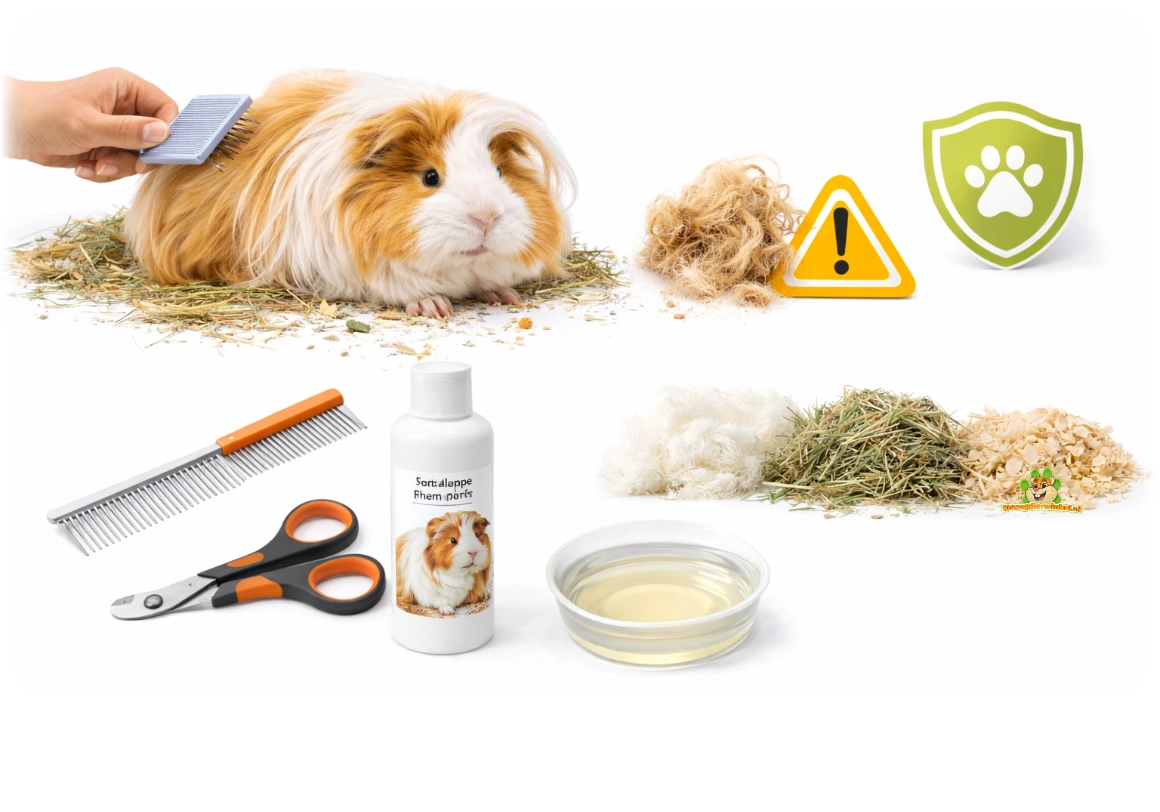 A long-haired guinea pig is beautiful, but its coat requires more daily attention than that of a short-haired guinea pig. Long hair can tangle more easily, trap dirt, and get wet in urine spots, hay corners, or under houses. Therefore, good care is not just about brushing, but also about a dry floor, calm monitoring, and a practical setup.
On this page, you will read how to care for a long-haired guinea pig, how often to brush, where tangles often form, when it is better to keep the hair short, and what type of bedding can be useful for long-haired guinea pigs . We also look at floor mats and pee pads , designated pee zones, hind leg control, and coat problems such as tangles, flakes, or itching.
At DRD Knaagdierwinkel®, we view long-haired guinea pigs from the perspective of daily practice. The coat remains most pleasant when grooming is brief, manageable, and regular. It is better to check quietly for a few minutes than to wait until large tangles form. Specialist since 2011.
Quick links:
Answer first | Grooming routine | Brushing | Preventing tangles | Hindquarters | Ground cover | Clipping & washing | Coat problems | Checklist | FAQ
Answer first: how do you care for a long-haired guinea pig?
You care for a long-haired guinea pig with short, regular coat checks. Brush the coat several times a week, check the hindquarters daily, and keep urine spots, hay corners, and resting places dry and clean. It is better to remove tangles early rather than waiting until they are tight against the skin.
✔ Check daily that the hindquarters are dry and clean.
✔ Brush briefly and gently, preferably briefly more often rather than for a long time occasionally.
✔ Pay extra attention to the belly, armpits, sides, hindquarters, and under the chin.
✔ Use a dry floor with smart pee zones, pee mats, or toilets.
Go to a veterinarian or groomer for tight mats, cuts, itching, pain, or skin problems.
Grooming routine for long-haired guinea pigs
A good routine doesn't have to be complicated. The most important thing is that you perform small checks often enough. This way, you will see more quickly if the fur is getting wet, if tangles are forming, and if your guinea pig is reacting sensitively in certain spots.
| Moment | What do you check? | Why? |
|---|---|---|
| Daily | Hindquarters, belly, wet hair, urine stains and hay in the coat | Wet or dirty spots can quickly become matted and irritated. |
| 2–4 times a week | Short brush check of back, sides, armpits, and hindquarters | Tangles remain small and are easier to remove gently. |
| Weekly | More extensive check of coat, nails, paw pads, weight, and skin | You spot changes faster and can make timely adjustments. |
| With a wet or dirty coat | Urinal area, bedding, mats, houses and hindquarters | The cause often lies in a damp spot or an awkward layout. |
Guinea pig care → | Guinea pig nail trimming → | Guinea pig health →
Brushing a long-haired guinea pig: here's how to take it easy
Brushing works best when your guinea pig has a good grip and you can work calmly. Use a towel or a non-slip mat, for example. Start in areas where your guinea pig tolerates touch well, such as the back and sides, and only then move on to more sensitive areas such as the belly, armpits, and hindquarters.
Brushing in short steps
✔ Place your guinea pig on a towel or rug with grip.
✔ Start with the back and sides, where most guinea pigs tolerate touch better.
✔ Gently hold the fur just above the skin when loosening a small tangle.
✔ Do not force through large tangles.
Stop in time if your guinea pig becomes restless, chatters its teeth, wants to get away, or shows signs of tension.
Do not use hard yanking movements. A tangle can pull on the skin and cause pain. You can gently work small tangles apart, but it is best to have large, tight, or matted tangles assessed or carefully removed by someone with experience.
Taming a guinea pig → | Guinea pig language → | Guinea pig cushions and baskets →
Preventing tangles in long-haired guinea pigs
Tangles mainly form where hair rubs against itself, where the coat gets wet, or where hay and bedding material get caught. In long-haired guinea pigs, hotspots are usually the hindquarters, belly, armpits, sides, and under the chin.
| Place | Why does a tangle form there faster? | Practical approach |
|---|---|---|
| Hindquarters | Contact with urine spots, droppings, and the ground | Check daily and keep her shorter if necessary. |
| Belly | Frequent contact with bedding and mats | Dry ground and short, quiet checks |
| Armpits | Friction while walking | Feel gently and quickly tackle small tangles. |
| Under chin and chest | Moisture, vegetable scraps, or hay can get stuck. | Check briefly after wet food or spills |
| Sides | Hair drags along the ground, small houses, or tunnels | Brush and check fixture for rough edges |
Keeping the hindquarters clean in a long-haired guinea pig
The hindquarters are the most important area to check in long-haired guinea pigs. Hair there can become wet, dirty, or matted more quickly. Check daily to ensure the coat is dry and that no droppings, urine, bedding, or hay is stuck in it.
✔ Check the hindquarters daily for wet or dirty coat.
✔ Replace wet pee pads, bedding, and hay on time.
✔ Keep the hair around the hindquarters practically shorter when it gets dirty quickly.
✔ Also check if your guinea pig urinates, defecates, and moves normally.
For dirty, wet, painful, or irritated skin, it is advisable to consult a veterinarian or an experienced groomer.
Cleaning a guinea pig cage → | Guinea pig bladder problems → | Guinea pig litter boxes →
Bedding for long-haired guinea pigs
For long-haired guinea pigs, choose bedding not only based on absorption but also on coat-friendliness. Loose, fine, or sticky particles can get stuck in long coats more easily. A dry, stable substrate with clearly defined urination zones often works best.
Create a dry spot with clean bedding, a mat, or a basket where your guinea pig does not lie in a urination zone.
Use a litter box, pee pad, or extra absorbent bedding in areas where your guinea pig often urinates.
Keep the hay corner dry and remove wet hay quickly, as long hair easily picks up dirt there.
For long-haired guinea pigs, a combination often works well: absorbent bedding where necessary, pee pads in designated spots, and soft, dry resting places that you can easily wash or replace.
Bedding for long-haired guinea pigs → | Guinea pig bedding → | Guinea pig floor mats and pee pads → | Guinea pig cleaning products →
Cutting and washing your hair: when to do it and when better not to?
For long-haired guinea pigs, it can be practical to keep the hair shorter around the hindquarters, belly, or sides. This is not a matter of beauty, but a care choice: shorter hair stays wet less quickly, pulls in less bedding material, and is easier to control.
Washing is usually not necessary if the bedding and coat are well maintained. Fully washing a guinea pig can cause stress and upset the skin's balance. In cases of stubborn dirt, urine burn, a dirty hindquarters, skin problems, or if in doubt, specific advice from a veterinarian or experienced groomer is better than simply washing it yourself.
✔ Preferably keep problem hair on the hindquarters practically short.
✔ Only cut when you can safely see what is hair and what is skin.
✔ Do not wash as standard; preferably prevent the coat from getting wet and dirty.
✔ Use only grooming products suitable for guinea pigs.
Have tight tangles, skin irritation, or painful spots professionally assessed.
Recognizing coat problems in long-haired guinea pigs
Grooming is also a health check. While brushing, you may notice flakes, scabs, bald patches, sores, itching, or sore spots. Take such signs seriously, especially if your guinea pig scratches a lot, bites at its fur, is lethargic, or eats less.
| What do you see? | Possible cause | What are you doing? |
|---|---|---|
| Tangles close to the skin | Friction, moisture, overdue coat check | Do not pull; have it removed carefully when necessary. |
| Flakes or scabs | Dry skin, irritation, parasites or skin problem | Check skin and behavior; see veterinarian if symptoms persist |
| Bald spots | Itching, scratching, parasites, fungus or other cause | Have the cause assessed in case of exacerbation or doubt |
| Wet hindquarters | Urinary spots, bladder problems, dirty floor, or reduced physical activity | Check the soil and call a veterinarian if there are any issues. |
| Pain upon touching | Tight tangle, wound, skin irritation or underlying problem | Stop brushing and have it checked out |
Guinea pig itch, mites and parasites → | Guinea pig not eating → | Guinea pig transport box →
Common mistakes with long-haired guinea pigs
Caring for long hair becomes difficult when you wait too long or when the roots constantly remain wet. These are pitfalls you’d rather avoid:
✔ Wait until tangles become large or tight.
✔ Pull through tangles with a brush or comb.
✔ Do not check the hindquarters daily.
✔ Leaving wet pee pads, hay, or bedding lying around for too long.
✔ Give a full wash when targeted cleaning or trimming would be more appropriate.
View coat problems separately from the floor, hygiene, bladder problems, itching, or group stress.
Cleverly combine long-haired guinea pig care with interior design
A long-haired guinea pig stays cleaner more easily when the enclosure is logically arranged. Think of a dry resting area, a clearly marked potty zone, hay that doesn't constantly get wet, soft materials that can be washed, and open pathways so the fur rubs less against rough edges.
Also check houses and tunnels. Long hair can get caught on rough edges or pick up dirt more quickly in low, wet hiding places. It is better to choose hiding places that are spacious enough and easy to keep clean.
Guinea pig houses → | Guinea pig tunnels → | Guinea pig hay racks → | Guinea pig cage accessories →
DRD chooses: coat care starts with a dry base
At DRD, we do not view long hair care as just brushing. The floor, urine spots, hay corner, resting area, and daily routine all combine to determine how clean and tangle-free the coat remains.
The power lies in minor maintenance: a quick check daily, short brushing sessions, tackling wet spots quickly, and keeping the coat manageable where necessary.
Checklist – caring for a long-haired guinea pig
✔ Do you check the hindquarters daily for wet or dirty fur?
✔ Do you brush briefly and gently several times a week?
✔ Do you pay extra attention to the stomach, armpits, sides, and under the chin?
✔ Do you keep your potty spots, hay corners, and resting spots dry?
✔ Do you use bedding, pee pads, or litter boxes suitable for long hair?
✔ Do you keep the hair around problem areas practically short when necessary?
Do you need help with tight tangles, skin irritation, itching, cuts, or pain?
Good to know
A long-haired guinea pig does not need to be perfectly groomed. The most important thing is that the coat remains clean, dry, and free of painful tangles. Do you notice itching, bald patches, scabs, sores, a wet hindquarters, lethargy, or reduced appetite? Then look beyond just the coat and contact a veterinarian if there are clear symptoms.
Would you like to read up on general background information about guinea pigs? Then also check out the LICG guinea pig information at licg.nl.
FAQ – frequently asked questions about caring for long-haired guinea pigs
How often should you brush a long-haired guinea pig?
For many long-haired guinea pigs, a quick brush check 2–4 times a week is a practical basic routine. It is better to check the hindquarters daily, as that area gets wet or dirty more quickly.
Where do tangles form fastest on a long-haired guinea pig?
Tangles often form on the hindquarters, belly, armpits, sides, and under the chin. These are places where moisture, friction, hay, or bedding gets trapped in the coat more easily.
What do you do about a tangle in a guinea pig's fur?
You can gently loosen small tangles without pulling. Is a tangle tight against the skin or is it causing your guinea pig pain? Then have the tangle removed by someone with experience.
Should you wash a long-haired guinea pig?
Usually not. It is better to prevent the coat from becoming wet and dirty by ensuring a dry base and proper potty areas. For stubborn dirt, skin irritation, or urine burn, specific advice is better than standard washing.
Can you cut the hair of a long-haired guinea pig?
Yes, it can be practical to keep the hair shorter around the hindquarters, belly, or sides. Only trim when you can safely see what is hair and what is skin, or have it done by someone with experience.
Which bedding is suitable for long-haired guinea pigs?
Choose a dry, absorbent, and coat-friendly base. A combination of bedding, pee pads, and a clearly marked potty area often works well.
Why does the hindquarters of my long-haired guinea pig get dirty?
This can be caused by long hair hanging in puddles, wet bedding, an awkward hay corner, bladder problems, lack of exercise, or a dirty resting place. Check coat, bedding, and behavior together.
How do you keep a long-haired guinea pig clean?
Work with daily hindquarter checks, short brushing sessions, dry resting areas, clean urination zones, washed textiles, and bedding that does not easily get caught in the coat.
When should you see the vet for coat problems?
Go to the veterinarian if there is itching, bald patches, scabs, sores, pain, a wet hindquarters that returns, lethargy, reduced appetite, or obvious skin irritation.
What do you combine with caring for a long-haired guinea pig?
Combine coat care with guinea pig care, bedding for long-haired guinea pigs, floor mats, pee pads, litter boxes, cleaning products, houses, tunnels, and daily health checks.
✔ Grooming long-haired guinea pigs with a clear routine for brushing, tangles, the hindquarters, and hygiene
✔ Convenient to combine with bedding, pee pads, litter boxes, care and cleaning products
✔ Specialist since 2011, delivered from our own stock
Ordered before 17:00, shipped the same day | Delivered from our own stock | Specialist since 2011
