 Polski

What goes in the hay rack? How to choose the right hay
- Geplaatst op
- Geplaatst in Chinchilla, degu, Guinea Pig, Rabbit
- 0
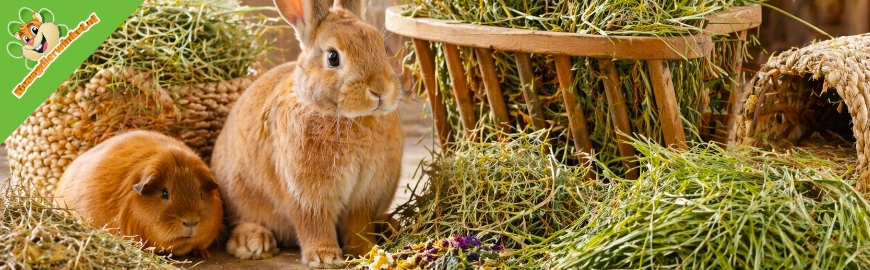
What actually belongs in a hay rack? Discover which hay suits your animals and when to choose a base hay rack, hay bag or extra enrichment.
Blog • rabbit & rodent • hay & hay racks • reading time 7 minutes
What goes in the hay rack? How to choose the right hay
What actually goes in a hay rack? The answer is quite simple: good hay that suits your animals. For rabbits and other herbivores such as guinea pigs, chinchillas and degus, a spacious, easy-to-reach base hay rack or hay bag is the fixed hay spot in the enclosure. Hanging hay racks, safe hay balls and hay rolls are nice extras for enrichment, but they should not be the only place where your animals get their hay.
This is exactly where things often go wrong in practice. A lot of attention sometimes goes to a fun hanging rack or play ball, while the real foundation is missing: a spacious hay spot where animals can eat calmly, cleanly and comfortably. At DRD, we therefore do not only look at which hay smells nice or looks appealing, but above all at what truly works for the animal and for the daily routine of the owner.
Quick links
The short answer • What is a good base hay rack? • Hay bag or hay rack? • Base or enrichment? • The different types of hay • Featured products • FAQ
What goes in the hay rack? The short answer
In a hay rack, the main thing you put in is simply hay. Not a mixture of random extras, not snacks as the main focus, but a proper type of hay that suits your animals. That could be timothy hay, meadow hay, mountain meadow hay or another option from our category hay for rodents & rabbits.
In short
- A base hay rack should be spacious enough for your animals and easy to reach.
- Do you have multiple animals? Then choose a larger rack, a model with multiple access points, or several hay spots.
- A hanging hay rack, hay ball or hay roll is great as extra enrichment, but not as the only hay spot.
- A hay bag can absolutely work as a base hay spot, as long as it is practical and suitable for the number of animals.
- Not every animal uses hay in the same way: for rabbits and herbivores it is a daily staple, while for many small rodents it is more often nesting and activity material.
What is a good base hay rack?
A good base hay rack is practical first and foremost. You want the hay to stay clean, your animals to be able to reach it easily, and you want to be able to see clearly how much is actually being eaten. That sounds simple, but in daily care it makes a real difference.
For one animal, a compact base rack may sometimes be enough. For a pair or a group, however, you need to think beyond “it holds hay.” Ideally, your animals should be able to eat together when they want to, without constantly pushing each other away. That is why a spacious base rack is often a better choice than a small one. In larger groups, several racks or several hay spots usually work best.
When we look at a base rack, we mainly focus on three things: accessibility, size and ease of use. A rack may look nice, but above all it has to work for the animal.
What should you look for in a base hay rack?
- The rack should be suitable for the size and number of your animals.
- The hay should stay dry, clean and neatly presented.
- With multiple animals, several feeding spots or several openings are often much more comfortable.
- The rack should suit the enclosure: standing, hanging, wall-mounted or in a corner.
- Refilling should be quick and practical.
Not every animal has the same need for hay
This is also an important specialist point. For rabbits, guinea pigs, chinchillas and degus, hay is a fixed daily part of life. That means they need a serious, easy-to-reach hay spot. For animals such as hamsters, gerbils, rats and mice, hay is much more often used as nesting material, activity material or an occasional nibble. That also means that a “nice hay rack” means something different for these animals than it does for a rabbit or guinea pig.
Hay bag or hay rack: which works better?
A hay rack and a hay bag both have their own advantages. A base hay rack is often clear, easy to refill and practical as a fixed hay spot. A hay bag, on the other hand, can be very tidy, space-saving and ideal in certain enclosures.
So yes, a hay bag can definitely be a base hay spot. This is especially true if you choose a model with multiple openings or use several hay bags for a pair or group. Here too, it is important not only to look at how nice it looks, but above all at how your animals can actually use it.
When is a hay bag a good choice?
- If you want to offer hay neatly and clearly.
- If you want to save floor space.
- If you can use a model with multiple openings for multiple animals.
- If your enclosure is better suited to a hanging solution than to a standing rack.
Base hay spot or enrichment? That distinction matters
One of the most important things we like to explain is the difference between a base hay spot and an enrichment spot. A base hay spot is the place where your animal should always be able to reach hay easily. That is the fixed place for daily hay.
Of course, you can also add extra variety. Think of a hanging rack, a safe hay ball, a hay roll or other enrichment solutions with hay. These are wonderful additions for variety, activity and natural behaviour, but they do not replace the base.
The same applies to hay bales and chunks. They are practical as stock, for larger consumption or as an extra nibbling spot, but in practice things work best when there is always a proper, easy-to-reach base hay rack or hay bag as well.
The different types of hay explained
Which type of hay you choose depends on your animals, their preferences and what you are looking for in structure, scent and daily use. There is no single hay type that is automatically the only right choice for everyone. That is exactly why we think it is so important to help owners compare properly.
1. Timothy hay
Timothy hay is a very popular choice as a daily base for rabbits and other herbivores. Many owners choose timothy because it has a clear, fibre-rich structure and fits well into a consistent routine. If you are looking for a hay type that is often used as a steady base, timothy is a logical first step.
2. Meadow hay
Meadow hay is the classic all-round choice. It often offers a nice balance of scent, structure and ease of eating. If you want an accessible base hay that works well in many situations, meadow hay is a very pleasant option for many owners.
3. Mountain meadow hay
Mountain meadow hay is often chosen when you want a little more scent, structure and character in the hay area. This type of hay often appeals to animals that like to nibble longer. It is a lovely choice when your animal enjoys hay with a bit more natural character.
4. Herbal hay
Herbal hay is especially interesting as a variation. It brings extra scent and often makes the hay spot more attractive. We therefore mainly see herbal hay as a nice addition alongside a base hay, or as a way to make the hay area more interesting for fussier eaters.
5. Fresh grass hay
Fresh grass hay is known for its fresh scent and often softer, greener appearance. It is a lovely option for variety and is often used to make the hay area extra appealing.
6. Hay bales and chunks
Hay bales and chunks are practical if you use a lot of hay, want more compact storage, or want to offer an extra nibbling spot next to the main hay area. They are practical and fun for variation, but in our experience they work best as an addition to a good base rack or hay bag.
What hay setup often works well in practice?
For many owners, a simple structure works best:
- choose one base hay type for the daily hay spot;
- use a spacious base hay rack or a practical hay bag;
- only then add variety with herbal hay, fresh grass hay or an enriching hay roll or hay ball.
That way, the foundation stays calm and clear, while you can still offer variety. That is exactly how we look at it as a specialist too: first make sure the daily hay spot is right, then add the extras.
Featured: three lovely choices for a good hay spot
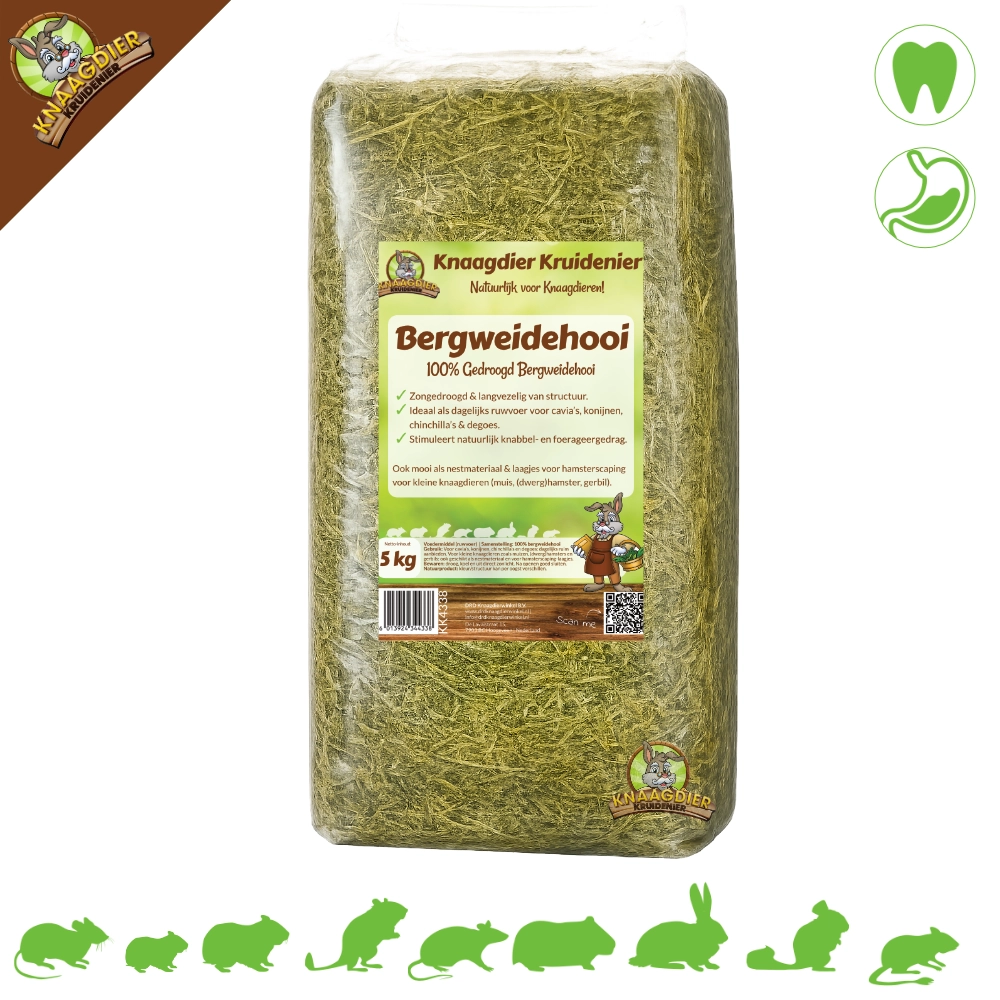
Alpine Meadow Hay 5 kg
A lovely choice if you are looking for a fragrant, natural base with a pleasant structure and enough stock at home.
- Ideal as daily hay for rabbits and herbivores
- Practical for larger consumption
- A great choice if you like characterful mountain meadow hay

Metal Hay Rack Standing with Roof 20 cm
A practical base hay rack for owners who want to offer hay neatly, clearly and cleanly.
- Standing model with an easy-to-reach hay spot
- The roof helps keep the hay neatly inside the rack
- Very practical as a fixed base hay spot in the enclosure
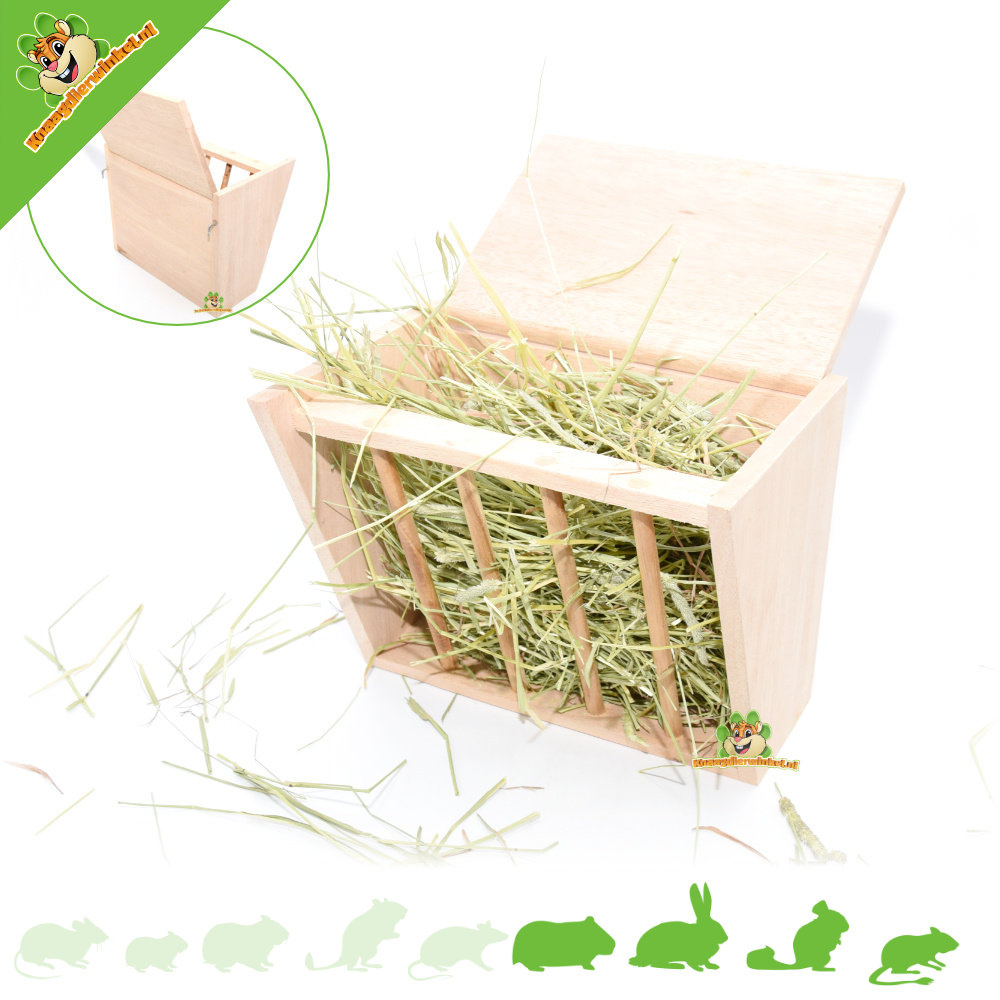
Hay Rack Durian Wood 24 cm
A beautiful base hanging hay rack for anyone who prefers a natural look and a fixed hanging spot in the enclosure.
- Base hay rack made from durian wood
- With hanging hooks and a closable lid
- Very suitable as a hanging base rack at the right height
Checklist: how to assess your hay spot
- Can your animals reach the hay calmly without constantly getting in each other’s way?
- Does the hay stay clean, dry and easy to manage?
- Can you clearly see what is actually being eaten?
- Does the size of the rack or hay bag suit the number of animals?
- Do you have room for enrichment next to the base hay spot?
- Does the chosen hay type really suit your animals and their preferences?
Helpful shop links
All hay types
Timothy hay
Mountain meadow hay
Herbal hay
Meadow hay
Fresh grass hay
Hay bales & chunks
Hay racks
Hay bags
Frequently asked questions about hay and hay racks
What is the best hay for my rabbit or guinea pig?
There is no single hay type that is automatically best for every animal. Many owners choose timothy hay or meadow hay as their regular base. Mountain meadow hay, herbal hay and fresh grass hay are lovely options when you want more variation in scent and structure.
Can a hay bag be used as the main hay spot?
Yes, absolutely. A hay bag is neat, space-saving and practical. If you have multiple animals, a model with multiple openings or several hay bags is often the better solution.
Is a hanging hay rack enough as the only hay spot?
That depends on the model and on your animals. A proper base hanging rack can work very well if it is easy to reach and offers enough space. Small play racks, hay balls and hay rolls are better seen as additions next to the base hay spot.
How large should a hay rack be for multiple animals?
A base hay rack should be large enough for your animals to use comfortably. For pairs and groups, it is often better to choose a larger model or to work with several hay spots. That usually creates much more peace in the enclosure.
What is the difference between timothy hay and meadow hay?
Timothy hay is often chosen as a clear, fibre-rich base with a recognisable structure. Meadow hay is more of a classic all-round option with a pleasant balance of scent and structure. Which one suits your animals best mainly depends on their preferences.
Are hay bales and hay rolls meant to be a base?
They can be practical as extra stock, a nibbling spot or enrichment, but in daily use they usually work best alongside a normal base hay rack or hay bag. That keeps the daily hay spot clear and easy to use.
Not sure which hay or hay rack suits your animals best?
We are happy to help you think it through. With hay and hay spots, small details often make a big difference: how many animals you have, how the enclosure is set up and what your animals actually like to use. Feel free to contact us.
Specialist since 2011 • personal and expert advice • shipped from our own stock
Reacties
Wees de eerste om te reageren...