 Polski


Rabbit droppings: what is normal and when should you watch out?
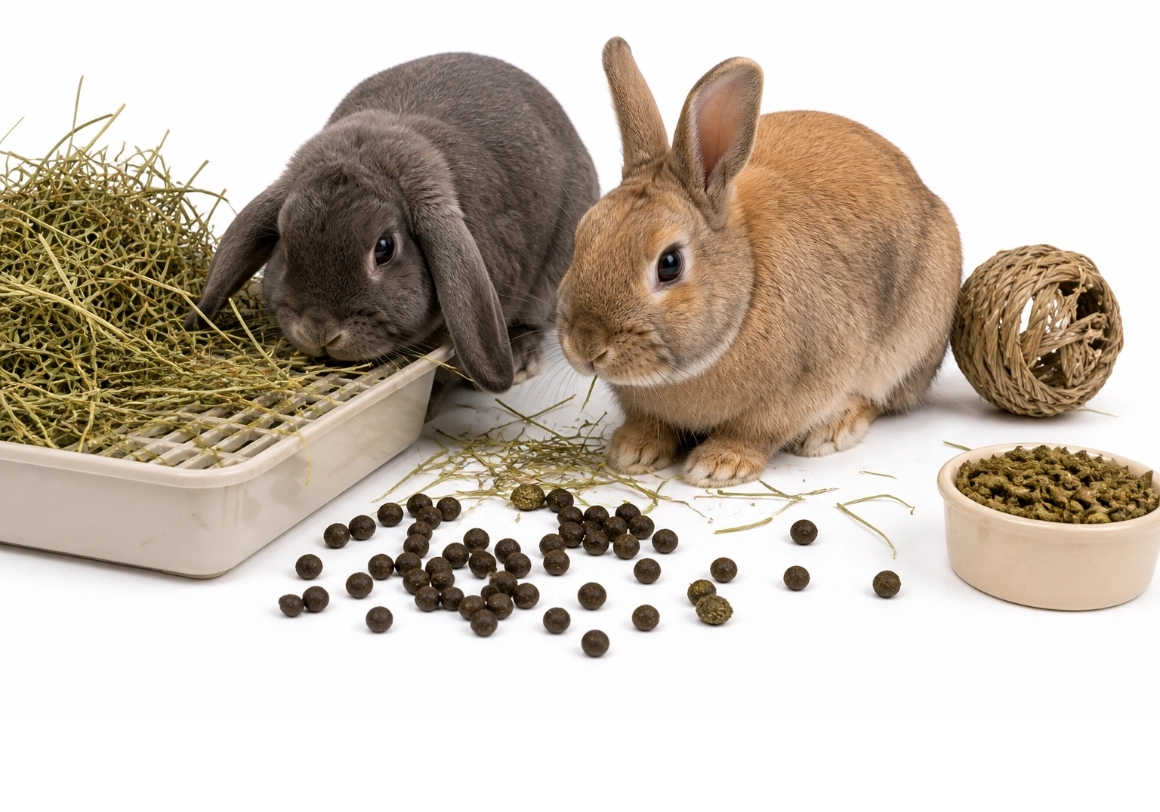 Rabbit droppings reveal a lot about your rabbit's well-being. By briefly checking the shape, size, quantity, and texture of the droppings daily, you will quickly develop an idea of what is normal for your rabbit. This is useful, as changes in droppings are often related to diet, hay intake, stress, exercise, hydration, teeth, or digestion.
This page is part of our Rabbit Information and helps you calmly assess normal droppings, cecal droppings, small hard droppings, soft droppings, and situations where you should quickly consult a rabbit-specialist veterinarian. Products can help with a good daily routine, but do not replace veterinary advice regarding symptoms or doubt.
✓ In short: normal rabbit droppings are usually round to oval, dry, firm, and fibrous in texture.
✓ Small, hard, wet, sticky, or clearly abnormal droppings are a reason to pay extra close attention to food, hay, drink, and behavior.
✓ Is your rabbit not eating, not pooping, or becoming lethargic? Then contact a rabbit-specialist veterinarian immediately.
Quick links:
Normal droppings · Cecal droppings · Small hard droppings · Soft or sticky droppings · No or fewer droppings · Diet & hay · Daily checklist · FAQ
Look at the shape
Normal droppings are usually round to oval, dry, and firm. Above all, learn what is normal for your own rabbits.
Look at the quantity
Are there suddenly far fewer droppings, or does your rabbit stop pooping? Then that is an important signal.
Look at food
Droppings are always assessed together with appetite, hay intake, drinking, posture, and behavior.
What do normal rabbit droppings look like?
Normal rabbit droppings are usually round to oval, dry, firm, and fibrous. They fall apart and are not wet, slimy, or sticky. The exact size can vary from rabbit to rabbit. A large rabbit often produces larger droppings than a small rabbit, and diet, hay, and activity can also have an influence.
Pay close attention to changes. If your rabbit normally produces large, dry droppings and they suddenly become much smaller, harder, softer, or fewer in number, that is more important than a single loose dropping that deviates slightly.
Normal droppings in brief
✓ Round to oval in shape.
✓ Dry and firm, but not rock-hard.
✓ Fibrous in texture when you break them open.
✓ Loose droppings, not stuck together as a wet mass.
✓ Regularly present during the day.
Handy shopping routes: Rabbit hay · Rabbit food · Drinking bottles & water bowls
Cecal pellets: why do you sometimes see them?
In addition to regular dry droppings, rabbits also produce cecal droppings. These are soft, shiny little pellets that often stick together in a small cluster. Normally, a rabbit should eat these immediately. That is why you usually do not see them lying around, or only barely.
Do you regularly see clusters of soft cecal pellets lying around, or does soft stool stick around the hindquarters? If so, it is advisable to pay extra attention to diet, weight, mobility, and hygiene. Too much rich food, too little hay, being overweight, pain, or difficulty bending can play a role here. In case of persistent sticky droppings, a dirty coat, or if you have any doubts, it is wise to consult a rabbit-specialist veterinarian.
Good to know
Seeing a single cecal pellet is not immediately unusual. However, regularly seeing many soft clusters, a dirty hindquarters, or wet/sticky stool is a reason to take a closer look at diet, hygiene, and health.
Small, hard droppings in rabbits
Small, hard droppings can mean that the intestines are not functioning properly or that your rabbit is eating less than normal. In that case, look at the whole picture immediately: is your rabbit still eating hay, drinking well, moving normally, and alert?
Sometimes you see small droppings after stress, a change of enclosure, eating little hay, drinking less, or a period of reduced appetite. If the droppings quickly return to normal and your rabbit is otherwise active and eating well, you can continue to monitor the situation closely. If the droppings remain small, become fewer, or your rabbit is eating less, contact a veterinarian specializing in rabbits.
Handy shopping routes to support the daily basics: Rabbit hay · Hay racks · Rabbit herbs · Play & foraging
Soft, wet, or sticky droppings
Soft or sticky droppings are different from normal dry droppings. Sometimes they are cecal droppings that have not been eaten. Sometimes they involve soft stool or diarrhea-like stool. Therefore, pay close attention to the texture, the quantity, and whether the fur around the hindquarters remains clean.
Possible causes may include too many rich treats, a sudden change in diet, insufficient hay, stress, or physical ailments. Do not endlessly try to treat the situation yourself if the droppings are wet, slimy, bloody, or watery, or if your rabbit is also eating less, becoming lethargic, or appears to be in pain. In that case, contact a veterinarian specializing in rabbits.
Be extra careful in the summer
A dirty or wet hindquarters in rabbits is always something to take seriously. During warm periods, hygiene is especially important, as flies can be attracted to dirty or wet fur. Therefore, check outdoor rabbits and long-haired rabbits thoroughly every day.
No or far fewer droppings: when to act quickly?
No droppings or significantly fewer droppings are important signals. Check immediately if your rabbit is still eating, taking hay, drinking, responding alertly, and moving normally. Rabbits should continue to eat and defecate properly. If this stops or clearly decreases, you must act quickly.
Contact a rabbit-specialist veterinarian immediately if your rabbit is not eating, producing no or almost no droppings, is puffed up, lethargic, grinding its teeth in pain, appears to have a hard or bloated abdomen, or is clearly reacting differently than normal. Waiting is not a good idea with rabbits when eating and defecating stop.
Contact the veterinarian immediately if these signs occur
✓ Your rabbit is not eating or barely eating.
✓ There are no or almost no droppings.
✓ Your rabbit is puffed up, quiet, or withdrawn.
✓ Your rabbit seems to be in pain or is clearly reacting differently.
✓ There is watery diarrhea, mucus, blood, or a dirty, wet hindquarters.
What do hay, feed, and water have to do with droppings?
Droppings are strongly linked to what your rabbit eats and drinks. Hay is the foundation for this. It provides plenty of fiber-rich material in the daily diet and keeps rabbits busy nibbling for a long time. An appropriate portion of complete rabbit food supplements this, but should not replace the hay.
Do you give a lot of snacks, rich extras, or do you suddenly change your diet? This can affect the stool. Therefore, introduce new herbs, vegetables, or snacks gradually and observe the droppings closely. A stable foundation with hay, water, and appropriate feed makes it easier to notice changes.
Nutritional basis for normal droppings
✓ Offer plenty of hay daily in an attractive spot.
✓ Give an appropriate portion of complete rabbit food.
✓ Ensure that drinking water is clean and easily accessible.
✓ Gradually introduce vegetables, herbs, and snacks.
✓ Pay attention to changes after a feed change, a stressful event, or a move.
Convenient shopping routes: Rabbit hay · Rabbit food · Rabbit herbs · Rabbit snacks · Drinking bottles & water bowls
Daily checklist: how to check rabbit droppings
You don't need to assess droppings in a complicated way. The most important thing is to take a quick look daily at what is normal for your rabbits. This way, changes will be noticed more quickly.
Poop check in 1 minute
✓ Are there enough droppings present?
✓ Are the droppings round to oval and dry?
✓ Are they about the same as you are used to from your rabbit?
✓ Don't they suddenly become much smaller, harder, or softer?
✓ Is the fur around the back clean and dry?
✓ Is your rabbit eating hay and feed well?
✓ Is your rabbit alert and reacting normally?
This check fits well with the daily care of the enclosure. Especially with a rabbit toilet, you can quickly see how many droppings are present and whether the toilet area remains dry and clean.
Frequently asked questions about rabbit droppings
What do healthy rabbit droppings look like?
Healthy rabbit droppings are usually round to oval, dry, firm, and fibrous. The size can vary from rabbit to rabbit. Pay particular attention to what is normal for your rabbit and to sudden changes.
Why are my rabbit's droppings small and hard?
Small, hard droppings can indicate that your rabbit is eating less, consuming less hay, or that its intestines are less active. Pay close attention to appetite, behavior, and the amount of droppings. If this persists or your rabbit is eating less, contact a veterinarian specializing in rabbits.
What are cecal pellets in rabbits?
Cecal pellets are soft, shiny little droppings that often stick together in a cluster. A rabbit should normally eat these immediately. If you often see them lying around or if soft droppings stick to the rabbit's teeth, pay extra attention to diet, weight, and health.
Is sticky poop normal in a rabbit?
Regular sticky stools or a dirty rear end is not something to ignore. It can be related to diet, being overweight, insufficient hay, difficulty moving, or physical ailments. If sticky stools persist, veterinary advice is recommended.
My rabbit is pooping less, what should I do?
Immediately check if your rabbit is still eating well, taking hay, drinking, and responding normally. Fewer droppings combined with reduced eating, lethargy, or signs of pain are reasons to call a rabbit-specialist veterinarian quickly.
My rabbit isn't pooping at all, is that an emergency?
Yes, no droppings combined with little to no eating is worrying in rabbits. Contact a rabbit-specialist veterinarian immediately.
Can snacks cause soft droppings?
Too many or overly rich extras can affect the stool. Therefore, give snacks in small portions and deliberately, and introduce new foods gradually. Hay and appropriate rabbit food remain the foundation.
Does more hay help with better droppings?
Hay is an important part of the daily diet. Offer it generously, fresh, and attractively. If your rabbit eats little hay or if its droppings change noticeably, also check its food, teeth, stress, water intake, and overall health.
Continue reading within Rabbit Information
Do you want to better understand the connection between diet and droppings? Then also read What does a rabbit eat? . Do you want to go over the complete basics? Check out the Rabbit Checklist . For toilet behavior and hygiene, you can read more at Housebreaking a rabbit . Or go back to the Rabbit Information .
Products for the daily rabbit routine
At DRD Knaagdierwinkel®, you will find products suitable for the daily monitoring and care of rabbits. Think of good hay, suitable rabbit food, hay racks, drinking facilities, rabbit toilets, litter bedding, and products for a clean, organized living space.
✓ Hay, feed, and herbs neatly organized together
✓ Practical shopping routes for toilets, hygiene, and personal care
✓ Specialist since 2011
✓ Delivered from our own stock
View now: Rabbit hay · Rabbit food · Rabbit toilets · Rabbit toilet bedding · Rabbit health .
