 Polski



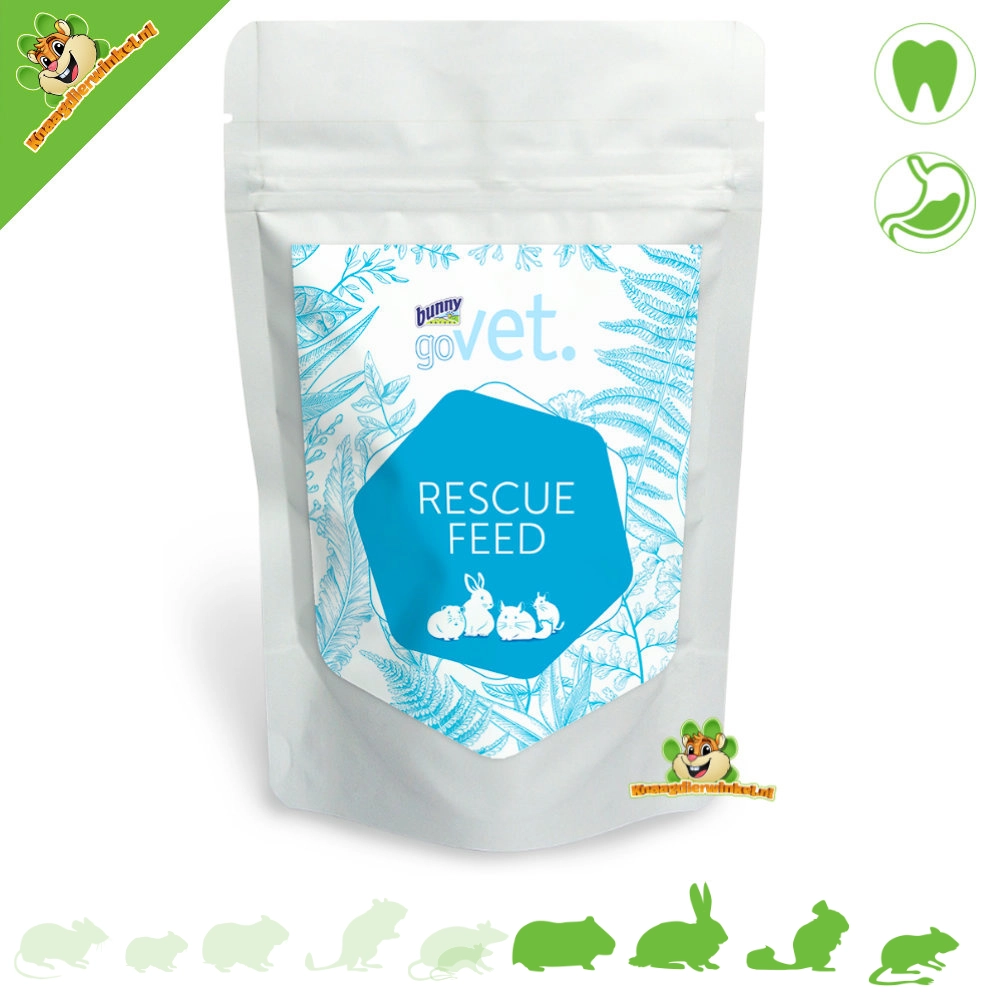
GoVet RescueFeed for Rodents & Rabbits!

- Dispatched from our own stock
- Personal & expert advice
- Always 100% rodent-friendly
- Ordered before 5 p.m., shipped the same day!
Bunny Nature GoVet RescueFeed 40 grams
Bunny Nature GoVet RescueFeed is a natural supplementary porridge for rabbits and herbivorous rodents that are temporarily unable to eat well on their own. You mix the powder with lukewarm water into a smooth paste and can then carefully administer it using a feeding syringe. This makes RescueFeed handy to have on hand for recovery periods, for example after dental treatment, surgery, a period of illness, or on the advice of the veterinarian.
At DRD, when it comes to these types of supportive feeds, we focus primarily on practical applicability, fiber content, acceptance, and straightforward use. RescueFeed is intended for herbivores such as guinea pigs, rabbits, chinchillas, and degus. These animals are highly dependent on a fiber-rich diet and a well-functioning digestive system. If such an animal suddenly stops eating, is lethargic, appears to be in pain, or has abnormal droppings, it is important to contact a veterinarian quickly.
In short
- Natural supplementary food porridge for rabbits and herbivorous rodents.
- Suitable for guinea pigs, rabbits, chinchillas, and degus.
- Powder that you mix with lukewarm water into a smooth paste.
- To be fed with a feeding syringe through the corner of the mouth.
- Useful when a herbivore temporarily does not eat sufficiently on its own.
- With, among others, timothy, water lentil protein, spirulina, lignocellulose, and inulin.
- Divide the daily ration into several freshly prepared portions.
- Contents: 40 grams.
✔ Quick to prepare with lukewarm water
✔ Easy to administer with a feeding syringe
✔ High-fiber composition with 18.5% crude fiber
✔ With water lentil protein as a source of essential amino acids
✔ With spirulina, inulin, dandelion, nettle, and chamomile
✔ Practical for the emergency first-aid kit of rabbit, guinea pig, chinchilla, and degu owners
When do you use RescueFeed?
You use RescueFeed when a herbivore temporarily needs support with eating. Think of times when eating independently is difficult, such as after a dental treatment, after a procedure, during recovery, or when your veterinarian advises supplementation. The powder is mixed into a paste, allowing you to offer it calmly and in a controlled manner.
For guinea pigs, rabbits, chinchillas, and degus, sufficient fiber intake is especially important. If these animals stop eating or clearly eat less, the cause must always be taken seriously. RescueFeed can help provide temporary nutrition, but it is not a solution for the underlying cause of the lack of appetite.
For which animals is Bunny Nature GoVet RescueFeed suitable?
- Guinea pig: suitable as a supplementary food mash when a guinea pig is not eating sufficiently on its own; contact a veterinarian immediately if the guinea pig is not eating.
- Rabbit: suitable as a supplementary mash in case of reduced food intake; not eating in rabbits always requires prompt attention.
- Chinchilla: suitable as temporary support during reduced food intake, always alongside the normal fiber-rich base as soon as eating is possible again.
- Degu: suitable as temporary support when eating is difficult, with attention to hay intake, droppings, and behavior.
RescueFeed is intended for herbivores/plant-eaters. For mice, dwarf hamsters, hamsters, gerbils, dwarf rats, and rats, you should preferably choose a supplementary or recovery food that suits their individual nutritional needs.
Here's how to prepare RescueFeed
- Mix the powder with lukewarm water into a smooth, easily absorbed paste.
- Stir well so that no dry lumps remain.
- It is better to prepare several small portions fresh than one large quantity at once.
- Use a suitable feeding syringe to administer the porridge slowly.
- Do not feed the porridge cold from the refrigerator.
This is how you give the porridge safely
Have your animal sit in a natural, upright position. Do not feed while your animal is lying on its back, and do not squirt the paste into the mouth too quickly. Gently insert the feeding syringe through the corner of the mouth and give small amounts at a time. Pause in between so that your animal can chew and swallow.
- Give small amounts at a time.
- Take quiet breaks while feeding.
- Stop if your animal chokes, seems very short of breath, or shows a lot of stress.
- Gently clean the mouth and chin after feeding if any porridge remains.
- Always follow your veterinarian's advice in case of illness, recovery, or intensive supplementary feeding.
Nutritional advice
Preferably, divide the daily ration into 3 to 5 freshly prepared portions. When more intensive supplementary feeding is necessary, smaller portions spread throughout the day are often used. The correct amount depends on the species, body weight, condition, cause of not eating, and what your animal is still able to consume on its own.
Therefore, always follow the instructions on the packaging and, if in doubt, consult your veterinarian regarding the quantity. Especially with guinea pigs, rabbits, chinchillas, and degus, it is important not only to observe how much porridge is consumed, but also the droppings, the abdomen, behavior, signs of pain, and whether the animal is picking up hay or food independently again.
When should you contact a veterinarian?
Contact a veterinarian if your animal suddenly stops eating, eats significantly less, is lethargic, appears to be in pain, has no or abnormal droppings, has a distended abdomen, or is deteriorating rapidly. In herbivores such as guinea pigs, rabbits, chinchillas, and degus, not eating can quickly become serious. RescueFeed can provide temporary support, but the underlying cause must be investigated.
Compound
Growth of permanent pastures, timothy, oat bran, wheat bran, oat flakes, water lentil protein 7.3%, carrot pulp, extracted linseed, extracted sunflower seed, extracted rapeseed, milk thistle seeds 2%, brewer's grain, brewer's yeast, spirulina 1%, lignocellulose 1%, dandelion root 0.7%, dandelion leaves, inulin 0.6%, nettle leaves, rosehip husk, narrow-leaved plantain leaves, chamomile flowers.
This composition is formulated as a temporary supplement for herbivores, containing fiber-rich plant parts, timothy, and additional components such as duckweed protein, spirulina, and inulin. The mix is intended to be prepared as a porridge when independent eating is temporarily difficult.
Analysis
Crude protein 14%, crude oils and fats 3.8%, crude fiber 18.5%, crude ash 7%, calcium 0.65%, phosphorus 0.4%, sodium 0.21%.
This analysis is suitable for a high-fiber supplementary feed mash for temporary use with herbivores. The 18.5% crude fiber aligns with RescueFeed's role as support when fiber intake temporarily requires extra attention. As soon as your animal is eating better again, the goal remains to return to the normal menu with hay, appropriate main food, and water.
Nutritional additives
Vitamin A 11,760 IU, vitamin D3 823 IU, vitamin E 70.6 mg, vitamin C 588 mg, copper 7.06 mg, iodine 1.06 mg, iron 58.8 mg, zinc 70.6 mg, manganese 47 mg, selenite 0.21 mg.
Good to know
- Mix the paste with lukewarm water, not boiling water.
- Do not feed the porridge cold from the refrigerator.
- It is better to prepare small portions fresh for better acceptance.
- Store leftovers briefly in the refrigerator and use them only when they still smell fresh and have a good texture.
- While supplementing, keep a close eye on whether your animal starts eating again on its own.
- Check droppings, behavior, posture, and belly carefully.
- Use RescueFeed as temporary support, not as a replacement for a diagnosis or treatment.
Frequently Asked Questions
For which animals is Bunny Nature GoVet RescueFeed suitable?
RescueFeed is suitable for guinea pigs, rabbits, chinchillas, and degus that are temporarily unable to eat sufficiently on their own. When using it during illness, recovery, or reduced food intake, preferably consult a veterinarian.
Is RescueFeed suitable for all rodents?
No, this supplementary food porridge is intended for herbivores/plant-eaters. For mice, dwarf hamsters, hamsters, gerbils, dwarf rats, and rats, you should preferably choose a product that suits their own nutritional needs.
Is RescueFeed the same as force-feeding?
RescueFeed is used as a supplementary feed and can be administered with a feeding syringe when a herbivore is not eating enough on its own. Many owners call this force-feeding, but the most important thing is to feed calmly, gently, and in small amounts.
How do I prepare Bunny Nature GoVet RescueFeed?
Mix the powder with lukewarm water into a smooth paste. Stir well and preferably prepare small portions fresh. The paste should be able to pass through a feeding syringe easily, but not be so thin that your animal is more likely to choke.
How often can I give RescueFeed?
Preferably divide the daily ration into 3 to 5 portions. With intensive support, more frequent feeding may be necessary, but adjust this based on animal species, weight, situation, and veterinary advice.
Can I save leftovers?
Yes, leftovers can be stored in the refrigerator for a short time. Do not feed the porridge cold afterwards, but let it come to room temperature first. Always check the smell and texture before offering it again.
When should I go to the vet?
Contact a veterinarian immediately if your animal is not eating, is lethargic, appears to be in pain, has no or abnormal droppings, has a distended abdomen, or is deteriorating rapidly. RescueFeed can provide temporary support, but it does not resolve the underlying cause of the loss of appetite.
Is 40 grams enough?
The 40-gram package is practical to have at home for short-term support or to try out. How long it lasts depends on the species, weight, the amount per portion, and how much your animal still eats on its own.
Useful shopping links
- Health & care
- Rabbit food
- Guinea pig food & nutrition
- Chinchilla food
- Degoevoer
- Hay & hay racks
- Bunny Nature
- Ask us for personal advice
Bunny Nature GoVet RescueFeed 40 grams is a practical supplementary food mash for times when your guinea pig, rabbit, chinchilla, or degu is temporarily not eating enough on its own. Thanks to its high-fiber composition, easy preparation with lukewarm water, and the option to feed with a syringe, RescueFeed fits well into the emergency first-aid kit of owners with herbivorous animals.
| Content (approx): | 40 gram |
| Composition: | Permanent pasture growth *, oat husk bran, sunflower extraction meal, apple waste, sweet lupine, buckwheat, whole plant corn, carrot pomace, linseed meal, wheat bran, quinoa, rapeseed meal, breweries, lignocellulose, brewer's yeast, rib |
| Analysis: | Crude protein 14%. Crude oils and crude fats 3%. Crude fiber 19%. Crude ash 7%. Calcium 0.6%. Phosphorus 0.4%, Vitamin A 8,800 IE. Vitamin D3 600 IE. Vitamin E / all rac alpha tocopheryl acetate 53 mg. vitamin C as ascorbyl monophosphate, calcium sodium s |
| Promotes Foraging: | Yes |
| Suitable for: | Rodents, Guinea Pig, Rabbit, Chinchilla, Degu |
| Type: | supplementary pet food |
| Particularities: | - |
| Disclaimer: | Not for food producing animals. If you have any doubts about the health, medication or treatment of your animal, you should always consult a veterinarian |

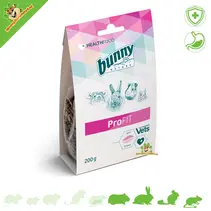
Zeer goede voeding voor een ziek konijn , om hem weer op krachten te krijgen.