 Polski

What do you need for guinea pigs? Complete checklist for a good start
 If you want to keep guinea pigs, you need more than just a cage and a food bowl. Guinea pigs are social ground animals. They need companions, plenty of usable floor space, ample hay, suitable guinea pig food, daily attention to vitamin C, multiple hiding places, a dry substrate, and a calm daily care routine.
This checklist helps you choose step by step. Not as a standalone shopping list, but as a complete starter guide: what do you really need, what is handy to include, what can you expand later, and which product category fits which need?
At DRD Knaagdierwinkel®, we don't just look at individual guinea pig products, but at the whole picture. An enclosure must be right for the animal and practical for you. That is why, in this checklist, we consistently link to the correct categories, selection guides, and information pages. Specialist since 2011.
✓ Complete checklist for new guinea pig owners
✓ With direct links to all important guinea pig categories
✓ Helps choose in order: base first, then expansion
✓ Suitable for two guinea pigs, groups, beginners, and owners who want to improve their enclosure
Quick links
Answer first • Basic checklist • Before you begin • Cage & enclosure • Bedding & hygiene • Nutrition & vitamin C • Decor & enrichment • Care & health • First week • All shopping routes • FAQ
Answer first: what is the minimum you need for guinea pigs?
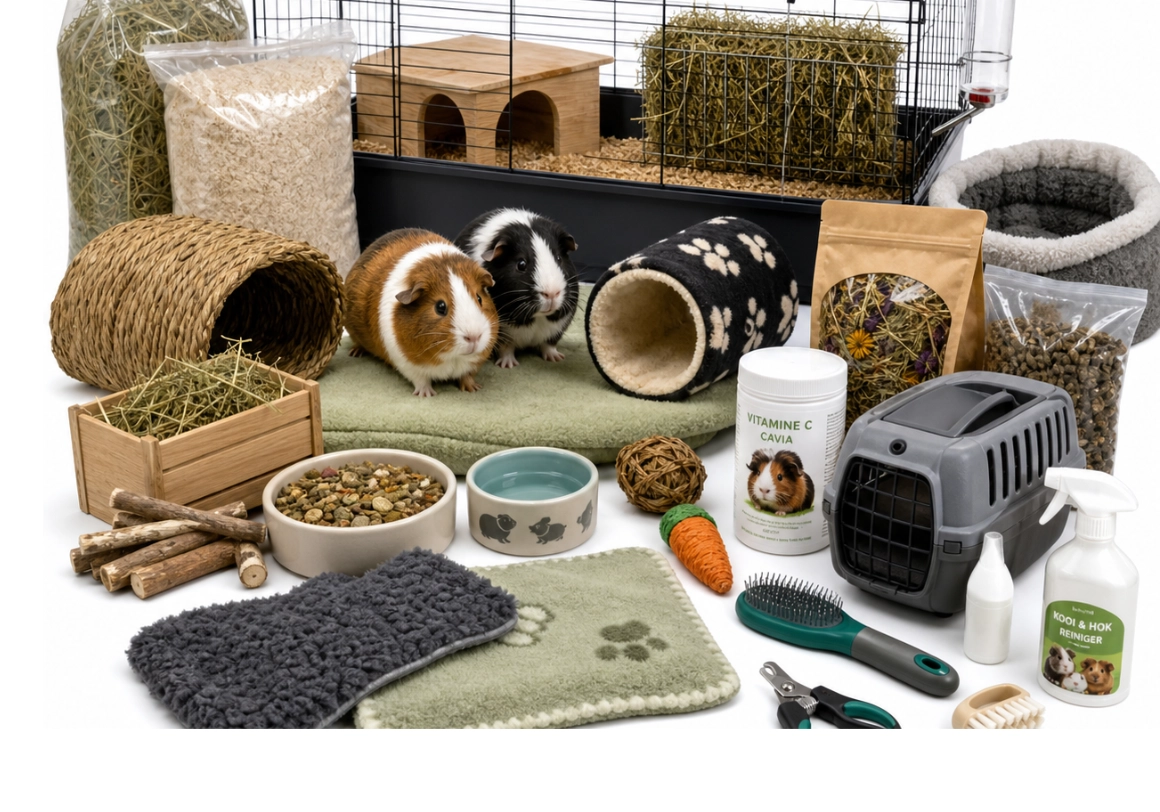
For guinea pigs, you need at a minimum: a spacious enclosure, at least two guinea pigs or a suitable group of guinea pigs, plenty of hay, special guinea pig food, daily attention to vitamin C, water, bedding or floor mats, multiple hiding places, a hay rack or hay corner, food bowls, a water bowl or water bottle, grooming products, a transport box, and cleaning supplies.
The order is important. Start with space, group composition, hay, food, water, and bedding. Then choose houses, tunnels, enrichment, care, and practical extras. This way, you avoid buying many individual products while the basics are not yet right.
First living space
Choose an enclosure with enough usable floor space, open walkways, and room for multiple hiding places.
Then nutrition
Hay is the daily basis. Guinea pig food, vitamin C, vegetables, herbs, and snacks each have their own role.
Then furnishing
Houses, tunnels, hay racks, feeding areas, pee pads, and enrichment make the enclosure logical and pleasant to use.
Complete basic checklist for guinea pigs
| Element | Why is it necessary? | Go directly to category |
|---|---|---|
| Spacious accommodation | For walking, sheltering, eating, resting, and being able to avoid each other. | Guinea pig cage |
| Hay | Daily basis for eating, chewing, being active, and fiber intake. | Guinea pig hay |
| Guinea pig food | Special food for guinea pigs, with a focus on vitamin C. | Guinea pig food and nutrition |
| Vitamin C | Guinea pigs cannot produce vitamin C themselves. | Vitamin C explanation |
| Soil | Dry, comfortable, and practical to keep clean. | Guinea pig bedding |
| Ground mats & pee pads | For designated potty areas, hay corners, and washable zones. | Ground mats and peat mats |
| Shelters | For peace, safety, and freedom of choice within the group. | Guinea pig houses |
| Tunnels | For routes, shelter, and quiet movement through the enclosure. | Guinea pig tunnels |
| Hay rack or hay sack | To present hay in an easily accessible and organized manner. | Guinea pig hay racks |
| Water spot | For daily access to drinking water, preferably logically placed and easily inspectable. | Drinking bottles and water bowls |
| Feeding bowls | For guinea pig food, vegetables, or separate feeding areas for multiple animals. | Guinea pig food bowls |
| Care | For nails, coat, check-ups, and daily handling. | Guinea pig care |
| Transport box | For pickup, vet visits, moving, or emergencies. | Guinea pig transport box |
| Cleaning | For hygiene, wet areas, drinking areas, and toilet/hay corners. | Guinea pig cleaning products |
Before you begin: do not buy guinea pigs as a standalone purchase
A good start begins before you choose products. Guinea pigs are social animals and live best with at least one other of their kind. A guinea pig also requires daily attention: replenishing hay, checking water, feeding, removing wet spots, observing behavior, and weighing or checking regularly.
So, first consider the group, the space, and the care routine. Only then choose the products. This way, you prevent the enclosure from becoming too small, the hay corner from being inconveniently placed, or discovering later that you have too few hiding places, pee pads, or feeding areas.
✔ It is preferable to keep guinea pigs with at least one other of their kind.
✔ Floor area is more important than height.
✔ Hay must be plentiful and available daily.
✔ Vitamin C should be included in your daily diet.
✔ Multiple hiding places, feeding areas, and hay areas provide calm within a group.
Also delve into: pairing guinea pigs , guinea pig language , and taming guinea pigs .
1. Guinea pig cage and enclosure: start with space
The guinea pig cage is the foundation of everything. Guinea pigs are ground-dwelling animals and primarily need usable floor space. A raised enclosure may sometimes seem large, but guinea pigs mainly use the floor. Therefore, choose an enclosure that leaves enough room for walking, eating hay, drinking water, resting, hiding, and passing each other.
For two guinea pigs, a minimum floor area of 1.6 m² is often used as a clear basic guideline. Larger is preferable, especially for males, active animals, or groups. Always consider the space remaining after placing houses, hay racks, food bowls, and toilet areas.
Guinea pig cage
For indoor enclosures, C&C setups, spacious cages, and complete basic setups.
C&C guinea pig cage
Modular, expandable, and practical when you want to work with zones, ground mats, and hay corners.
Run & stay
Handy as extra space, a temporary extension, an outdoor moment, or a safe barrier.
If in doubt, use the guinea pig cage selection guide . There you look at size, floor area, layout, hiding places, hay corners, and ease of cleaning.
Stay checklist
✓ Sufficient usable floor space after furnishing.
✓ Open walking routes without obstructions.
✓ Multiple shelters and escape routes.
✓ Space for hay corner, water area, feeding area and toilet/pee zone.
✓ Practical to clean without having to constantly take everything apart.
2. Floor covering, pee pads and hygiene
Guinea pigs live close to the ground. Therefore, the bedding must be dry, comfortable, and easy to keep clean. You can use loose bedding, washable floor mats, pee pads, litter bedding, or a combination thereof.
The best choice depends on your enclosure, the number of guinea pigs, the hay corner, the potty spots, and your cleaning routine. Many owners opt for a soft base and extra absorption on the wet spots.
Guinea pig bedding
For loose bedding, absorbent layers, and natural soil solutions.
Ground mats & pee pads
Washable mats for C&C, hay corners, potty corners, and soft zones.
Long-haired guinea pigs
Coat-friendly floor choices that are less likely to get caught in long hair.
Do you have a C&C enclosure? Then also check out bedding for C&C guinea pig cages .
3. Diet: hay, guinea pig food, vitamin C and extras
Guinea pig nutrition starts with hay. Hay should be readily available and forms the basis for eating, chewing, fiber intake, and staying active. Additionally, choose guinea pig food specifically intended for guinea pigs, as guinea pigs require vitamin C daily.
Herbs, fresh herbs, snacks, flowers, and foraging products can be nice additions, but they never replace hay and appropriate guinea pig food. View them as variety, enrichment, and extra scent or flavor in the daily routine.
Guinea pig hay
The daily basics. Choose based on aroma, texture, freshness, and absorption.
Guinea pig food
Special food for guinea pigs, tailored to their nutritional needs.
All-in-one chunks
Handy for picky eaters, because every kibble has the same composition.
Vitamin C
For explanations, guidelines, calculation aids, and additional products.
Guinea pig herbs
Dried herbs, leaves, and flowers as a supplement and foraging moment.
Fresh guinea pig herbs
Fresh variety for owners who want to offer extra variety.
Guinea pig snacks
As an extra alongside the basics, fitting into the daily routine.
Nutrition Choice Guide
For explanations regarding hay, pellets, mixed feed, herbs, snacks, and vitamin C.
Nutrition checklist
✓ Hay is always plentiful.
✓ Guinea pig food is intended specifically for guinea pigs.
✓ Vitamin C receives daily attention.
✓ New foods and vegetables are introduced gradually.
✓ Snacks, herbs, and flowers remain supplementary.
4. Furnishings: houses, tunnels, hay racks and enrichment
A good guinea pig enclosure is not crowded, but logically arranged. Guinea pigs need hiding places, but also open space to move around. They want to be able to eat, rest, sniff, seek each other out, and avoid one another. Therefore, it is smart to work with zones: a hay corner, resting areas, walking routes, a water area, a feeding area, and an enrichment area.
With two or more guinea pigs, distribution is important. Do not place everything in one popular spot, but create multiple access points. Think of multiple houses, multiple hay stations, and, where necessary, multiple water or food stations.
Guinea pig houses
For peace, shelter, and freedom of choice. Multiple cottages work better than one.
Guinea pig tunnels
For sheltered routes, quiet passages, and extra structure in the enclosure.
Hay racks
For an organized hay corner and better accessibility to the hay.
Playing & foraging
For quiet searching, sniffing, nibbling, and engaging with food or herbs.
Chewing material
For gnawing, exploring, and extra natural variety in the enclosure.
Cushions & baskets
For soft resting places, especially if you pay close attention to dryness and cleanliness.
Hammocks
Only use when the setup is low, stable, and suitable for guinea pigs.
Cage accessories
For practical additions to the furnishings, depending on the stay and needs.
5. Care, health and check-ups
Guinea pigs do not always clearly show discomfort. Therefore, daily checks are important. Observe appetite, hay eating, droppings, drinking, posture, movement, weight, coat, skin, eyes, nose, and behavior. Eating less or not eating at all is always an important signal in guinea pigs.
For the basics, you need grooming products, cleaning supplies, and a transport box. Coat care is especially important for long-haired guinea pigs. Never use products as a substitute for a veterinarian if there are signs of health.
Guinea pig health
For products related to support, recovery moments, and health check-ups.
Transport box
Indispensable for pickup, vet visits, moving, and emergencies.
Cleaning products
For daily maintenance of the floor, toilet areas, water bowls, and feeding areas.
Important information pages: guinea pig not eating , guinea pig teeth , guinea pig itching, mites and parasites , guinea pig bladder problems , trimming guinea pig nails and caring for long-haired guinea pigs .
The first week with guinea pigs: start slowly
The first week revolves around rest, routine, and observation. Set up the enclosure in advance so that your guinea pigs have hay, water, hiding places, and a dry surface immediately. Do not change the layout every day, but give your guinea pigs time to get to know routes, sounds, and familiar spots.
| Moment | What are you doing? | What do you look out for? |
|---|---|---|
| Before arrival | Set up the enclosure with hay, water, bedding, little houses, and quiet spots. | No busy layout; overview and safety first. |
| Day 1 | Rest, check hay and water, do not pick up unnecessarily. | Eating, drinking, sheltering, droppings and general impression. |
| Day 2–3 | Speak calmly, fixed feeding times, build a small routine. | Which places are used for hay, resting, and urinating? |
| Days 4–7 | Optionally make minor improvements to the floor, hay corner, or puddle zone. | Don't change too much at once. |
Don't forget immediately
✓ Do not place the transport box too far away; you will need it for vet visits or emergencies.
✓ Weigh your guinea pigs regularly so you spot changes faster.
✓ Check daily if eating and pooping are normal.
✓ Remove wet hay, wet spots, and vegetable scraps in time.
✓ Contact a veterinarian if there is no eating, lethargy, shortness of breath, pain, or a clear change in behavior.
What do you not need right away?
You don't have to do everything on day one. It is better to start with a strong foundation than with an overcrowded enclosure. Extra toys, seasonal products, decorations, gifts, and special themes can be added later, once you see how your guinea pigs use the enclosure.
This also prevents bad purchases. Some guinea pigs like to use tunnels, while others prefer lying in open houses. Some groups need more resting places, others mainly more hay and water areas. Observe first, then expand in a targeted manner.
All major guinea pig shopping routes in one place
Nutrition & daily basics
Guinea pig hay • Guinea pig food and nutrition • All-in-one kibble and pellets • Guinea pig herbs • Fresh guinea pig herbs • Guinea pig snacks
Accommodation & space
Guinea pig cage • C&C guinea pig cages • Guinea pig runs and enclosures • Guinea pig platforms and ladders • Guinea pig cage accessories
Bottom, puddles & cleaning
Guinea pig bedding • Guinea pig floor mats and pee pads • Guinea pig toilet bedding • Guinea pig toilets • Guinea pig cleaning products • Bedding for long-haired guinea pigs • C&C bedding
Furnishing & enrichment
Guinea pig houses • Guinea pig tunnels • Guinea pig hay racks • Guinea pig food bowls • Drinking bottles and water bowls • Guinea pig play and foraging • Guinea pig gnawing material • Guinea pig cushions and baskets • Guinea pig hammocks
Care, health & transport
Guinea pig care • Guinea pig health • Vitamin C for guinea pigs • Guinea pig transport box
Season, packages & extras
Guinea pig summer products • Guinea pig winter products • Guinea pig packages • Guinea pig gifts • Guinea pig information
All important guinea pig information pages
Guinea pig cage selection guide • Guinea pig food selection guide • Vitamin C for guinea pigs • Bonding guinea pigs • Taming a guinea pig • Guinea pig language • Cleaning a guinea pig cage • Trimming guinea pig nails • Guinea pig not eating • Guinea pig teeth • Guinea pig itching, mites and parasites • Guinea pig bladder problems • Caring for a long-haired guinea pig
DRD makes its choice: the basics first, then the extras.
With guinea pigs, a purchase is only truly right when the whole package is right. A beautiful cage without a good floor is not comfortable. A hay rack without a proper hay corner remains impractical. One house in a group can cause tension. And food without attention to vitamin C is not suitable for guinea pigs.
That is why we are structuring this checklist as a decision-making process. First, space, companions, hay, guinea pig food, vitamin C, water, and bedding. Then, hiding places, tunnels, hay racks, enrichment, grooming, cleaning, and seasonal products. This way, you buy better, not more.
Good to know
This checklist helps you organize the basics properly. It is not a substitute for veterinary advice. Do you notice that a guinea pig is not eating, is clearly taking less hay, is losing weight, is lethargic, is short of breath, seems to be in pain, or has abnormal droppings? Then contact a veterinarian.
Would you like personal advice on the right combination of enclosure, substrate, food, and setup? Feel free to contact us via our contact page. We are happy to help you.
Frequently asked questions about what you need for guinea pigs
What do you need for guinea pigs?
For guinea pigs, you need a spacious enclosure, at least two guinea pigs or a suitable group, hay, guinea pig food, vitamin C, water, bedding or floor mats, multiple hiding places, hay racks, food bowls, grooming products, a transport box, and cleaning supplies.
What do you need for two guinea pigs?
For two guinea pigs, you need to pay extra attention to space, multiple hiding places, multiple food and hay stations, and sufficient open running routes. This allows the animals to seek each other out, but also to avoid each other.
Can a guinea pig be kept alone?
Guinea pigs are social animals and are preferably kept together with at least one other of their kind. A good combination, sufficient space, and multiple hiding places are important in this regard.
Which cage do you need for guinea pigs?
Choose a cage or enclosure with plenty of usable floor space. Guinea pigs are ground animals and primarily need space to walk, rest, eat, hide, and pass each other. If in doubt, use the guinea pig cage selection guide.
What bedding do you need for guinea pigs?
That depends on your enclosure and cleaning routine. You can choose loose bedding, floor mats, pee pads, litter box bedding, or a combination. It is important that the floor is dry, comfortable, and easy to keep clean.
What do guinea pigs eat daily?
Guinea pigs need plenty of hay daily, supplemented with special guinea pig food and attention to vitamin C. Vegetables, herbs, and snacks can be used additionally within a calm feeding routine.
Why is vitamin C important for guinea pigs?
Guinea pigs cannot produce vitamin C themselves. Therefore, vitamin C must be obtained daily through appropriate guinea pig food, suitable vegetables, or a targeted supplement.
How many houses do guinea pigs need?
It is better to use multiple hiding places than just one house. For two guinea pigs, it is nice to have at least two hiding places, preferably with wide passageways or multiple exits.
Do guinea pigs need toys?
Guinea pigs primarily need peace and quiet, routes, hay, hiding places, and gentle enrichment. Foraging products, tunnels, herbs, and gnawing material can make the enclosure more interesting.
Do you need a transport box for guinea pigs?
Yes, it is wise to have a transport crate at home right away. You use it for pickups, vet visits, moving, or emergencies.
Which products can you buy later?
You can add extra tunnels, foraging products, seasonal products, gifts, extra baskets, and expansions later. Start first with a good foundation of enclosure, hay, food, bedding, water, shelters, and care.
Where do you start when you get guinea pigs for the first time?
Start with the guinea pig cage selection guide, guinea pig food selection guide, and this checklist. After that, you can click through specifically to hay, guinea pig food, bedding, houses, tunnels, hay racks, care, and transport.
✓ Complete checklist for guinea pigs: enclosure, food, bedding, decor, care, and health
✓ With direct routes to all major guinea pig categories and selection guides
✓ Practical for beginners, two guinea pigs, groups, and owners who want to improve their enclosure
✓ Ordered before 5 PM, shipped the same day
✓ Specialist since 2011
✓ Delivered from our own stock
Unsure which products you really need for your guinea pigs? Feel free to contact us via our contact page . We are happy to help you figure it out.
