 Polski


Setting up a rabbit room: how to create a safe living space for indoor rabbits
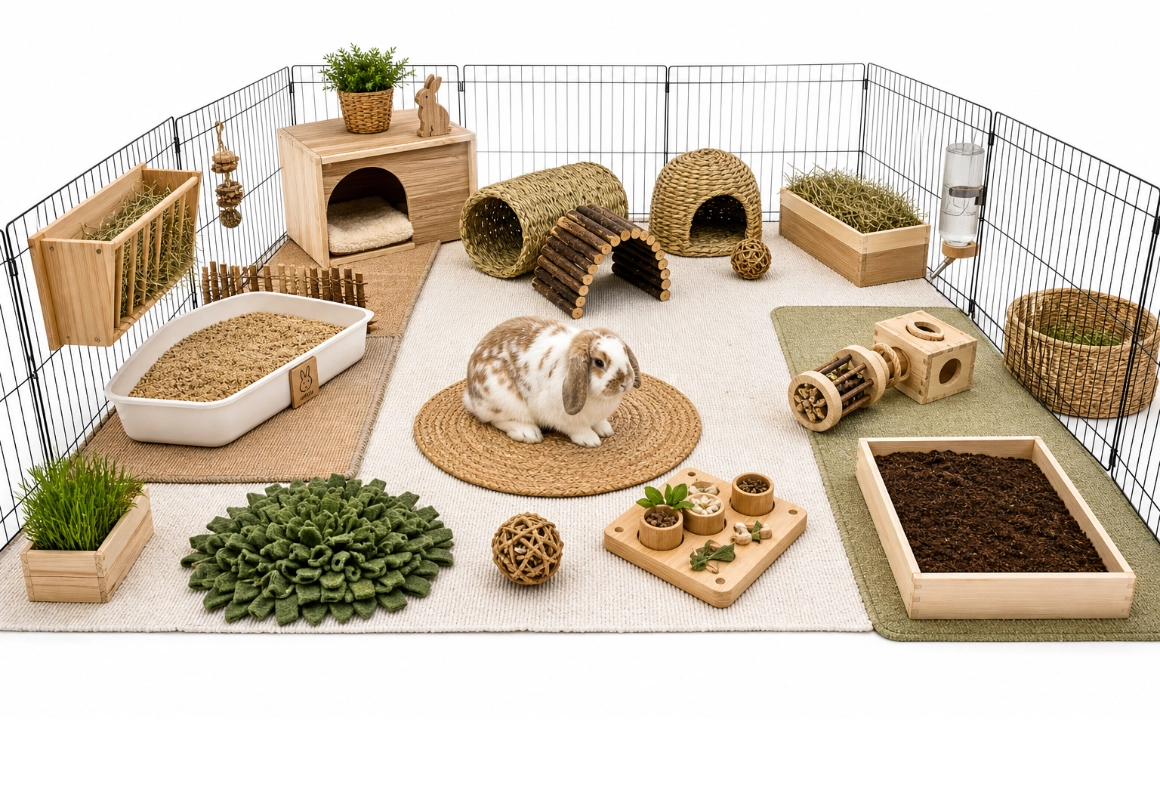 A rabbit room is a permanent indoor space that you furnish specifically for your rabbits. This can be an entire room, but also a spacious corner or a partitioned living area in the house. The goal is not only to allow your rabbits to run “free,” but also to ensure the space functions logically: with grip on the floor, a designated litter box, hay, drinking water, hiding places, tunnels, gnawing material, and quiet enrichment.
This page is part of our Rabbit Information . Here you can read how to make a rabbit room safe, which zones are useful, and how to cleverly combine products from the Rabbit Room category with toilets, floor mats, hay racks, houses, tunnels, digging boxes, and foraging toys.
✓ In short: a good rabbit room has grip, safe fencing, a litter box, hay, hiding places, exercise space, and enrichment.
✓ Work with zones: eating and toilet together, hiding places at the edges, open movement space in the middle, and enrichment scattered throughout the room.
✓ Make the room rabbit-proof: cables, plants, baseboards, furniture, smooth floors, and small openings deserve extra attention.
Quick links:
Why a rabbit room? · Rabbit-proofing · Creating zones · Flooring & grip · Litter box & hay · Enrichment · Maintenance · FAQ
Safe base
A rabbit room starts with safe fencing: no loose cables, poisonous plants, sharp edges, or places where your rabbit could get stuck.
Clear layout
With zones for the toilet, hay, rest, hiding, and play, the room becomes quieter for your rabbits and easier to keep clean.
Daily enrichment
Tunnels, digging boxes, gnawing material, and foraging toys give your rabbits something to do without making the room messy.
Why choose a rabbit room?
A rabbit room provides indoor rabbits with more living space than a small cage. You can arrange a room or enclosed space so that your rabbits can move, rest, eat, drink, shelter, gnaw, and search for food. This makes the living space much more logical than when all functions are clustered together in one small area.
A rabbit room requires preparation. The space must be safe, the floor must provide sufficient grip, and the layout must be practical for daily care. Therefore, do not view the room as an empty space, but as an enclosure with clear functions.
Handy shopping routes: Rabbit room · Rabbit runs · Rabbit hutch selection guide
Making the rabbit room safe: rabbit-proofing
Rabbits are curious and use their teeth to explore their surroundings. Therefore, safety is the first step. Tuck away cables, remove poisonous plants, screen off baseboards or vulnerable corners, and check for any openings your rabbit could get behind, under, or through.
Also pay attention to furniture. Rabbits can hide, gnaw, or get stuck under sofas, behind cabinets, or near low tables. This does not mean that no furniture should be in the room, but it does mean that you consciously check which areas are accessible and which are better to block off.
Rabbit-proof checklist
✓ Cables concealed or shielded.
✓ Keep poisonous plants out of reach.
✓ Skirtings, corners, and furniture protected where necessary.
✓ No small openings where your rabbit can get stuck.
✓ No slippery floor without a grippy surface.
✓ Sufficient safe alternatives to gnaw on, dig, and explore.
Useful shopping routes: Rabbit gnawing material · Rabbit bedding mats · Rabbit runs
Work with zones in the rabbit room
A nice rabbit room has clearly defined zones. This provides a sense of calm and makes the room easier to keep clean. Do not place everything in the middle of the room. Rabbits often feel more comfortable when hiding places, houses, and tunnels are positioned along edges or in sheltered spots, while ensuring there is plenty of free space to move around in the center.
Think of a hay and toilet area, a quiet shelter area, a free-roaming zone, and an enrichment zone. This way, every product gets a clear role, and you prevent the room from being cluttered with loose items without cohesion.
Logical zones in a rabbit room
✓ Hay and toilet area: rabbit toilet, toilet bedding, hay, and hay rack together.
✓ Rest zone: small house, tunnel, or sheltered spot where your rabbits can retreat.
✓ Walking zone: free space to move, turn, run, and pass each other.
✓ Enrichment zone: digging box, gnawing material, sniffing mat, or foraging toys.
✓ Care zone: a place where you can easily clean, check, and have supplies at hand.
Floor and grip: prevent slipping
Many floors in the home are slippery for rabbits. Think of laminate, PVC, tiles, or wood. A slippery floor can cause rabbits to move unsteadily, be less active, or have difficulty turning and pushing off. Therefore, grip is one of the most important features of a rabbit room.
Use floor mats, washable mats, or other grippy surfaces in areas where your rabbits walk, rest, and jump. Choose something that is firm, easy to keep clean, and does not shift easily. For rabbits that like to gnaw, checking for wear is especially important.
Floor check for indoor rabbits
✓ Does your rabbit have sufficient grip when walking and turning?
✓ Does the mat or surface stay in place well?
✓ Is the surface easy to clean?
✓ Is there a difference between the toilet area and the walking/rest area?
✓ Do you regularly check for gnaw marks, loose threads, or wear?
Useful shopping routes: Rabbit floor mats · Rabbit bedding · Rabbit cleaning products
Toilet area and hay in the rabbit room
A rabbit room becomes much easier to keep clean when you create a clear toilet area. Preferably, place the rabbit toilet where your rabbits already like to urinate or defecate. Use suitable litter bedding inside and make the rest of the room clearly distinct with floor mats or another type of substrate.
Hay near the toilet is often practical. Many rabbits enjoy eating hay while sitting on or near the toilet. A hay rack, hay sack, or hay feeder above or next to the litter box can therefore help make the spot logical and attractive.
Setting up a toilet area
✓ Choose a spacious litter box where your rabbits can sit comfortably.
✓ Use absorbent toilet bedding in the toilet bowl.
✓ Place hay near or above the toilet.
✓ If you have multiple rabbits or large rooms, consider placing multiple litter boxes.
✓ Check daily for wet spots, odor, and abnormal droppings.
Useful shopping routes: Rabbit toilets · Rabbit toilet bedding · Hay racks for rabbits · Litter training rabbits
Enrichment in the rabbit room
A rabbit room only becomes truly interesting when your rabbits have something to do. Think of tunnels to run through, houses to hide in, a digging box to dig in, gnawing material to explore, and foraging toys to make searching for food more fun.
Don't put everything down at once. Rotating items often works better than filling the entire room. This way, you maintain an overview, cleaning remains practical, and the room stays interesting. Place enrichment items primarily in logical spots: along edges, near tunnels, in an enrichment corner, or spread across multiple quiet search spots.
Enrichment for indoor rabbits
✓ Tunnels: create safe routes and sheltered passages.
✓ Shelters: provide peace and hiding places.
✓ Digging box: gives digging and sniffing a designated place.
✓ Chewing material: helps to properly manage gnawing and destructive behavior.
✓ Foraging toys: makes searching for kibble, herbs, or snacks more fun.
Useful shopping routes: Rabbit tunnels · Rabbit houses · Rabbit digging box · Rabbit gnawing material · Rabbit play & foraging
Keep the rabbit room clean and organized
A rabbit room remains most pleasant when you perform small daily checks. Remove wet litter spots, check hay and drinking water, look for droppings, and pay attention to wear and tear on mats, tunnels, houses, and gnawing material. This prevents cleaning from becoming a major chore.
Also pay attention to odor. A clear litter box, good bedding, and regular spot cleaning make a big difference. If your rabbits suddenly urinate next to the litter box or their droppings change, look not only at cleanliness, but also at behavior, stress, diet, and health.
Daily check
✓ Check the toilet tray and remove wet spots.
✓ Replace the hay when it has become wet or dirty.
✓ Check and replenish drinking water.
✓ Check droppings for quantity, shape, and change.
✓ Check ground mats, tunnels, and houses for wear.
✓ Remove small food remnants or old snacks from foraging areas.
Handy shopping routes: Rabbit cleaning products · Rabbit litter bedding · Rabbit droppings: what is normal?
Checklist: furnishing the rabbit room
Check these points
✓ Are cables, plants, and fragile furniture safely shielded?
✓ Does the floor have sufficient grip?
✓ Is there a clearly marked toilet area with toilet bedding?
✓ Is the hay always accessible, preferably in a logical place?
✓ Are there multiple shelters or sheltered routes?
✓ Is there free walking space left?
✓ Is there gnawing material, foraging toys, or a digging spot?
✓ Can your rabbits pass each other and move out of the way?
✓ Is the room practically easy to keep clean?
Important to know
A rabbit room is no substitute for daily checks. Check every day to see if your rabbits are eating well, producing normal droppings, responding actively, and do not have wet or dirty fur around their hindquarters.
Is your rabbit eating less, not defecating or barely defecating, puffed up, or reacting clearly differently than normal? Then contact a rabbit-specialist veterinarian immediately.
Frequently asked questions about furnishing a rabbit room
What is a rabbit room?
A rabbit room is a permanent indoor space that you furnish safely for your rabbits. This can be an entire room, but also a spacious, enclosed corner with sufficient grip, a litter box, hay, hiding places, and enrichment.
How do you make a room safe for rabbits?
Tuck away cables, remove poisonous plants, screen off fragile furniture and baseboards, and check for any small openings where your rabbit could get stuck.
Which flooring is suitable for a rabbit room?
A floor must provide sufficient grip and be easy to keep clean. On slippery floors, floor mats or other grippy surfaces are often useful.
Do you still need a rabbit cage for a rabbit room?
Not always. Some owners use a cage as a base for hay, a toilet, and rest, but a well-furnished rabbit room or spacious run can also serve as a permanent living space.
Where do you put the toilet in a rabbit room?
Preferably place the litter box in the spot where your rabbits already like to urinate or defecate. Place hay near or above the litter box, as many rabbits enjoy eating hay while sitting there.
What do you put in a rabbit room?
Consider a litter box, litter bedding, a hay rack, drinking water, ground mats, houses, tunnels, gnawing material, a digging box, and foraging toys. Additionally, ensure that there is still plenty of free space to move around.
How do you prevent a rabbit from gnawing on furniture?
Make vulnerable areas safe and offer attractive alternatives, such as gnawing material, tunnels, digging boxes, and foraging areas. Place these especially in places where your rabbit likes to be active.
How do you keep a rabbit room clean?
Create a clear toilet area, remove wet spots daily, check hay and water, remove old feed residue, and check mats, houses, and toys for wear or dirt.
Continue reading within Rabbit Information
Do you want to determine which type of enclosure suits you first? Then read the Rabbit Enclosure Selection Guide . For toilet behavior, you can read more under Litter Training a Rabbit . Do you want to enrich the room? Then check out Foraging for Rabbits , Digging Box for Rabbits , and Chewing Material for Rabbits . Or go back to the Rabbit Information .
Everything for a rabbit room at DRD Knaagdierwinkel®
At DRD Knaagdierwinkel®, you will find products to furnish a rabbit room in a practical, safe, and animal-friendly way. From bedding mats, litter boxes, and hay racks to houses, tunnels, digging boxes, gnawing material, and foraging toys: every item helps to structure the space logically.
✓ Everything for indoor rabbits neatly organized in one place
✓ Practical shopping routes for flooring, toilet, hay, rest, and enrichment
✓ Specialist since 2011
✓ Delivered from our own stock
View now: Rabbit room · Rabbit bedding mats · Rabbit toilets · Hay racks · Rabbit tunnels · Rabbit digging box .
