 Polski


Chewing material for rabbits: choosing, placing, and using
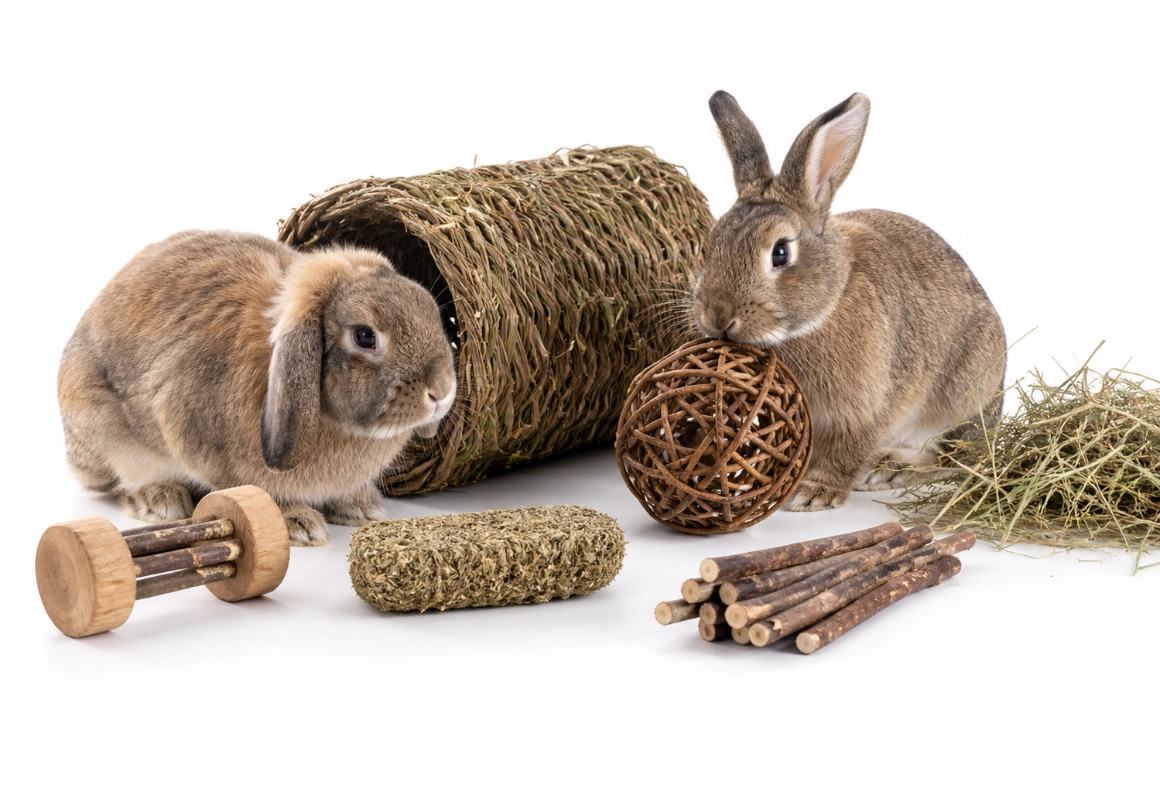 Rabbits enjoy gnawing. This is part of their behavior and can serve various functions: exploration, occupation, moving materials, satisfying destructive behavior, and preventing boredom. Well-chosen gnawing material gives this behavior a clear place in the enclosure, alongside the daily basics of hay, appropriate rabbit food, water, space, and resting spots.
This page is part of our Rabbit Information . Here you can read why gnawing material can be useful, what types are available, what to look out for when using it, and how to combine it with hay , foraging , tunnels, houses, and a logical rabbit room.
✓ In short: gnawing material is a form of enrichment and helps to give gnawing and destructive behavior a proper place.
✓ Hay remains the most important daily basis. Chewing material does not replace hay, complete feed, or veterinary advice for dental problems.
✓ Regularly check gnawing material for wear, loose parts, sharp edges, and dirt.
Quick links:
Why gnawing material? · Hay remains the basis · Types of gnawing material · Where to place it? · Gnawing on furniture · Combining with enrichment · Checklist · FAQ
Being natural
Chewing material gives rabbits something to explore, grab, destroy, and keep themselves occupied.
Next to hay
Hay remains the most important daily nibbling material. Gnawing products are supplementary for variety and enrichment.
Smart placement
Place gnawing material in places where your rabbits already enjoy spending time, such as near tunnels, resting spots, or foraging zones.
Why gnawing material for rabbits?
Rabbits explore their environment with their nose, mouth, and teeth. Gnawing can therefore stem from curiosity, boredom, habit, destructive behavior, or the need to keep busy. With good gnawing material, you give this behavior a clear place, so your rabbits are not solely reliant on furniture, baseboards, rugs, or cardboard boxes that are not intended for this purpose.
Chewing material is particularly effective when it is part of a complete living space. Think of sufficient hay, safe running space, a toilet area, resting places, tunnels, foraging toys, and variety. The product itself is therefore not the whole answer; its function within the enclosure makes it valuable.
Useful shopping routes: Rabbit gnawing material · Rabbits playing & foraging · Rabbit tunnels
Hay remains the most important basis
Chewing material is not a substitute for hay. Rabbits should have plenty of hay to eat daily. Hay provides prolonged chewing, aligns with their natural eating behavior, and is an important part of the daily feeding routine. When a rabbit eats little hay, simply providing extra chewing material will not solve the problem.
Therefore, view gnawing material as extra enrichment alongside hay. Use it to keep your rabbits occupied, allow them to explore materials, and provide a proper place for gnawing behavior. Is your rabbit eating little hay, eating less, or are the droppings noticeably changing? Then look further into diet, teeth, stress, environment, and health.
Handy shopping routes: Rabbit hay · Hay racks for rabbits · Rabbit hay selection guide
What types of gnawing material are there?
There are various types of gnawing material for rabbits. Think of willow branches, wooden toys, gnaw balls, edible tunnels, braided materials, hay toys, or houses that are allowed to be gnawed on. Which type suits you depends on your rabbits and how they use the material.
Some rabbits enjoy gnawing on sturdy branches, while others prefer pulling, destroying, or pushing lighter materials. It can therefore be wise to try out multiple textures. Pay particular attention to interest, safety, wear and tear, and whether the material is suitable for the place where you use it.
Choosing gnawing material based on function
✓ Branches and twigs: great for rabbits who like to gnaw on real material.
✓ Chew balls: suitable for pushing, rolling, pulling, and nibbling.
✓ Wooden toys: useful as a regular activity in the enclosure.
✓ Tunnels and houses: combine hiding, walking, and gnawing.
✓ Hay toys: combines nibbling, hay, and foraging.
View now: Chewing material for rabbits · Rabbit houses · Rabbit tunnels
Where do you place gnawing material in the enclosure?
Chewing material works best when you place it in spots where your rabbits already enjoy spending time. For example, place it near a tunnel, along a runway, next to a house, or near a foraging area. This way, it becomes part of the enclosure instead of a loose item left lying in a corner.
It is better to use several small gnawing points than one large product in an illogical place. This is also more practical with multiple rabbits, as each rabbit can then choose its own spot. However, do check regularly what is happening with the material: is it being used neatly, completely ignored, or destroyed too quickly?
Good places for gnawing material
✓ Near tunnels or small houses that your rabbits like to walk past.
✓ In a foraging zone with herbs, hay, or sniffing toys.
✓ In places where your rabbit likes to gnaw or destroy things.
✓ Not directly in wet toilet bedding or next to drinking water.
✓ Distributed throughout the enclosure among multiple rabbits.
My rabbit gnaws on furniture, baseboards, or rugs.
Chewing on furniture, baseboards, cables, or rugs is common among indoor rabbits. This does not automatically mean that your rabbit is “disobedient.” It could be curiosity, boredom, habit, material preference, or a setup with too few attractive alternatives.
Start by making the environment safe. Cables, poisonous plants, and fragile materials should be out of reach. Next, you can observe where your rabbit likes to gnaw and offer suitable alternatives. Consider willow, wood, gnaw balls, suitable cardboard products, tunnels, or a designated, supervised destruction area.
What can you try?
- First, make cables, plants, and fragile furniture safe or out of reach.
- Offer gnawing material in the places where your rabbit already shows interest.
- Use tunnels, houses, and digging boxes to make the living space more interesting.
- Combine gnawing material with foraging, for example with herbs or a few pellets.
- Vary the materials when your rabbit gets bored quickly.
Useful shopping routes: Rabbit room · Rabbit gnawing material · Rabbit digging box
Combining gnawing material with enrichment
Chewing material becomes stronger when combined with other forms of enrichment. For example, place a chew ball near a tunnel, hang a safe chewing product at a different height, hide some hay or herbs in a suitable product, or place chewing material next to a digging box.
This way, you give your rabbits not just “something to gnaw on,” but a small activity: walking, sniffing, pulling, pushing, destroying, searching, and resting. It is precisely this combination that makes an enclosure more interesting.
Combination ideas
✓ Place a chew ball near a tunnel or little house.
✓ Combine willow branches with a hay bale.
✓ Use herbs to make a gnawing or sniffing spot more attractive.
✓ Set up a digging box, tunnel, and gnawing material as an enrichment corner.
✓ Rotate weekly, so that not everything has to be in the enclosure at the same time.
Useful shopping routes: Foraging for rabbits · Digging box for rabbits · Rabbit herbs
Checklist: choosing gnawing material for rabbits
Check these points
✓ Is hay always plentiful?
✓ Does the material suit the size and behavior of your rabbits?
✓ Is the product intended for use in rabbits?
✓ Is it standing or lying in a logical place in the enclosure?
✓ Can multiple rabbits be added without crowding?
✓ Do you regularly check for wear, sharp edges, and loose parts?
✓ Is the material getting wet, dirty, or musty? Then replace it on time.
✓ Is your rabbit still eating well, pooping, and reacting normally?
Important to know
Chewing material provides enrichment and activity, but it is not a solution for dental problems. Is your rabbit eating less, leaving the hay untouched, drooling, losing weight, producing fewer droppings, or does it seem to be in pain? Then contact a veterinarian specializing in rabbits.
Always check gnawing products for proper use and wear. Remove products if they are broken, sharp, wet, or heavily soiled.
Frequently asked questions about gnawing material for rabbits
Does a rabbit need gnawing material?
Chewing material is a valuable form of enrichment. It gives rabbits something to discover, destroy, and keep themselves occupied. However, hay remains the most important daily staple.
Is gnawing material good for rabbits' teeth?
Prolonged chewing on fiber-rich hay is the most important basis for the daily dental and dietary rhythm. Chewing material can provide additional activity, but it does not replace hay and does not solve dental problems.
Which gnawing material is suitable for rabbits?
Choose products intended for rabbits, such as suitable branches, willow, wooden toys, chew balls, tunnels, or houses that are allowed to be gnawed on. Pay attention to size, material, wear and tear, and placement.
Why does my rabbit gnaw on furniture?
This can be caused by curiosity, boredom, material preference, or a lack of attractive alternatives. Make the environment safe and offer gnawing material in places where your rabbit already enjoys spending time.
Can you combine gnawing material with foraging?
Yes, that often works very well. For example, you can combine gnawing material with hay, herbs, tunnels, a digging box, or a sniffing area. That way, it becomes part of an activity.
How often should you replace gnawing material?
Replace gnawing material when it is broken, sharp, wet, musty, or heavily soiled. Check regularly, especially with rabbits that are avid destroyers.
My rabbit isn't using gnawing material, what now?
Try a different texture, place the product in a more interesting spot, or combine it with hay, herbs, or a tunnel. Not every rabbit has the same preference.
Is cardboard suitable as gnawing material?
Some cardboard products may be suitable if they are intended for that purpose and are used without unsuitable additives. Always check that your rabbit uses the product safely and remove wet, damaged, or heavily chewed cardboard in time.
Continue reading within Rabbit Information
Do you want to do more with searching and sniffing? Then also read Foraging for rabbits . Do you want to create an enrichment area with digging and searching? Then check out Digging Box for rabbits . For hay as a daily basis, you can read more in the Rabbit Hay Selection Guide . Or go back to the Rabbit Information .
Chewing material and enrichment at DRD Knaagdierwinkel®
At DRD Knaagdierwinkel®, you will find gnawing materials and enrichment that you can logically incorporate into your rabbits' enclosure. Think of willow, wood, gnawing balls, tunnels, houses, hay, herbs, and foraging toys. This way, each item acquires a clear function: gnawing, searching, hiding, exploring, or quietly engaging in activities.
✓ Chewing material, tunnels, and enrichment neatly organized together
✓ Practical to combine with hay, herbs, digging bucket, and foraging
✓ Specialist since 2011
✓ Delivered from our own stock
View now: Rabbit gnawing material · Rabbit play & foraging · Rabbit tunnels · Rabbit houses · Rabbit digging box .
