 Polski


Foraging for rabbits: searching for food as daily enrichment
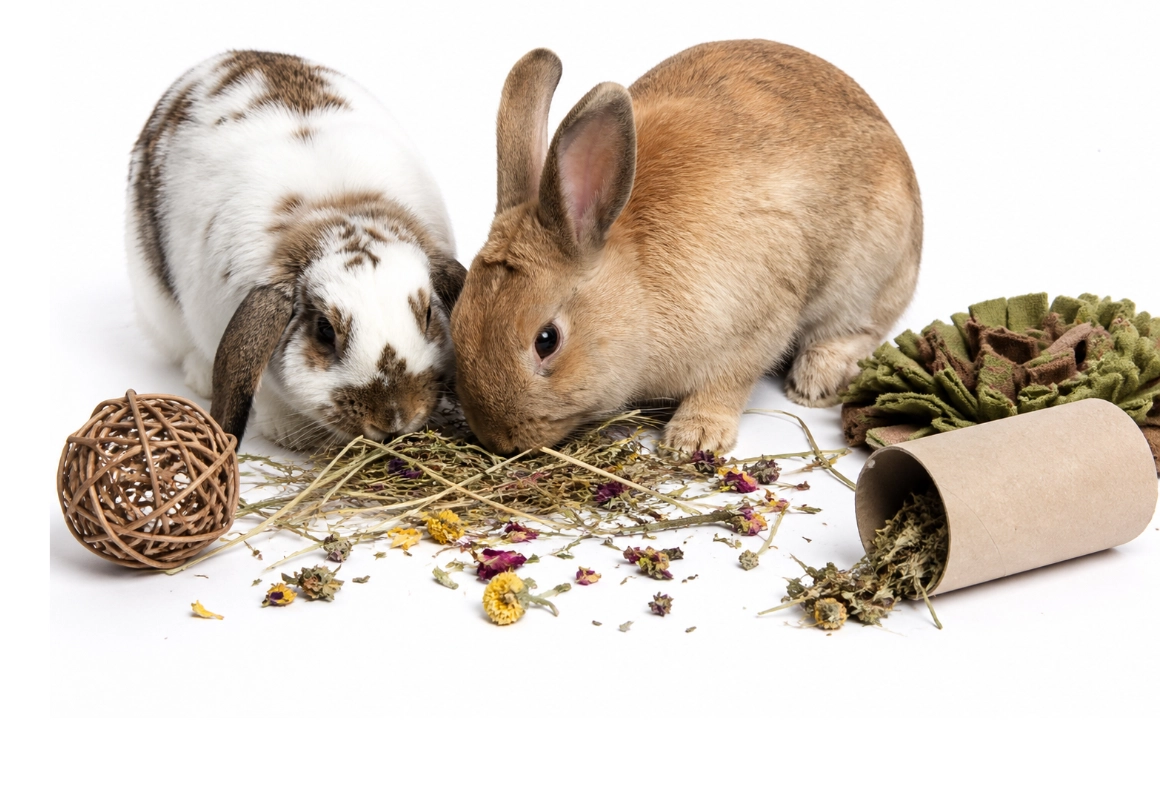 Foraging means that your rabbits don't just get their food from a bowl, but are also allowed to search for it. This aligns nicely with natural behavior: sniffing, choosing, nibbling, exploring, and being quietly occupied. You don't need to start with something complicated for this. Enriching a little hay with herbs, scattering pellets, or using a snuffle mat can already make a big difference.
This page is part of our Rabbit Information . Here you can read how to safely and practically incorporate foraging into your routine using hay , herbs , pellets, snacks, sniffing mats, treat balls, food rolls, and digging boxes.
✓ In short: foraging makes searching for food more fun and gives your rabbits something natural to do.
✓ Start simply by offering hay, herbs, or a portion of the daily pellets spread out.
✓ Choose foraging products that suit your rabbits, their size, experience, age, and movement.
Quick links:
What is foraging? · Why forage? · Enriching hay · Scattering pellets · Foraging toys · Digging box & sniffing box · Build up gradually · FAQ
Searching for food
Use a portion of the daily food to let your rabbits search, sniff, and choose.
Making hay more interesting
Herbs, flowers, or leaves mixed into the hay can make a hay spot more attractive.
More activities
Snuffle mats, treat balls, food rolls, and digging boxes provide more variety during the day.
What is foraging in rabbits?
Foraging means searching for food. For rabbits, this is much more than just finding something tasty. It involves sniffing, moving, choosing, nibbling, and engaging with their surroundings. Instead of placing everything ready-made in one food bowl, you can spread or hide part of the daily food.
That can be done very simply. Think of herbs mixed into the hay, a few pellets in a snuffle mat, a treat ball with small pieces, or a handful of hay in a safe box. The goal is not to make eating difficult, but to let your rabbits calmly do something that suits their behavior.
Useful shopping routes: Rabbit play & foraging · Training & foraging toys · Rabbit herbs
Why is foraging good for rabbits?
Rabbits are curious and active. When food is always offered in exactly the same way, it is gone quickly and the moment is over. Foraging makes eating last longer and keeps your rabbit more engaged with its surroundings. This provides variety without having to clutter the enclosure with loose items.
Foraging is particularly powerful because you immediately give daily food a function. The pellets, herbs, or small snacks you already provide are not only eaten but also sought out. This way, you turn an ordinary feeding time into a small enrichment moment.
Foraging helps with
✓ Search, browse, and discover more.
✓ Eat slower and more actively.
✓ Present hay, herbs, and pellets in a more interesting way.
✓ More variety in the daily routine.
✓ Make the enclosure more functional with searching spots, resting areas, and walking space.
Enriching hay: the easiest start
Hay is the daily staple for rabbits and therefore the easiest place to start foraging. You can mix a small amount of herbs, flowers, or leaves into the hay. This causes many rabbits to sniff and search more actively through the hay.
Mix herbs with hay with care. You do not want your rabbit to simply pick out the herbs and leave the hay. Therefore, scatter them in small pieces, distribute them well, and alternate between different hay spots. A hay rack near the litter box can also be handy, as many rabbits enjoy eating hay while sitting there.
Ideas with hay
✓ Sprinkle a small amount of herbs through a handful of hay.
✓ Make several small hay piles instead of one large heap.
✓ Use a hay rack, hay sack, or hay bin to keep hay clean.
✓ Vary the scent and texture, for example, other hay or herbal hay.
✓ Place hay near the litter box if your rabbits like to eat there.
Useful shopping routes: Rabbit hay · Rabbit herbs · Hay racks for rabbits
Spread the kibble instead of putting everything in a bowl
You can use part of the daily rabbit food portion for foraging. Instead of putting all the pellets in a food bowl, you can spread a small portion in a snuffle mat, treat ball, snack roll, or among a handful of hay. This way, the portion remains the same, but the moment becomes more active.
This works especially well for rabbits that eat their food quickly. By letting them search for the pellets, they eat more slowly and take longer. Do weigh out the daily portion as usual, so that foraging does not become extra food on top of the normal amount.
Using kibble smartly
- Use a portion of the normal daily portion.
- Distribute kibble in a snuffle mat or food roll.
- Scatter a few pellets among hay or herbs.
- Start easy and only make it harder when your rabbits understand it.
- Check that each rabbit has sufficient opportunity to search and eat.
Convenient shopping routes: Rabbit food · Training & foraging toys · Food bowls
Foraging toys for rabbits
Foraging toys help make searching for food an easier part of the day. Think of snuffle mats, treat balls, food rolls, treat plates, and puzzles. Always choose a product that suits your rabbits. A young, active rabbit can sometimes handle more of a challenge than an older rabbit or a rabbit that moves less smoothly.
Start with a simple version. First, let your rabbits understand that there is something to be found. Then, you can make it more difficult by filling it less visibly, placing the mat differently, or spreading the pellets more widely. Check toys regularly for wear and tear and remove broken parts.
Which shape suits your rabbit?
✓ Snuffle mat: great for searching with nose and mouth, especially with kibble or herbs.
✓ Snack ball: handy for small pieces or kibble that roll out while moving.
✓ Feeding roller: suitable for dispensing kibble or small snacks.
✓ Snack board: fun for quiet searching and small rewards.
✓ Hay toys: suitable for presenting hay and herbs together in a more interesting way.
View now: Rabbit play & foraging · Training & foraging toys .
Digging box or sniffing box for rabbits
A digging box or sniffing box can also be part of foraging. For example, you can hide hay, safe sniffing materials, herbs, or a few pellets in it. This way, searching is combined with digging, pushing, sniffing, and discovering.
When choosing a digging box, pay close attention to the material, dust, moisture, and cleaning. The box must suit your rabbits and the location where it is placed. Indoors, you usually want a practical box that doesn't make too much mess; outdoors, you pay extra attention to moisture, dirt, and hygiene.
use excavator bucket
- Start with a low, easily accessible container.
- Use materials that suit the rabbits and the location in the enclosure.
- Hide small amounts of herbs or chunks.
- Check regularly for moisture, dirt, and sharp edges.
- Take into account the age, size, and agility of your rabbits.
Handy shopping routes: Rabbit digging box · Rabbit herbs · Rabbit snacks
Gradually build up foraging
Not every rabbit understands new toys immediately. Therefore, start simple. Place a few pellets visibly in a snuffle mat or among some hay. As soon as your rabbits understand that there is something to be found, you can gradually make it more challenging.
When you have multiple rabbits, pay close attention to their distribution. Some rabbits search faster or are bolder than others. In that case, create multiple foraging spots so that every rabbit can participate calmly. Foraging should not become a battle, but rather a pleasant activity.
Building up in steps
✓ Start looking for visible food.
✓ Use familiar chunks or herbs.
✓ Only make it more difficult when your rabbits understand it.
✓ Create multiple search locations for multiple rabbits.
✓ Check toys and bins regularly for wear and dirt.
✓ Stop or make it easier when your rabbit becomes frustrated or cannot reach the food properly.
Checklist: foraging for rabbits
Check these points
✓ Are you using part of the normal daily portion instead of extra food?
✓ Is the foraging game easy enough to start with?
✓ Can all the rabbits participate calmly?
✓ Does the toy suit the size and activity level of your rabbits?
✓ Will hay remain the daily staple?
✓ Check your toys and digging buckets for wear, dirt, and moisture?
✓ Do you pay attention to appetite, droppings, and behavior when using new snacks or spices?
Important to know
Foraging is intended to make searching for food more enjoyable and natural. It is not a substitute for sufficient space, companionship, resting places, hay, clean drinking water, and appropriate nutrition.
Is your rabbit eating less, producing abnormal droppings, or do you notice clearly different behavior? Then stop giving new treats and, if in doubt, contact a rabbit-specialist veterinarian.
Frequently asked questions about foraging for rabbits
What is foraging in rabbits?
Foraging means searching for food. With rabbits, you can encourage this by not only giving pellets, herbs, snacks, or hay in a bowl, but by scattering or hiding them.
Why is foraging good for rabbits?
Foraging gives rabbits something to do. They can sniff, search, pick, and move. As a result, an ordinary feeding time becomes a form of daily enrichment.
What can you start with?
Start simple with a few pellets in a snuffle mat, herbs mixed into the hay, or a small amount of food in a treat ball. Only make it more difficult when your rabbits understand it.
Can you use hay for foraging?
Yes, hay is actually a great base for foraging. You can mix small amounts of herbs, flowers, or leaves into the hay so that your rabbits will sniff and search more.
Is a snuffle mat suitable for rabbits?
A snuffle mat can be suitable for rabbits, especially with small pellets or herbs. However, check that your rabbits handle it gently and that the mat remains intact.
Can you use snacks for foraging?
Yes, but use snacks in small quantities and deliberately. It is even better to also use a portion of the normal daily ration of kibble or herbs, so that foraging does not automatically mean extra food.
What if one rabbit finds everything faster than the other?
Create multiple foraging spots or give each rabbit its own foraging time. This prevents one rabbit from eating everything and the other from getting little of a chance.
How often can you offer foraging?
This can be done daily, as long as you keep it calm and the food remains consistent with the normal daily portion. Small, simple search moments often work better than one very difficult game.
Continue reading within Rabbit Information
Do you want to better understand how foraging fits into the complete diet? Then also read What does a rabbit eat? . Do you want to use herbs responsibly? Then check out Herbs for rabbits . For the complete basics, you can return to the Rabbit Checklist or to the Rabbit Information .
Foraging toys and enrichment at DRD Knaagdierwinkel®
At DRD Knaagdierwinkel®, you will find various products to easily make foraging a part of the day for rabbits. Think of snuffle mats, treat balls, food rolls, herbs, snacks, hay, digging boxes, and toys that make searching for food more fun.
✓ Foraging toys, herbs, and snacks neatly organized together
✓ Practical to combine with hay, pellets, and digging buckets
✓ Specialist since 2011
✓ Delivered from our own stock
View now: Rabbit play & foraging · Training & foraging toys · Rabbit herbs · Rabbit snacks · Rabbit digging box .
