 Polski



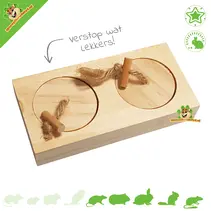
Wooden Foraging Puzzle Game Flip Up 18 cm for Rodents
- Dispatched from our own stock
- Personal & expert advice
- Always 100% rodent-friendly
- Ordered before 5 p.m., shipped the same day!
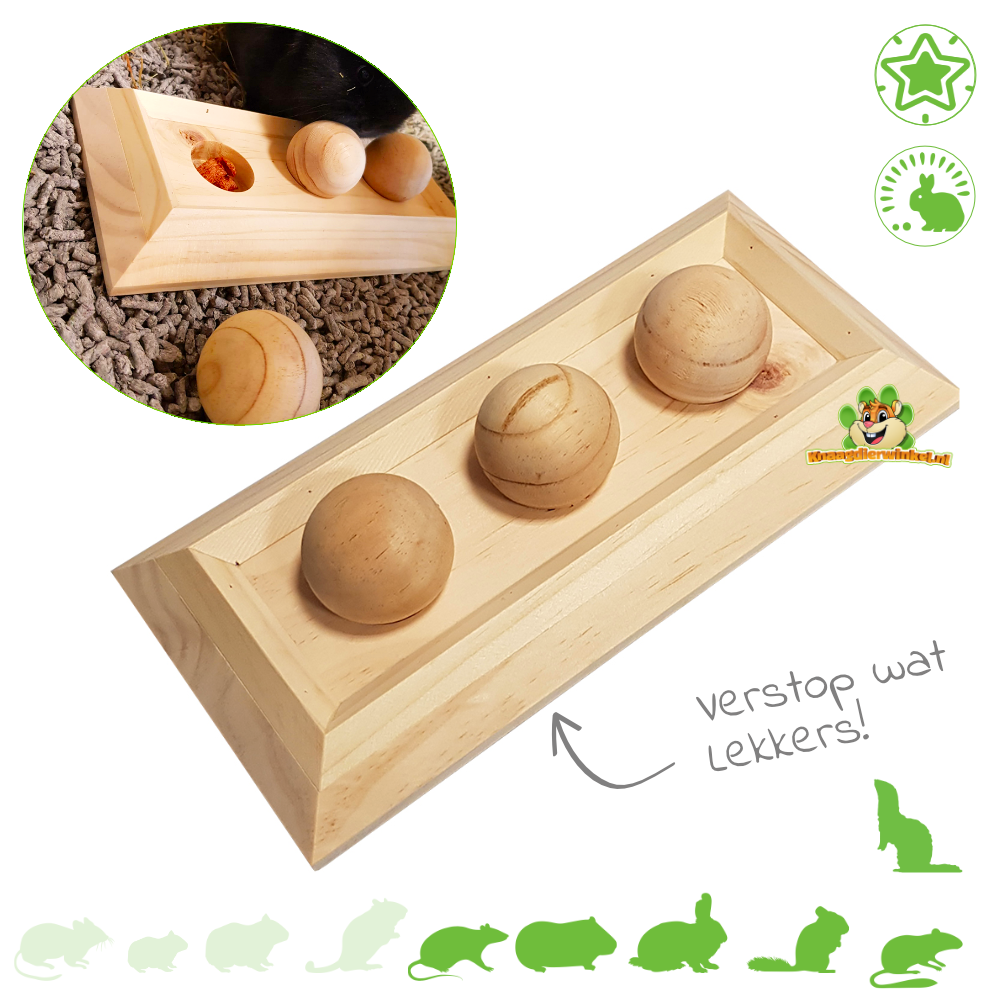
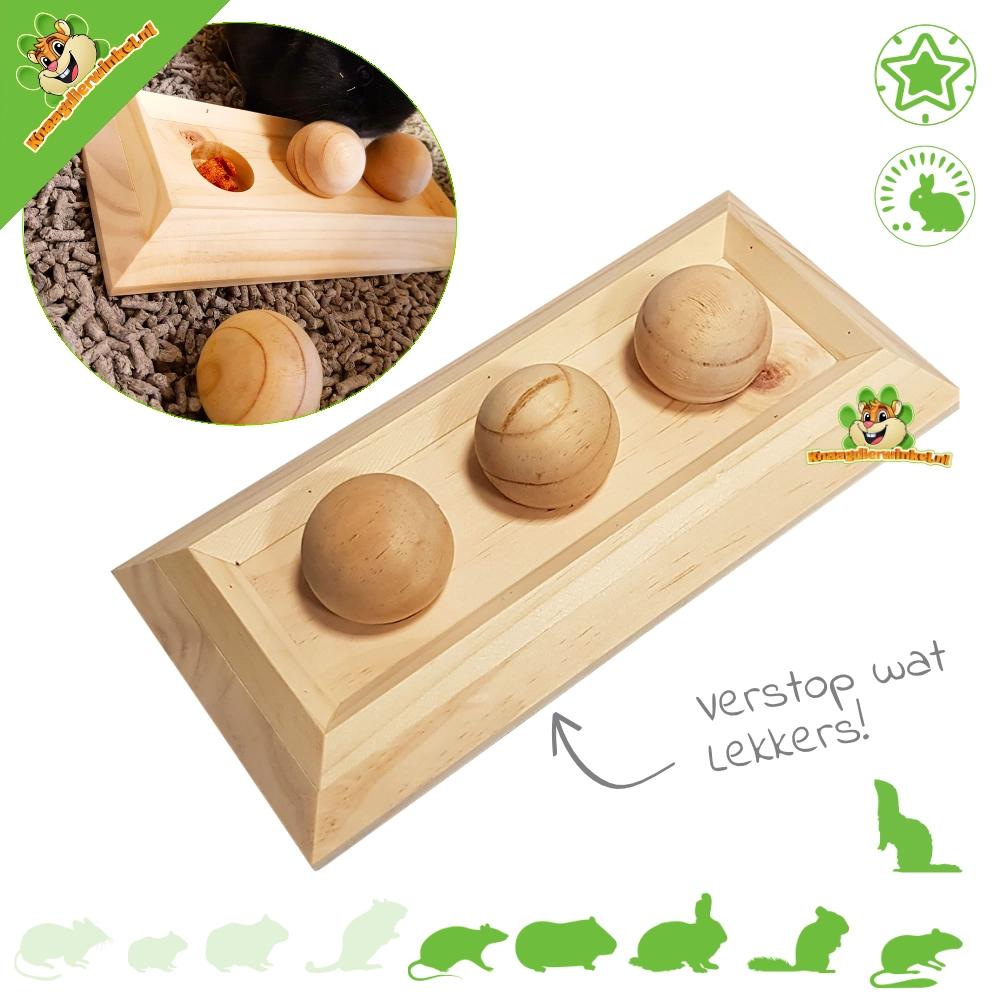
Wooden Foraging Puzzle Game Balls 28 cm for rodents, rabbits & ferrets
The Wooden Foraging Puzzle Balls 28 cm is a fun food puzzle for animals that love to search, sniff, push, and discover. You hide small kibble, herbs, or suitable snacks in the puzzle, and your animal has to figure out how to get to the reward on its own. By moving or hiding the wooden balls, an active foraging moment is created that makes snacking just a little more interesting.
When it comes to puzzle games, DRD focuses primarily on their function in daily use. This game is not a standard toy simply left lying in the enclosure, but a deliberate activity for short, supervised play sessions. Rats, guinea pigs, rabbits, chinchillas, degus, and ferrets, in particular, can benefit from an extra challenge with such a puzzle, provided the filling is suitable for the species and the animal is given ample time to learn to understand the game.
In short
- Wooden foraging puzzle game with balls
- Dimensions approx. 28 × 13 × 6 cm
- Suitable for rats, guinea pigs, rabbits, chinchillas, degus, and ferrets
- To be filled with kibble, herbs, or suitable small snacks
- Stimulates searching, sniffing, trying, and active foraging
- For short, supervised play sessions
Advantages of the Wooden Ball Puzzle Game
✔ Fairly large wooden intelligence game of approx. 28 cm
✔ Makes snacking more active and challenging
✔ Fun for animals who like to search, push, and explore
✔ Suitable for rats, guinea pigs, rabbits, chinchillas, degus, and ferrets
✔ To be used with part of the daily diet or suitable snacks
✔ Combines well with training & foraging and interactive snacks
Why choose a wooden foraging puzzle game?
Animals naturally spend a lot of time searching for food. In an enclosure or run, food is often clearly laid out, but a puzzle game makes that moment more active. Your animal has to sniff where something tasty is, try to figure out how the balls work, and discover which movement yields results. This makes foraging more fun and less predictable.
This Wooden Ball Puzzle Game is particularly interesting because it provides a clear task: there is a tasty treat hidden, but your pet has to work for it. Some animals grasp this quickly, while others need a little more time. That is precisely part of the game. Therefore, start easy with good-smelling rewards and a few open or partially visible compartments. Then, you can make the game more challenging step by step.
A puzzle game is not a product that needs to remain in the enclosure all day. It works best as a deliberate play moment. You place it down, fill it with something suitable, let your animal search, and then remove it again. This keeps the game interesting and prevents it from getting dirty or unnecessarily chewed on.
For which animals is this puzzle game suitable?
- Rat: very suitable as a food puzzle and training game. Rats are curious and can easily learn how to get snacks or pellets out of a puzzle game. Use small pieces of appropriate reward or a portion of their daily food.
- Dwarf rat: may be suitable if the size and weight of the game match your dwarf rat. Because dwarf rats can vary in size and strength, it is a good idea to calmly test how your animal handles the balls.
- Guinea pig: suitable as a quiet foraging game with pellets, herbs, or small pieces of dried vegetables. Not every guinea pig understands it immediately, so start simple and let your guinea pig search at its own pace.
- Rabbit: suitable as a puzzle game for pellets, herbs, or small, matching snack pieces. For rabbits, it is helpful to start with something low-threshold so they learn that the balls can be moved.
- Chinchilla: suitable as a dry foraging toy with matching pellets or dried herbs. Do not use moist filling and keep the portions small.
- Degu: suitable as a puzzle game with degu-appropriate treats or herbs. Preferably avoid sweet fillings and use the game as a short activity under supervision.
- Ferret: suitable as a playful puzzle game with rewards appropriate for ferrets. Use it during a controlled play session and remove the game after use.
For mice, dwarf hamsters, hamsters, and gerbils, this puzzle game is usually too large and heavy to serve as a practical food puzzle. For these smaller animals, more compact foraging toys, scatter food, sniffing spots, or small snack rolls are often more logical. For this, take a look at hamster play & foraging or mouse toys , for example.
How do you use the Wooden Ball Puzzle Game?
Place the puzzle game on a flat, stable surface. Fill a few compartments with small kibble, dried herbs, or suitable treats. At first, do not place the balls in too difficult a spot so that your animal experiences success quickly. As soon as your animal realizes there is something to find, you can make the game more challenging by hiding the reward better.
Always use the puzzle game under supervision. Let your animal try calmly and only help when absolutely necessary. Some animals will sniff first, while others immediately push against the balls or try to use their paws. This difference is normal. It is precisely the act of discovery that makes this type of toy fun.
Remove the puzzle game from the enclosure after playtime. This keeps the game clean, interesting, and looking good for longer. Preferably, do not use it with wet or sticky food, as this can soak into the wood and make it more difficult to clean.
Which filling works well?
The best filling depends on the animal species. For rats, you can use small pieces of vegetables, pellets, or suitable snacks. For guinea pigs and rabbits, pellets, dried herbs, small pieces of dried vegetables, or a portion of their daily diet are suitable. For chinchillas and degus, it is preferable to choose dry herbs or suitable pellets and avoid sweet or moist filling as the standard choice.
Use small portions. A puzzle game doesn't need to be full to be interesting. Often, a few well-chosen rewards work better than many individual snacks. This keeps the game manageable and ensures you use it as enrichment rather than as an extra-large snack portion.
You can find handy combinations, for example, with interactive snacks , rodent and rabbit herbs , and kibble and pellet food .
Build up gradually for more success
Not every animal understands a puzzle game immediately. That is okay. Start with an easy version: place a few treats visibly in the compartments and leave the balls lying loose or half to the side at first. Your animal will then learn that there is something to find. After that, you can increasingly use the balls to hide the reward.
For guinea pigs and rabbits, it can help to use strongly scented herbs or a familiar treat. Rats and ferrets are often more inclined to actively try and explore. Chinchillas and degus can be somewhat more cautious or, conversely, very enthusiastic; therefore, observe your animal's behavior closely and adjust the difficulty accordingly.
Material & dimensions
- Product: Wooden Foraging Puzzle Game Balls 28 cm
- Material: wood
- Dimensions: approx. 28 × 13 × 6 cm
- Use: foraging, training, searching, sniffing, and puzzle play
- Suitable for: rats, guinea pigs, rabbits, chinchillas, degus and ferrets
Because the puzzle game is made of wood, it may show signs of wear from animals that like to gnaw. This is inherent to natural materials, but the game must remain safe and tidy. Therefore, check it regularly and, above all, use it as an activity under supervision.
Cleaning & maintenance
Remove all food residue from the puzzle game after use. Preferably use dry filling, as wood can absorb moisture. If cleaning is necessary, wipe the game with a slightly damp cloth and allow it to dry completely before using or storing it again.
Also check the balls and the edges of the compartments. Do you see loose parts, sharp edges, or obvious damage? If so, take the game out of use. With avid gnawers, such as some rats, degus, or ferrets, wear may become visible more quickly.
Easy to combine with
This puzzle game works best in combination with small, dry treats that are well-suited to the animal species. This way, you turn a snack time into an active search moment.
- Training & foraging for more food puzzles and puzzle games
- Interactive snacks for active snack moments
- Rodent and rabbit herbs to hide in the puzzle game
- Rats playing & foraging for smart rat enrichment
- Rabbit training & foraging toys
Good to know
Offer the puzzle game only under supervision and check regularly for wear and tear. Use the game as a short activity and remove it from the enclosure after playtime. This ensures the game remains interesting, clean, and safe to use.
Preferably do not use wet or sticky filling. Tailor the reward to the animal species and give small amounts. For guinea pigs and rabbits, hay remains the basis of their daily diet; this puzzle game is primarily intended as an extra foraging and snacking moment.
Frequently asked questions about the Wooden Ball Puzzle Game
Is this puzzle game suitable for rats?
Yes, this puzzle game is very suitable for rats. Rats are curious and can often learn well how to get pellets or snacks out of a food puzzle.
Can my rabbit use this puzzle game?
Yes, rabbits can use this puzzle game with small pieces of suitable snack, herbs, or pellets. Start easy so your rabbit learns that the balls can be moved.
Is this puzzle game suitable for guinea pigs?
Yes, guinea pigs can use this puzzle game. Some guinea pigs need a little more time to understand the game. Therefore, start with scented herbs or a familiar treat and do not make the game too difficult right away.
Can I use this puzzle game for chinchillas or degus?
Yes, for chinchillas and degus you can use the game with dry, suitable pellets or herbs. Do not use moist filling and keep the portions small.
Is this puzzle game suitable for ferrets?
Yes, ferrets can use this puzzle game during a controlled play session with appropriate rewards. Remove the game after use and check for wear.
What can I do in the thinking game?
Use small dry kibble, dried herbs, or suitable snack pieces. Always tailor the filling to the animal species. Preferably do not use wet or sticky food.
May the puzzle game remain in the enclosure?
We recommend removing the puzzle game after playtime. This way, it remains clean, safe, and interesting for next time.
What if my pet doesn't understand the game right away?
Then start easier. First, place the reward visibly and only use the balls later to cover the compartments more. This way, your animal learns how the puzzle game works step by step.
Useful shopping links
- Training & foraging
- Interactive snacks
- Rodent and rabbit herbs
- Rats playing & foraging
- Rabbit training & foraging toys
The Wooden Foraging Puzzle Game Balls 28 cm is a great choice for owners who want to turn snacking into an active foraging moment. By hiding small kibble, herbs, or suitable snacks, you give rats, guinea pigs, rabbits, chinchillas, degus, and ferrets a fun puzzle that they can learn to solve step by step.
| Size (approx): | 28 x 13 x 6 cm |
| Suitable for: | Rodents, Rat, Guinea Pig, Rabbit, Chinchilla, Degu | Ferret |
| Particularities: | Offer only under supervision |
| Safety Information: | Offer only under supervision. Check regularly for wear and tear |


Mijn konijnen krijgen die balletjes niet uit het vakje.. met de balletjes los spelen ze wel.
rat speel er mee e n is er uren zoet mee