Polski

Campbell's dwarf hamster – care, housing, nutrition & behavior
 The Campbell's dwarf hamster (often written as Phodopus (sungorus) campbelli , now usually Phodopus campbelli ) is native to the steppes of Altai, Tuva, Northern Mongolia, and Manchuria. This species is closely related to the Russian dwarf hamster . In the past, they were sometimes considered a (sub)species, but this was later changed when it became clear that they were two different species. On this page, you can read how to keep a Campbell's dwarf hamster happy: from housing and bedding to nutrition, taming, and health. DRD Rodent Shop® has been a specialist since 2011 and helps you choose based on well-being, safety, and a logically designed enclosure.
Head-body length: up to 14 cm
Weight: usually 55 – 65 grams (depending on build and condition)
Life expectancy: average 1.5 – 2 years
Directly to the Hamster shop: Hamster (all) · Hamster cages & enclosures · Bedding · Hamster food · Exercise wheels
Quick to:
- Behavior & daily routine
- Taming & building trust
- Keeping together: when is it possible and what should you pay attention to?
- Housing & furnishing (hamsterscaping)
- Ground cover & excavation layer
- Houses, tunnels & shelters
- Running wheel: size & safety
- Sand bath: which sand and how do you use it?
- Nesting material & nest building
- Nutrition (incl. sugars/diabetes)
- Gnawing material & teeth
- Health & prevention
- Useful shopping links
- FAQ
Campbell's Dwarf Hamster Checklist (Quick, Good Basic)
- ✓ Choose a spacious enclosure with plenty of ground surface and fixed zones (nest, sand, runs).
- ✓ Provide a deep, diggable layer of ground cover (guideline: around 20cm or more).
- ✓ Provide hiding routes : multiple houses, tunnels and shelters.
- ✓ Provide a safe exercise wheel with a closed running surface (minimum 20 cm).
- ✓ Add a sand bath as a permanent zone and keep it clean.
- ✓ Feed complete (dwarf) hamster food and be careful with sugary snacks.
- ✓ Check daily: food/drink , activity, coat/eyes/nose and feces; if in doubt, consult a vet early.
✓ Digging & foraging
Campbell's thrive on deep substrate, fixed zones, and food that can be (partially) scattered to encourage foraging.
✓ Approach calmly
Trust is built through predictability: short sessions, a soft voice, and rewards. Letting your hamster choose for itself works best.
✓ Conscious with sugars
Many Campbell's lines are prone to diabetes. Therefore, a suitable basic diet and sensible snacking are especially important.
Behavior & daily routine
Campbell's dwarf hamsters are crepuscular : you'll see the most activity in the evening and early morning. They often sleep in short bursts (cyclically), so you'll also see them awake regularly during the day. They are prey animals: a secure enclosure with plenty of hiding places provides your hamster with peace and quiet and encourages natural behaviors such as digging, gathering, nest-building, and foraging.
Taming & building trust
A Campbell's can make lovely contact, but taming them is best achieved in small steps. Especially in the beginning, picking them up can be a little daunting. Because of their limited depth perception, they can unexpectedly run away from your hand if startled, so always work low over a soft surface and take your time.
- Start (week 1): Get used to your voice and routine. Speak calmly during your stay and maintain regular contact.
- Building up (week 2): Hold your hand still in the enclosure and reward with a small treat. Let your hamster come sniff around on its own.
- Next (week 3+): Let your hamster step onto your hand or into a tube. Lift briefly (low) and put it back down gently.
Campbell's hamsters sometimes clearly indicate when something is too exciting. For example, you might see them " boxing ": the hamster stands on its hind legs and pushes with its front paws. This is a signal to take it easier. It's better to use a small tube or give food as a reward instead of pushing.
Tip: Many Campbell's dwarf hamsters find dried mealworms a great training reward. Keep the portion small.
Want a complete step-by-step plan that's structured calmly and invitingly? Check out: Hamster Taming (Dwarf Hamster & Golden Hamster) .
Keeping together: when is it possible and what should you pay attention to?
Campbell's dwarf hamsters are sometimes described as "more sociable" than other hamsters, and some owners keep them in groups. In practice, it's always something to be aware of and vigilant about : group dynamics can change, and hierarchy behavior can escalate into stress or fighting.
If you keep Campbell's together, make it as easy as possible: plenty of space , multiple hiding places, and more than one of everything (houses, food, water, sand baths, and preferably several exercise wheels). If you see chasing, biting, or animals that are reluctant to eat or sleep, then separating them is the safest option.
Housing & furnishing (hamsterscaping)
Campbell's dwarf hamsters need a spacious enclosure. A common guideline is at least 80 x 40 cm (LICG), but larger is always better—especially if you want to create multiple zones (nesting zone, digging zone, sand bath zone, and run/wheel zone).
In the wild, they build elaborate burrow systems; a burrow can be 1–2 meters deep and around 1 meter long. This explains why a deep substrate and hamster scaping are so well-suited to this species: Hamsterscaping .
A terrarium or closed tank with good ventilation is often a good base because it allows for a deep digging layer. Ensure ventilation (preferably multiple vents) and keep the habitat stable.
Campbell's plants don't tolerate high temperatures combined with high humidity very well. A temperature of around 20-24°C and a humidity below 70% are often maintained. Measurements can be made with a digital thermo-hygrometer .
Shop: Hamster cages & enclosures · Cage accessories · Tunnels · Houses · Play & forage
Ground cover & excavation layer
The substrate should be dust-free and, above all, suitable for digging (tunneling). A practical guideline for digging behavior is often around 20 cm of substrate or more, depending on your enclosure and layout.
Examples of diggable soils include humus , burrowed sand , and fiber-rich soils such as cotton and cotton . Many people make a stable mix, for example, cotton and hemp fiber or cotton and wood fiber . A combination of wood fiber , hemp fiber, and hay can also work well.
View everything in: Hamster Bedding or learn more via: Bedding Selection Guide .
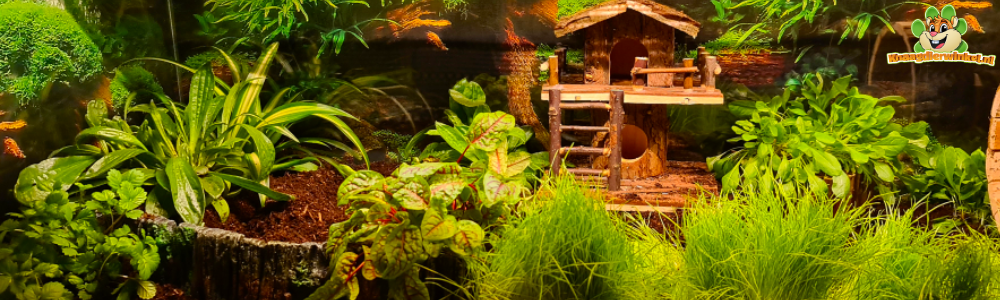
Houses, tunnels & shelters
Campbell hamsters feel safer when they find shelter along the way. We recommend at least two houses (a main house for sleeping and an additional hiding/storage area). One house can be a bit larger so your hamster can also store supplies.
Keeping a group? Then the rule is: proportionally more hiding places (and preferably multiple routes rather than just one "blind spot"). See: Hamster houses · Hamster tunnels
Running wheel: size & safety
An exercise wheel is an important part of the setup. Campbell's love to run (often at night), and a good wheel promotes activity and fitness. Always choose a wheel with a closed running surface and an appropriate size.
Guideline: an exercise wheel for the Campbell's dwarf hamster should preferably have a minimum diameter of 20 cm and a closed running surface .
If you keep more than one animal together, it often helps to install multiple exercise wheels to reduce the pressure on one spot. Shop: Hamster exercise wheels · Further reading: Exercise wheel selection guide
Sand bath: which sand and how do you use it?
Campbell's dwarf hamsters enjoy taking an occasional sand bath. Sand has a degreasing effect and can be cooling. Because it can also have a dehydrating effect, it's important to monitor their bathing habits.
Note: If you have skin problems (red patches, bald spots, scabs, wounds), you can temporarily remove the sand bath and consult your veterinarian. Shop: Hamster sand & sand bath · More: Sand bath selection guide
Nesting material & nest building
Campbell's dwarf hamsters are true nest builders. They always need nesting material to line their burrows. A practical amount is often 15–25 grams of nesting material.
Choose nesting material that is soft, absorbent, and easy to work with. Avoid materials with long, strong fibers that can entangle hamster legs. See: Hamster nesting material
Nutrition (incl. sugars/diabetes)
Campbell's dwarf hamsters are granivores (seed eaters). Their diet consists primarily of seeds, with small supplements (e.g., herbs) and animal protein (in the wild, they catch small insects). Choose a complete basic diet and provide a controlled variety.
Useful categories: Hamster food · Herbs & seeds · Animal proteins
Many Campbell's bloodlines are prone to developing diabetes . Therefore, it's wise to be frugal with sugar : choose snacks wisely and don't make "sweet" the default treat. Instead, use small protein snacks or foraged food that fits within the basic diet.
Dental formula: 1013/1013 (incisors continue to grow)
Teeth don't grow
Stomach: consists of two chambers (ante- and glandular stomach)
Small appendix: limited ability to process crude fiber
For dwarf hamsters, it is often assumed that the crude fiber content does not need to be extremely high; around 10% is often cited as a practical upper limit for good digestibility.
More selection help: Hamster food selection help · Dwarf hamster food selection help
Gnawing material & teeth
Campbell's dwarf hamsters are rodents with continuously growing incisors. They therefore always need suitable gnawing material to wear down their teeth. Some hamsters gnaw vigorously, others less so—this can also vary depending on the season and the food they eat.
View: Hamster Gnawing Material · Play & Forage
Recognizing dental problems
For example, watch out for: enthusiastically grabbing food but not eating it, drooling, a wet chin, selectively eating "soft foods," weight loss, or visibly abnormal teeth. If in doubt, it's wise to consult a veterinarian.
Reproduction (basic information)
In the wild, Campbell's live in small family groups. When they have young, the parents care for them together until they leave the nest. Practical advice for pets: prevent unplanned litters by confirming the sexes and not "trying to determine."
Sexually mature: from 4 weeks
Ready to breed: females from 12 weeks
Litter size: average 7 (max. 10)
Gestation period: 19–21 days
Weaning time: from week 3
Health & prevention
The most common concern with Campbell's dwarf hamsters is susceptibility to diabetes (especially in certain lines). Dental problems, tremors, and skin problems also occur. Daily observation is the best prevention: appetite, drinking behavior, activity, coat, and stool. Preventative treatment for parasites is generally not necessary, and additional vitamins are usually not needed with a complete basic diet.
When is it wise to consult a veterinarian?
Pay extra attention to signals such as:
- Teeth/food: drooling, wet chin, not eating (well), losing weight, unable to process food, wanting to eat strange soft materials.
- Skin/coat: bald patches, lots of scratching, scabs, wounds, bumps/lumps.
- General: wet/dirty bottom, drinking a lot, falling over, listlessness, abnormal stools or clearly different behavior.
Practical categories: Hamster care · Transport boxes
Read more (extra depth)
Useful Hamster shopping links (most relevant)
Accommodation & furnishings:
Hamster Cages · Houses · Tunnels · Exercise Wheels · Play & Foraging · Hamsterscaping
Bottom & nest:
Ground cover · Nesting material · Sand & sand bath
Power supply:
Hamster food · Herbs & seeds · Animal proteins
Practical:
For general background information you can also consult the LICG .
FAQ – Campbell's dwarf hamster
Can a Campbell's dwarf hamster be kept with other hamsters of its own kind?
It's possible in some situations, but it requires space, multiple facilities, and careful observation. In cases of chasing, biting, or stress, separation is the best option.
Why is sugar such an issue at Campbell's?
Many Campbell's lines are prone to diabetes. Therefore, a suitable base diet is important, and it's wise to avoid sugary snacks.
What is the minimum size of the accommodation?
A commonly used guideline is a minimum of 80 x 40 cm, but larger is better — especially to allow for deep ground cover and multiple zones.
What does “boxing” mean in a Campbell's case?
This is a defense/warning: standing on your hind legs and pushing with your front legs. It's a signal to calm down and build trust gradually.
Tip: Want to quickly choose from the selection? Start with the main Hamster category: Hamster .
✓ Practical explanation for a richly furnished, diggable stay
✓ Useful shopping links to click directly to the correct categories
✓ Selection assistance and in-depth information from a specialist since 2011