 Polski

Russian Dwarf Hamster Information

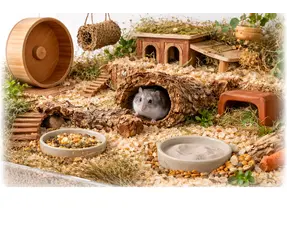


Russian dwarf hamster – care, housing, nutrition & behavior
 The Russian dwarf hamster ( Phodopus sungorus ) is native to eastern Kazakhstan and southwestern Siberia. It's also often called the Siberian dwarf hamster or the Dzungarian dwarf hamster . They are small, inquisitive hamsters that are primarily active at dusk and night, but their cyclical sleep pattern means they also wake up regularly during the day. This page explains how to keep a Russian dwarf hamster in a pleasant, safe, and logical way: from housing and bedding to nutrition, taming, and health. DRD Rodent Shop® has been a specialist since 2011 and helps you choose based on well-being and practicality.
Head-body length: up to 13 cm
Weight: usually 45 – 65 grams (depending on build and condition)
Life expectancy: average 1.5 – 2 years
Directly to the Hamster shop: Hamster (all) · Hamster cages & enclosures · Bedding · Hamster food · Exercise wheels
Quick to:
- Behavior & daily routine
- Taming & Handling
- Housing & furnishing (hamsterscaping)
- Ground cover & excavation layer
- Houses, tunnels & shelters
- Running wheel: size & safety
- Sand bath: which sand and how do you use it?
- Food & animal proteins
- Gnawing material & teeth
- Winter paralysis (torpor): recognize and act
- Health & prevention
- Useful shopping links
- FAQ
Russian dwarf hamster checklist (quick, good basic)
- ✓ Choose a spacious enclosure with plenty of floor space and a safe layout.
- ✓ Provide a deep, diggable layer of ground cover (guideline: around 20cm or more).
- ✓ Create hiding routes with multiple houses, tunnels and shelters.
- ✓ Provide a safe exercise wheel with a closed running surface (minimum 20 cm diameter).
- ✓ Add a sand bath as a permanent zone and maintain it regularly.
- ✓ Feed complete (dwarf) hamster food and use small snacks as a reward/foraging.
- ✓ Check daily: food/drink , activity, coat/eyes/nose and feces; if in doubt, consult a vet early.
✓ Digging = relaxation
A Russian dwarf hamster only feels truly at home with a deep digging layer and safe hiding routes above and below the substrate.
✓ Quietly build trust
Taming works best with predictability: short sessions, soft voice, rewarding and letting your hamster choose for itself.
✓ Feeding as enrichment
Foraging and scattering feed are perfect for "hoarding": searching, gathering, and stockpiling. This provides exercise and mental stimulation.
Behavior & daily routine
Russian dwarf hamsters are crepuscular : you'll see the most activity in the evening and early morning. At the same time, they often sleep in short bursts (cyclically), so you might even encounter them during the day. They are prey animals: safety and a sense of security determine how much "bold behavior" you see. In a well-equipped enclosure with plenty of hiding places, you'll often see curiosity, foraging, and active use of digging areas.
In the wild, Russian dwarf hamsters live semi-solitarily (for example, in pairs), but keeping them together often leads to stress and territorial behavior. Therefore, we generally recommend housing one hamster per enclosure , unless you are very consciously and experienced in working with a suitable pair.
How do you tame a Russian dwarf hamster?
A Russian dwarf hamster can become surprisingly tame, but the pace varies from animal to animal. It helps to think in terms of "building trust" rather than "picking it up quickly." Especially in the beginning, being picked up can be daunting. Because of their limited depth perception, they can also unexpectedly run away from your hand if startled, so always work low over a soft surface.
- Start (week 1): Get your hamster used to the smells and sounds. Talk calmly in the enclosure and do regular maintenance.
- Build-up (week 2): Place your hand in the enclosure and reward with a small treat. Let your hamster come sniff on its own.
- Further (week 3+): Let your hamster step onto your hand or into a tube. Lift briefly (low) and put it back down gently. Repeat often, but briefly.
Tip: Many Russian dwarf hamsters love dried mealworms as a training reward. Keep the portion small.
Want a complete step-by-step plan (including biting prevention, without stress)? Check out: Taming Hamsters (Dwarf Hamsters & Golden Hamsters) .
Housing & furnishing (hamsterscaping)
Russian dwarf hamsters need space, peace, and opportunities to dig . A common guideline is a minimum of 80 x 40 cm (LICG), but larger is always better—especially because it allows you to create multiple zones: hiding, digging, sand baths, and runs.
In the wild, they build elaborate burrows. A burrow can be 1–2 meters deep and about 1 meter long. This demonstrates the importance of "surface": your hamster will also want to build tunnels and dens at home. Hamsterscaping is therefore ideal: Hamsterscaping .
A terrarium or closed tank with good ventilation makes a deep substrate easiest. Pay extra attention to ventilation in warm weather. Russian dwarf hamsters do not tolerate high temperatures combined with high humidity well. A temperature of around 20-24°C and a humidity below 70% is often maintained. Measuring is practical with a digital thermohygrometer .
Shop: Hamster cages & enclosures · Cage accessories · Tunnels · Houses · Platforms & ladders · Play & forage
Ground cover & excavation layer
The substrate should be dust-free and, above all, diggable (tunnel-proof). Your hamster should be able to create tunnels and burrows in it, preferably remaining intact. A practical guideline for digging behavior is often around 20 cm of substrate or more.
Examples of diggable soils include humus , hollow sand , and also fiber-rich soils like cotton and cotton . Many people make a stable mix, for example, cotton and hemp fiber or cotton and wood fiber . A combination of wood fiber , fiber, and hay can also work well.
Some substrates are primarily absorbent but less suitable for building tunnels. Therefore, consciously choose a "dig layer + solid zones." View everything in: Hamster substrate or learn more via: Hamster substrate selection guide .
Houses, tunnels & shelters
Russian dwarf hamsters are prey animals and don't like to roam freely in their enclosure. Therefore, houses and tunnels aren't luxuries, but essentials. We recommend at least two hiding places (a main house for sleeping and an additional hiding place/storage area). At least one house should be a bit larger so your hamster can also store its food.
View: Hamster houses · Hamster tunnels

Running wheel: size & safety
An exercise wheel is an important part of the setup. Russian dwarf hamsters love to run (often at night), and a good wheel promotes activity and fitness. Always choose a wheel with a closed running surface and an appropriate size.
Guideline: an exercise wheel for the Russian dwarf hamster preferably has a diameter of at least 20 cm and a closed running surface .
Shop: Hamster exercise wheels · Floor: Exercise wheel selection guide
Sand bath: which sand and how do you use it?
Russian dwarf hamsters enjoy taking an occasional sand bath. Sand has a degreasing effect and can also be cooling. Because it can also have a dehydrating effect, it's important to monitor its use.
Note: If you have skin problems (red patches, bald spots, scabs, wounds), you can temporarily remove the sand bath and consult your veterinarian. Sometimes a sandbox is also used as a "toilet zone"; this can be useful, as long as you keep the sand clean.
Shop: Hamster sand & sand bath · Floor: Sand bath selection guide
Nest building & nesting material
Russian dwarf hamsters are true nest builders. They always need nesting material to line their burrows. A practical amount is often 15–25 grams of nesting material.
Choose nesting material that is soft, absorbent, and easy to work with. Avoid materials with long, strong fibers that can entangle hamster legs. See: Hamster nesting material
Food & animal proteins
Russian dwarf hamsters are granivores (seed eaters). Their diet consists primarily of seeds, with a small portion of plant-based supplements (such as herbs) and animal protein (in the wild, they catch small insects). Therefore, choose a complete basic diet and provide a controlled variety.
Handy to combine: Hamster food · Herbs & seeds · Animal proteins
Hamsters carry food in their cheek pouches . You often see your hamster "stuffing" food and then safely carrying it to a storage location. This behavior is normal and part of hoarding. It's better to give smaller portions and distribute food throughout the enclosure so foraging happens naturally.
Dental formula: 1013/1013 (incisors continue to grow)
Teeth don't grow
Stomach: consists of two chambers (ante- and glandular stomach)
Small appendix: limited ability to process crude fiber
For Russian dwarf hamsters, it is often assumed that the proportion of crude fiber in the diet does not need to be extremely high; around 10% is often cited as a practical upper limit for good digestibility.
More selection help: Hamster food selection help · Dwarf hamster food selection help
Gnawing material & teeth
Russian dwarf hamsters are rodents with continuously growing incisors. They therefore always need suitable gnawing material to wear down their teeth. Some hamsters gnaw vigorously, others much less so—this can also vary depending on the time of year and the type of food they eat.
View: Hamster Gnawing Material · Play & Forage
Recognizing dental problems
Identifying signs can sometimes be difficult. For example, look for: enthusiastically grabbing food but not eating it, drooling, selectively eating "soft foods," weight loss, or a wet chin. If in doubt, it's wise to consult a veterinarian.
Winter paralysis (torpor): recognize and act
If the ambient temperature falls below 17°C for an extended period, the Russian dwarf hamster can enter winter paralysis (torpor). This is different from hibernation and is particularly common in this species. The hamster wakes briefly daily and then returns to torpor.
A hamster in winter paralysis may feel cold and a bit stiff. Gently warm the animal in your hands and let it warm up. Food shortages and shorter days can be triggers.
Additional information (blog): Winter paralysis in the Russian dwarf hamster
Reproduction (basic information)
Russian dwarf hamsters are semi-solitary in the wild. When they have young, the parents care for them together until they are old enough to leave the nest. Practical advice for pets: prevent unplanned litters by confirming the sexes and not "trying to determine."
Sexually mature: from 4 weeks
Ready to breed: females from 12 weeks
Litter size: average 7 (max. 10)
Gestation period: 19–21 days
Weaning time: from week 3
Health & prevention
Russian dwarf hamsters are generally quite healthy animals. Common concerns include dental problems, susceptibility to diabetes (especially in certain lines/crossbreeds), tremors (seen in some color-related lines), and eye problems. Daily observation is the best prevention: appetite, drinking behavior, activity, coat, and stool.
When is it wise to consult a veterinarian?
Pay extra attention to signals such as:
- Teeth/food: drooling, wet chin, not eating (well), losing weight, unable to process food, wanting to eat strange soft materials.
- Skin/coat: bald patches, lots of scratching, scabs, wounds, bumps/lumps.
- General: sitting hunched over, lethargic, wet/dirty bottom, drinking a lot, falling over, shortness of breath, abnormal stools or clearly different behavior.
Practical categories: Hamster care · Gnawing material · Transport boxes
Read more (extra depth)
Useful Hamster shopping links (most relevant)
Accommodation & furnishings:
Hamster cages · Houses · Tunnels · Platforms & ladders · Exercise wheels · Play & forage
Bottom & nest:
Ground cover · Nesting material · Sand & sand bath
Power supply:
Hamster food · Herbs & seeds · Animal proteins
Practical:
For general background information you can also consult the LICG .
FAQ – Russian Dwarf Hamster
Is the Russian Dwarf Hamster a Good Pet for Kids?
It's possible, especially because they regularly wake up during the day. However, they remain prey animals: the pleasure of watching and gentle hand-feeding often works better than frequent handling. Always handle them under supervision and low over a soft surface.
What is the minimum size of the accommodation?
A commonly used guideline is a minimum of 80 x 40 cm, but larger is better — especially to allow for the combination of deep ground cover, multiple hiding places, and fixed zones.
Why does all the food “disappear”?
Hoarding is normal behavior: they carry food in their cheek pouches and build up caches. Provide smaller portions and scatter some around the enclosure so foraging happens naturally.
Does my hamster really need a sand bath?
Many hamsters like to use it for grooming and as a designated area. Keep it clean and watch for skin irritation; if there are any problems, you can remove it temporarily.
What is winter paralysis and how do I recognize it?
In prolonged cooler conditions (around/below 17°C), the Russian dwarf hamster can go into torpor. The animal feels cold and sometimes stiff. Warm up slowly and read our blog about winter paralysis.
Tip: Want to quickly choose from the selection? Start with the main Hamster category: Hamster .
✓ Practical explanation for a richly furnished, diggable stay
✓ Useful shopping links to click directly to the correct categories
✓ Selection assistance and in-depth information from a specialist since 2011

