Polski


Basic rabbit furnishing – indoor enclosure, toilet training, hay corner & enrichment with shopping list
Basic rabbit furnishing – how to set up a safe and practical indoor enclosure
Rabbits are social animals and should preferably live with another rabbit. This basic setup is based on indoor rabbits : a safe, enclosed living space where they can run, rest, gnaw, and forage. A well-designed enclosure prevents frustration (and destructive behavior) and, above all, makes it much easier for you as the owner to maintain.
DRD Rodent Shop® has been a specialist since 2011. That's why you won't find random ideas here, but a well-thought-out foundation with logical zones: hiding places , toilets , hay corners , and enrichment . Below, you can shop the products from this basic setup directly.
Indoor rabbits need a fenced-in living space where they can really run, turn and relax.
Rabbits are often easy to litter train. A single, logical litter box keeps the rest of your space cleaner.
Multiple hiding places and suitable gnawing material ensure peace in the group and less gnawing on furniture.
1) Space & safe deposition
For indoor rabbits, a fenced-off area (e.g., a section of the living room) often works better than a small cage: you create a proper habitat with zones. Consider providing ample open space for running and safe screening of cables, plants, and vulnerable corners. See: rabbit runs and rabbit cages (as a basic or night shelter, depending on your situation).
2) Shelters: peace and overview
Rabbits are prey animals. They feel safe when they can hide and quickly escape. Therefore, choose hiding places with multiple openings (less "crushing" and less fighting between pairs). Practical options include a spacious house, a tunnel house, or a flexible willow bridge that you can set up as an arched shelter.
Shop here: rabbit houses and tunnels . For extra comfort (especially when kept indoors) , cushions and baskets are also very popular.
3) Toilet zone & toilet training
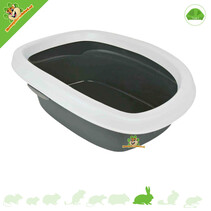
Indoors, a spacious litter box is invaluable. Many rabbits become potty-trained quickly if the litter box is placed logically: in a fixed corner, preferably near the spot where they also eat hay. Choose a model with a higher rim if you notice a lot of litter goes missing. See: litter boxes .
Use a litter box that is absorbent and easy to maintain: litter box bedding for rabbits .
4) Hay corner: hay and manger
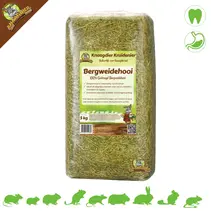
Hay should always be available. Therefore, create a fixed hay area: hay and a hay rack (or hay rack holder) above or next to the litter box. This keeps the hay cleaner and helps with toilet training. See: rabbit hay and hay & racks .
5) Food: chunks and food bowls
In addition to hay (and fresh vegetables), rabbits are usually fed a limited amount of pellets . Ideally, choose a complete pellet to prevent selective eating, and if you have a pair of rabbits, it's best to provide two separate bowls to avoid any hassle. See: rabbit food and feeding bowls .
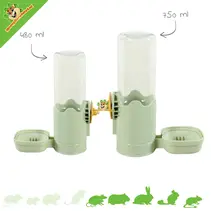
Provide water using a sturdy water bowl or drinking bottle—whatever is most practical in your situation: drinking bottles & water bowls .
6) Enrichment & gnawing material
Rabbits need something to do every day. Think of tunnels to run through, foraging challenges, and especially suitable gnawing materials to direct their gnawing urges to safe objects (instead of baseboards or furniture). See: gnawing materials and rabbit play & foraging .
Want to give your rabbit a little something extra every now and then? Then choose snacks that fit a responsible feeding policy: rabbit snacks .
Checklist basic rabbit setup (indoor)
- Fenced living area with sufficient free running space
- At least 2 hiding places (preferably with multiple openings)
- Spacious toilet tray + absorbent toilet bedding
- Unlimited hay + manger (preferably near/added to the toilet area)
- Food bowls (2 for duos) + drinking bowl/bottle
- Rodent material + tunnels/foraging enrichment
7) Maintenance & cleaning
- Daily: scoop/clean the toilet as needed, change the water, and replenish the hay.
- Several times a week: spot clean wet areas and “corners”.
- Periodically: clean the toilet and rearrange the living areas (without clearing everything out at once).
8) Safety & common mistakes
- Not enough space: a small cage as the main residence often leads to frustration and destructive behavior.
- Insufficient hiding places: especially in duos, you want multiple resting places and exits.
- Not a "rabbit-proof" environment: protect cables, plants, and baseboards; direct gnawing to suitable gnawing material.
- Don't keep hay in a central area: create a fixed hay corner; this improves hygiene and toilet training.
FAQ – Basic rabbit setup (indoor)
Should I use a cage if they run loose indoors?
Not necessarily. Many indoor rabbits live in a fenced-in area. A cage can serve as a "base" or night shelter, but space and zones are more important.
How do I potty train my rabbit?
Place a spacious litter box in a fixed corner and hang/place hay near the toilet area. Reward calmness and routine; make the toilet the most attractive place.
What's the easiest upgrade for more challenge?
Add foraging items and vary the tunnels and gnawing items. Small changes can provide a lot of extra stimulation.
Where can I find everything for rabbits in one overview?
Visit the Rabbit Webshop for all subcategories.
Shop the complete basics (products in this category)
Below you'll find the products that fit this basic design. Tip: start with a space + toilet area + hay area , then add hiding places and enrichment. Want to see all the examples? Visit all the inspiration pages .
You can also read general information about rabbits at the LICG: licg.nl .