 Polski



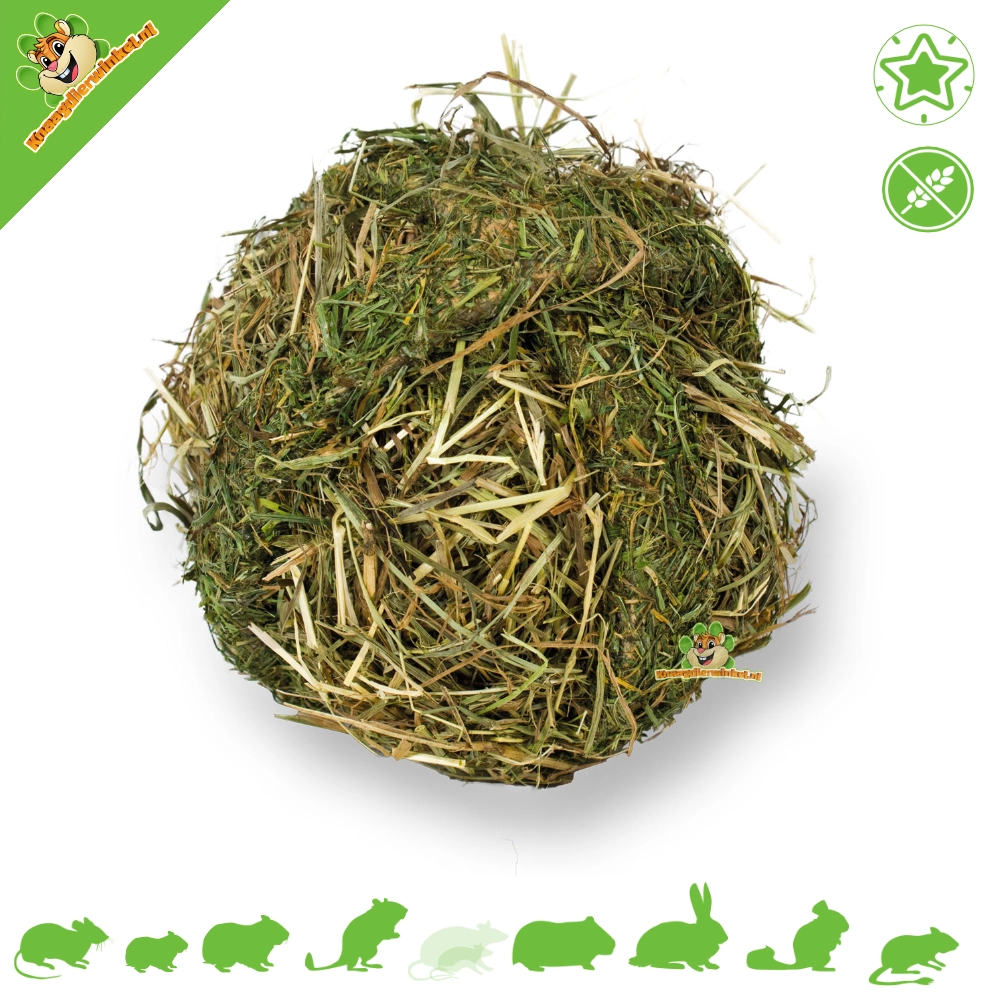
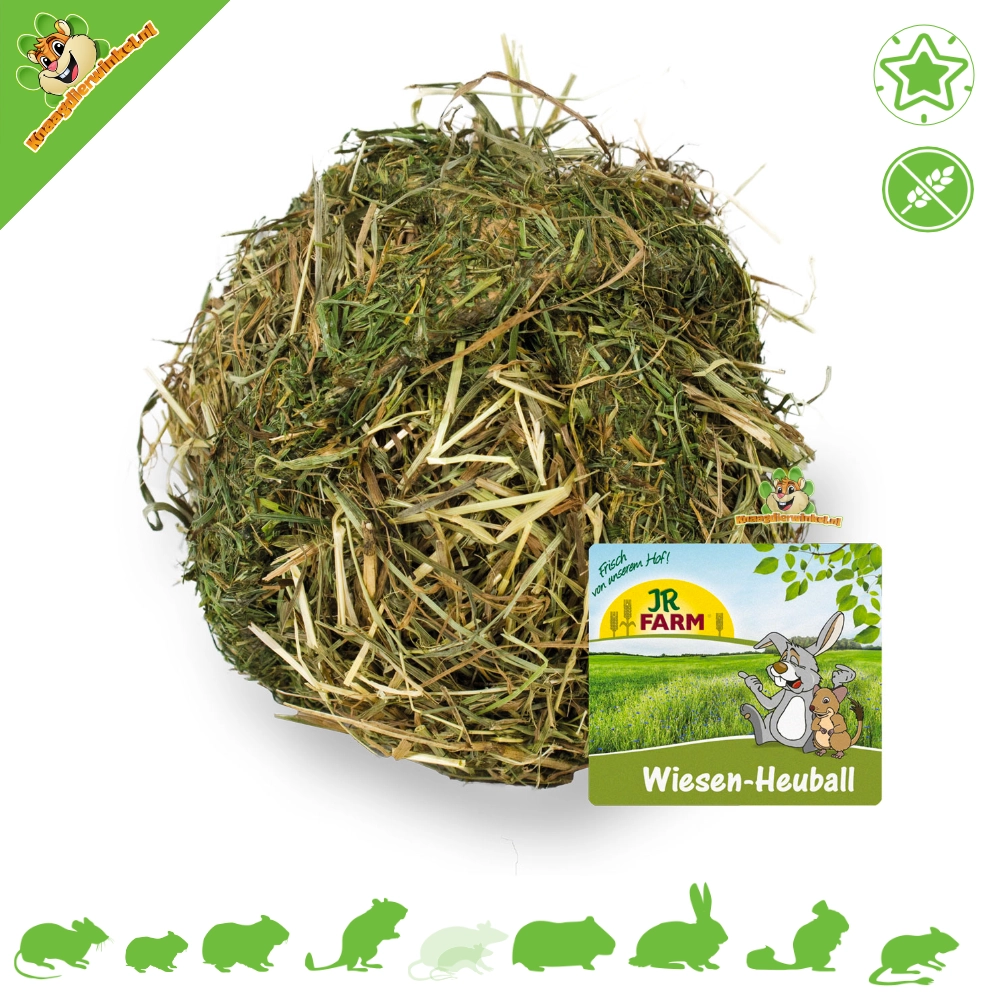
Meadow Hay Bale
- Dispatched from our own stock
- Personal & expert advice
- Always 100% rodent-friendly
- Ordered before 5 p.m., shipped the same day!
JR Farm Pasture Hay Bale – rolling, nibbling, pulling, and nesting with hay
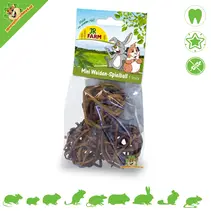
The JR Farm Meadow Hay Ball is a natural ball filled with mountain meadow hay for rodents and rabbits. For herbivores such as guinea pigs, rabbits, chinchillas, and degus, this is a delightful hay ball to nibble on, push against, roll, or pull together. For small rodents such as mice, dwarf hamsters, hamsters, and gerbils, the hay ball is particularly interesting as a surprising way to offer nesting material.
That makes this ball more fun than an ordinary handful of hay. Your animal gets not only something to eat or explore, but also something to keep occupied. Herbivores can use the ball for hay and nibbling, while small rodents pull on it, tear off pieces, and take the hay to their nest. This way, you introduce nesting material in a playful manner, instantly turning it into behavioral enrichment.
In short
- Natural hay bale from JR Farm with mountain meadow hay
- Approx. 1 ball of 125 grams
- For herbivores to nibble, roll, and pull together
- For small rodents as surprising nesting material and a foraging opportunity
- Suitable as a complementary feed and edible enrichment.
Why choose the JR Farm Pasture Hay Bale?
✔ More experience than loose hay in a corner
✔ Stimulates nibbling, pulling, rolling, and exploring
✔ Also fun for small rodents as nesting material in ball form
✔ A nice way for herbivores to play with hay
✔ Pairs well with foraging and natural enrichment
At DRD, when it comes to hay products, we look not only at food but also at behavior. A hay ball gives animals something to do. Guinea pigs and rabbits can pull on it, nibble together, or move the ball a short distance. Chinchillas and degus can examine the texture and pull loose fibers. Small rodents often use the hay in their own way: they pull on it, drag tufts along, and incorporate it into their nests.
That is precisely what makes this hay ball valuable in the enclosure. You are not offering a standard snack, but a natural activity. The animal decides for itself whether it wants to nibble, pull, roll, gather, or nest. As a result, the hay ball is a good fit for owners who do not just want to fill the enclosure, but also want to add more natural activity.
Does this fit natural behavior?
In nature, animals spend a lot of time searching, pulling, gathering, gnawing, and moving material. A compact hay bale fits in nicely with this, because the hay is not immediately lying loose. Your animal has to work to get the fibers loose and can decide for itself what to do with them.
For herbivores, the hay ball is particularly suited to natural nibbling on fiber-rich plant parts. For small rodents, however, the ball is specifically suited to nesting and foraging behavior. They can pull loose tufts of hay, drag them along, and take them to a nest site. In this way, hay becomes not only edible material but also part of the enclosure and daily behavior.
For which animals is the JR Farm Pasture Hay Bale suitable?
- Mouse: suitable as surprising nesting and foraging material. Mice can pull off tufts, move them, and incorporate them into their nest.
- Dwarf hamster: suitable as natural enrichment. Dwarf hamsters can pull on it, sniff it, and take small tufts to their nest.
- Hamster: suitable as nesting material in a playful shape and as a foraging opportunity. The ball can be nicely placed in a hamsterscaping enclosure near a sheltered route or digging zone.
- Gerbil: suitable as material to pull, gnaw, and pull apart. Gerbils can use the hay as nesting and landscaping material.
- Guinea pig: suitable as a hay ball for nibbling, rolling, and pulling together. Especially fun as a change of pace alongside the regular daily hay.
- Rabbit: suitable as a natural hay ball to nibble on, push around, and engage with hay in a different way than from a hay rack.
- Chinchilla: suitable as dry, fiber-rich hay enrichment. Place the ball down stably and use it as an alternative alongside the daily hay.
- Degu: suitable as a hay ball for nibbling, pulling, and investigating. Also fun as a quiet, plant-based activity in the enclosure.
We do not include this hay ball as a target group for pygmy rats and rats. Hay has no clear function for rats in their daily care and can be unpleasant for their sensitive airways due to dust. For rats and pygmy rats, it is preferable to choose low-dust bedding, tunnels, hammocks, foraging toys, and suitable nesting material.
How do you use the JR Farm Pasture Hay Bale?
Place the hay ball loosely in the enclosure in a dry, clean spot. For guinea pigs, rabbits, chinchillas, and degus, you can place the ball with the hay, in a hay corner, or at a designated snack and enrichment spot. This way, they can nibble on it, roll it, or pull on it together.
For mice, dwarf hamsters, hamsters, and gerbils, you can place the hay ball near a nesting zone, tunnel route, digging area, or natural scape. These animals often will not use the hay in the same way as herbivores. They pull out tufts, drag it along, and use it as part of their nest or furnishings.
Check the hay ball regularly. Replace it when it has become dirty, no longer smells fresh, or has almost completely fallen apart. Use the ball as extra enrichment alongside the daily basic diet suitable for your animal.
Composition & analysis
Composition: mountain meadow hay 48.8%, lignocellulose, vegetable starch.
Analysis: protein 6.5%, fat content 1.9%, crude fiber 36.6%, crude ash 11.8%, calcium 25750 mg/kg, phosphorus 1320 mg/kg, sodium 735 mg/kg.
The composition is typical of a hay bale with a distinct fiber structure. The mountain meadow hay provides aroma and natural hay value, while the sturdy ball shape ensures that animals really have to pull, nibble, and stay active. As a result, the hay bale is not just a snack, but also a practical form of enrichment.
Good to know
The JR Farm Meadow Hay Ball is a complementary feed. For guinea pigs, rabbits, chinchillas, and degus, this ball does not replace daily loose hay, but is intended as an extra hay moment and enrichment. For small rodents, use the ball primarily as nesting material, scavenger hunt material, and foraging activity.
Because hay is a natural product, color, smell, and texture may vary slightly from bale to bale. This is characteristic of dried hay and makes every bale just a little bit different.
Nice to combine with
- Hay for rodents and rabbits
- Hay bales and chunks
- Playing and foraging
- Nesting material for rodents
- Hamster nesting material
- JR Farm
Frequently asked questions about the JR Farm Pasture Hay Bale
What is the JR Farm Pasture Hay Bale?
The JR Farm Meadow Hay Ball is a natural ball filled with mountain meadow hay. You use it as a supplementary hay, nibbling, nesting, and foraging activity, depending on the animal species.
Is the hay ball suitable for guinea pigs and rabbits?
Yes, for guinea pigs and rabbits, the hay ball is fun to nibble on, roll around in, and pull on together. Use it as extra variety alongside the daily loose hay.
Is the hay ball suitable for hamsters and gerbils?
Yes, for hamsters and gerbils, the ball is especially fun as nesting material and behavioral enrichment. They can pull off tufts and take them to their nest or playground corner.
Is the JR Farm Pasture Hay Bale suitable for rats?
No, we do not include this hay ball as a target group for rats and pygmy rats. Hay has no clear function for rats in their daily care. For rats, it is better to choose low-dust bedding, tunnels, hammocks, and suitable foraging toys.
Does this hay bale replace regular hay?
No, for herbivores, the hay bale does not replace the daily loose hay. View it as an extra hay moment, snack, and enrichment alongside the normal hay offering.
Can my animal pull the hay bale apart?
Yes, that is actually part of using it. Animals are allowed to pull on it, loosen tufts, nibble, and move the material.
Where do I put the hay bale?
Place the hay ball in a dry, clean spot. For herbivores, this can be in a hay corner or snack area. For small rodents, you can place it near a nesting zone, tunnel route, or natural setup.
The JR Farm Pasture Hay Ball is a great choice if you want to offer hay in a more playful way. Herbivores can enjoy nibbling, rolling, and tugging together, while small rodents discover the hay in their own way and take it back to their nest. This way, a simple hay ball suddenly becomes a surprising piece of behavioral enrichment.

| Content (approx): | 1 ball | 125 grams |
| Composition: | Mountain meadow hay 48.8%, lignocellulose, pea starch |
| Analysis: | Protein 6.5%, fat content 1.9%, crude fiber 36.6%, crude ash 11.8%, calcium 25750 mg/kg, phosphorus 1320 mg/kg, sodium 735 mg/kg |
| Promotes Foraging: | Yes |
| Suitable for: | Rodents, Mouse, Dwarf Hamster, Hamster, Gerbil, Rat, Chinchilla, Degu |
| Type: | supplementary pet food |
| Particularities: | - |
| Disclaimer: | Not for food producing animals |
Echt heel leuk voor mijn cavia! Hij speelt er heel veel mee en vindt het heel lekker! Je kan het ook steeds bijvullen. De grootte is misschien iets te groot, maar mijn cavia vindt dat niet erg... :)
Ons konijn vind hem superleuk en speelt er ook mee.
Wat een super leuke bal om in je kooi neer te leggen. De grote is voor mijn cavia's ook perfect! Het hooi vinden ze echt heel erg lekker! Lekkerder dan wat ze normaal krijgen! Het was daarom ook al heel snel op! Nu gebruik ik de bal nog steeds om het te hervullen! Het is zeker iets wat ik nog een keer ga bestellen!
Mijn konijnen vonden het heel lekker.
Mijn cavia’s waren er dol van .