 Polski

Guinea pig language – understanding the sounds, behavior, and body language of guinea pigs
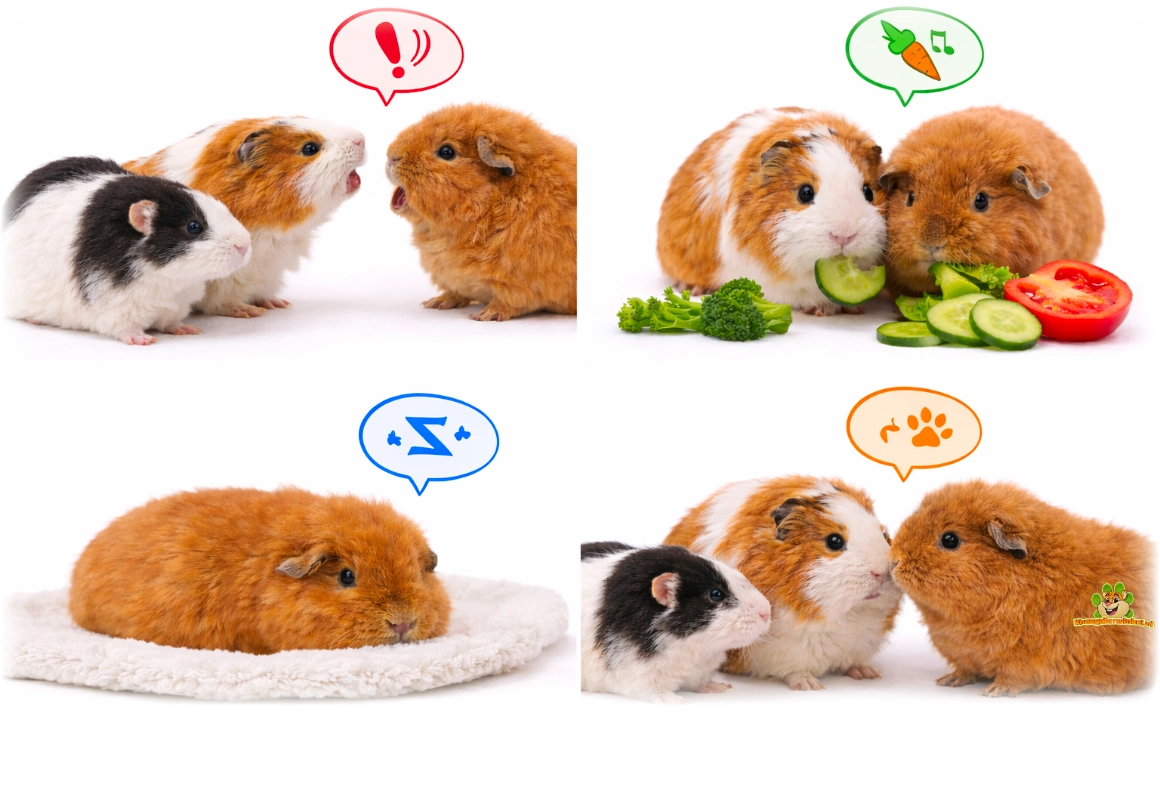 Guinea pigs communicate all day long. They squeak, purr, purr, chatter their teeth, run away, sit still, or make little hops through the enclosure. If you learn to recognize guinea pig language, you will understand more quickly whether your guinea pig is relaxed, curious, insecure, tense, or possibly not feeling well.
Guinea language does not consist of a single isolated sound. You always look at the combination of sound, posture, movement, and situation. A squeak when opening the refrigerator means something different than a loud scream when being picked up. And purring during bonding requires a different assessment than soft purring while walking around.
At DRD Knaagdierwinkel®, we use behavior as an important indicator for better choices. Caviataal helps you with taming guinea pigs , bonding guinea pigs , setting up a quiet enclosure, and recognizing signals that require extra attention. Specialist since 2011.
Quick links:
Answer first | Guinea pig sounds | Body language | Reading context | Stress signals | Calm environment | Common mistakes | Checklist | FAQ
Answer first: how do you read guinea pig language?
You read guinea pig language by looking at sound, posture, movement, and situation together. One sound does not always have one fixed meaning. So always look at what is happening at that moment.
✔ Squeaking can mean enthusiasm, anticipation, seeking contact, or discomfort, depending on the situation.
✔ Soft gurgling while walking around is often consistent with relaxed examinations.
✔ Grumbling can be interest, tension, dominance, or group behavior.
✔ Teeth chattering is a clear warning that tension is rising.
Not eating, lethargy, pain posture, or sudden changes in behavior require extra attention and sometimes a veterinarian.
Guinea pig sounds: what can they mean?
Guinea pigs make many different sounds. Some sounds are easy to recognize, such as loud squeaking at mealtimes. Other sounds are more subtle, for example, soft purring while walking around or growling when stressed. Use the table as a guide, but always consider the context.
| Sound | What could it mean? | What do you look out for? |
|---|---|---|
| Loud squeaking or whistling | Expectation, enthusiasm, recognizing food or seeking contact | Does it happen around feeding times, with a rustling in the pocket, or with your voice? |
| Gently simmering or murmuring | Walking around quietly, examining or contact noise | Is the posture relaxed and is your guinea pig moving calmly? |
| Humming or rumbling | Dominance, interest, tension, or group behavior | Look at posture, chasing, bonding, or approaching another guinea pig. |
| Teeth chattering | Warning, irritation or rising tension | Give space and prevent animals from blocking each other. |
| High scream | Shock, pain, panic or severe fear | Check immediately what is happening and see if your guinea pig seems injured or sick. |
| Grinding or abnormal chewing sound | Can mean discomfort, dental problem, or pain | Watch out for eating less, drooling, losing weight, or leaving hay untouched. |
Guinea pig not eating → | Guinea pig teeth → | Guinea pig health →
Guinea pig body language: recognizing posture and movement
Guinea pigs don't just communicate with sound. Body language, in particular, reveals a lot. Pay attention to whether your guinea pig walks in a relaxed manner, ducks away, freezes, chases another guinea pig, popcorns, or simply sits quietly in a corner. The difference between relaxed and tense often lies in small details.
| Behavior | Possible meaning | Practical advice |
|---|---|---|
| Popcorn | Excitement, energy, or happy behavior, especially in young guinea pigs | Ensure a safe walking area without slippery or sharp spots |
| Ducking away | Fear, uncertainty, or need for safety | Approach more calmly and leave hiding places undisturbed |
| Stiffen | Could be anxiety or freezing | Do not automatically confuse sitting still with being relaxed |
| Walking one after the other | Group behavior, interest, ranking or tension | See if both animals can move aside and continue eating. |
| Sitting huddled together | It can be rest, but also discomfort or pain. | Pay attention to food, droppings, weight, breathing, and activity |
| Lying stretched out | Often relaxation, especially in a safe environment | Check if your guinea pig reacts normally and gets up easily. |
Guinea language always depends on the context
The same behavior can mean something different in a different situation. Therefore, you should always look at the question: what happened just before the behavior? Is there food nearby? Is there a new guinea pig? Is your guinea pig being approached? Is there a loud noise? Or is the behavior suddenly different than normal?
✔ During feeding: squeaking and agitated behavior can be signs of anticipation or enthusiasm.
✔ When coupling: growling, following, and teeth chattering require extra observation.
✔ When taming: sitting still can indicate tension, not always relaxation.
✔ During care: ducking, whimpering, or struggling may mean that your step is too big.
With sudden changes in behavior, reduced appetite, or lethargy, look beyond just “behavior”.
Guinea pig food selection guide → | Bonding guinea pigs → | Taming a guinea pig →
Stress signs and warning signs in guinea pigs
Guinea pigs sometimes show stress or discomfort subtly. Because guinea pigs are prey animals, they may hide discomfort or fear. Therefore, it is important to compare their behavior daily with what is normal for your guinea pig.
✔ Eat less, do not pack hay or leave feed lying around.
✔ Lethargy, frequently isolating or sitting quietly in a corner.
✔ Frequent cowering, panic reactions, or no longer daring to move.
✔ Persistent teeth chattering, chasing, or blocking group members.
✔ Walking differently, sitting hunched over, drooling, losing weight, or chewing abnormally.
Contact a veterinarian if the animal is not eating, is in pain, has difficulty breathing, has injuries, or shows a clear change in behavior.
Guinea pig health → | Guinea pig not eating → | Guinea pig care →
How the environment helps to better understand guinea pig language
A well-designed enclosure makes behavior clearer. If your guinea pig has enough space, hiding places, and routes, you can better see whether behavior is due to character, group dynamics, or stress. In an enclosure that is too cramped or too busy, behavior appears "troublesome" more quickly, while the cause is sometimes the layout.
Guinea pigs need choices: the ability to hide, the ability to eat without being blocked, the ability to pass each other, and the ability to keep their distance. The more these basics are in place, the calmer you can read guinea pig language.
✔ Use multiple hiding places, preferably with two exits.
✔ Ensure open walking routes so that guinea pigs can pass each other.
✔ Distribute hay, water, and food over enough space for multiple guinea pigs.
✔ Place the enclosure quietly, without much unexpected movement from above.
Use tunnels, houses, and hay to create safe zones.
Guinea pig cage → | Guinea pig runs and enclosures → | Guinea pig houses → | Guinea pig tunnels →
Common mistakes when reading guinea pig language
Misunderstanding guinea pig behavior happens easily, especially when you look at a single signal in isolation. These are common pitfalls:
✔ Thinking that a guinea pig sitting still is always relaxed.
✔ Seeing every beep as happiness, without looking at the situation.
✔ Ignore teeth chattering during coupling or handling.
✔ Interpret ducking as “stubborn”, when your guinea pig might be scared.
✔ Eating less or viewing quiet behavior as normal, calm behavior for too long.
View behavior separately from accommodation, group dynamics, nutrition, health, and daily routine.
Smartly combine guinea pig language with daily care
Guinea pig language becomes clearer when you have fixed care times. You observe a lot of behavior while giving hay, changing water, feeding, and cleaning: does your guinea pig come to look normally, does he eat immediately, does he move smoothly, and does he react as usual?
Use those moments as a daily check. A guinea pig that normally squeaks enthusiastically while eating but suddenly sits still might be telling you something important. It is precisely the difference from normal behavior that is often the key.
Guinea pig hay → | Guinea pig hay racks → | Guinea pig food bowls → | Guinea pig cleaning products →
DRD chooses: reading behavior helps choose better
At DRD, we view guinea pig language as practical knowledge. If you better understand what your guinea pig is showing, you can also make better choices: a quieter enclosure, more hiding places, different routes, more hay, a better distribution of feeding spots, or more patience when taming.
The power lies in looking at the whole. Sound, posture, movement, environment, and health should be interpreted together.
Checklist – better understanding guinea pig language
✔ Do you look at sound, posture, movement, and the situation?
✔ Do you know what normal behavior is for your guinea pigs?
✔ Do you pay extra attention when bonding, taming, picking up, and cleaning?
✔ Do your guinea pigs have enough hiding places and open runways?
✔ Monitor your daily food intake, hay intake, droppings, weight, and activity?
Do you take action in case of not eating, lethargy, signs of pain, or sudden abnormal behavior?
Good to know
Caviataal helps you understand your guinea pigs better, but behavior can also change due to pain, illness, or stress. Is your guinea pig not eating, eating significantly less, losing weight, becoming lethargic, or suddenly behaving differently? Then contact a veterinarian.
Would you like to read up on general background information about guinea pigs? Then also check out the LICG guinea pig information at licg.nl.
FAQ – frequently asked questions about guinea pig language
What does it mean when a guinea pig squeaks loudly?
Loud squeaking can mean that your guinea pig is expecting food, seeking contact, or is excited. Always look at the situation: does it happen around feeding times or during stressful times?
Why is my guinea pig growling?
Grumbling can be associated with dominance, interest, tension, or group behavior. Pay attention to posture, chasing, teeth chattering, and whether the other guinea pig can move out of the way.
What does teeth chattering mean in guinea pigs?
Teeth chattering is usually a warning or sign of rising tension. Give space and pay close attention, especially during coupling, approaching, or handling.
Why does a guinea pig popcorn?
Popcorning consists of small jumps or silly movements that often correspond to energy, excitement, or cheerful behavior. Do make sure the surface is safe.
Why does my guinea pig run away?
Guinea pigs are prey animals and can be easily startled by movement, sound, or hands from above. Approach calmly and provide plenty of hiding places.
Is a quiet guinea pig always relaxed?
No. Sitting still can be a sign of rest, but also tension, freezing, or discomfort. Look at posture, eating, breathing, activity, and the situation.
How do you recognize stress in guinea pigs?
Stress can manifest as frequent withdrawing, panic, teeth chattering, chasing, freezing, eating less, or isolation. Also consider the room layout and group dynamics.
When is changed behavior concerning?
Changed behavior is cause for concern if your guinea pig eats less, does not take hay, becomes lethargic, loses weight, seems to be in pain, or walks differently. In that case, contact a veterinarian.
How does guinea pig language help with taming?
By reading guinea pig body language, you can more quickly see when your guinea pig is relaxed or showing signs of tension. This allows you to build contact gradually without forcing anything.
What do you combine with understanding guinea pig language?
Combine guinea pig language with a spacious enclosure, multiple houses, tunnels, hay, quiet routes, good nutrition, daily checks, and knowledge of taming and bonding.
✔ Guinea pig language explained with sounds, body language, context, stress signals, and practical examples
✔ Useful for taming guinea pigs, bonding guinea pigs, health, and a calm environment
✔ Specialist since 2011, delivered from our own stock
Ordered before 17:00, shipped the same day | Delivered from our own stock | Specialist since 2011
