 Polski


Guinea pig cage selection guide: how to choose a spacious and practical enclosure for your guinea pigs
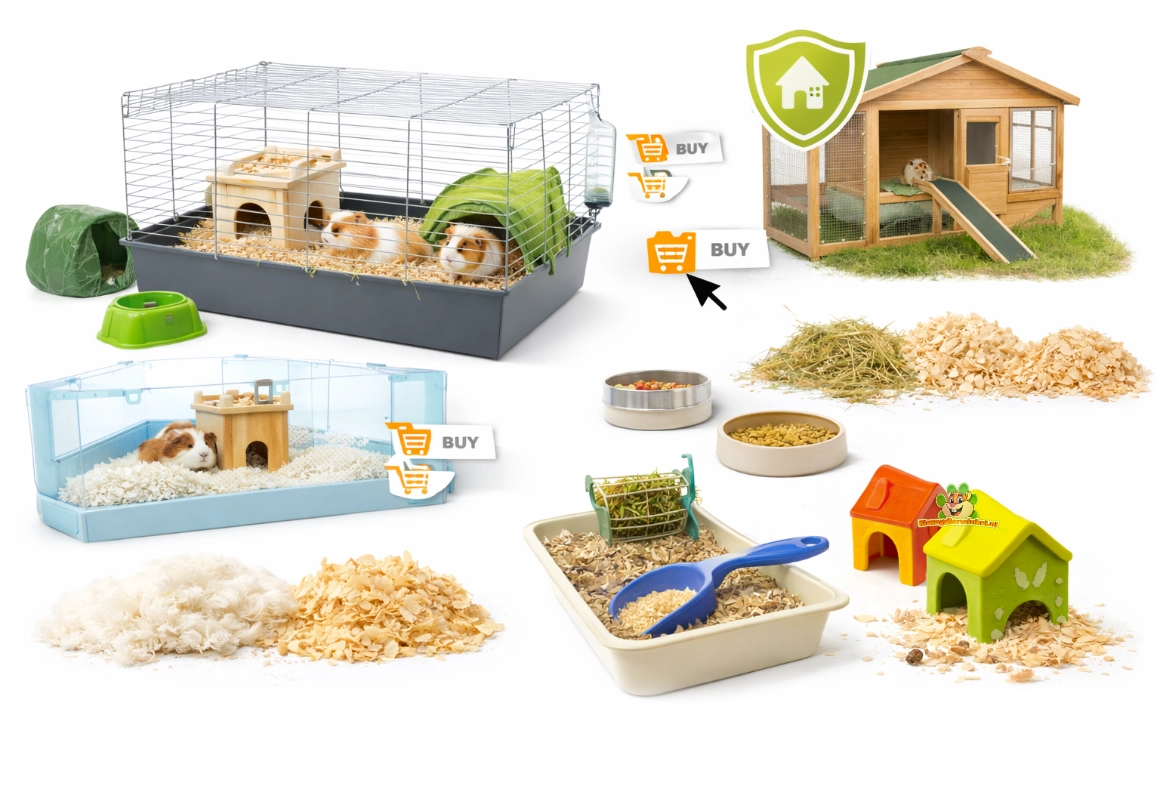 A good guinea pig cage starts with space. Guinea pigs are social ground animals and primarily use the floor: that is where they walk, eat hay, seek shelter, rest, and live together with other guinea pigs. Therefore, you should choose a guinea pig enclosure not only based on external dimensions or appearance, but above all on usable floor space, layout, and daily use.
In this guinea pig cage selection guide, you will read what to look for regarding size, floor area, C&C guinea pig cages, bedding, hay corners, hiding places, tunnels, water, feeding areas, and cleaning. This way, you don't just choose any cage, but an enclosure that is right for your guinea pigs and remains practical for you.
At DRD Knaagdierwinkel®, we first look at the living space. A guinea pig cage must allow for certain behaviors: walking, eating hay, resting, hiding, being together, and taking a step back. Only then do you choose bedding, a hay rack, houses, tunnels, pee pads, and additional furnishings. Specialist since 2011.
✓ Choose based on usable floor area, not just external dimensions
✓ For two guinea pigs, a minimum floor area of 1.6 m² is a clear guideline.
✓ C&C guinea pig cages are handy when you want a modular setup
✓ Consider the ground, hay corner, hiding places, walking routes, and cleaning at the same time
Quick links
In short • Which size? • Calculating floor area • C&C guinea pig cages • Setting up the cage • Flooring & hygiene • Indoors or outdoors • Checklist • FAQ
In short: what to look for in a guinea pig cage?
A good guinea pig cage has sufficient floor space, multiple hiding places, open runways, a clear hay corner, a dry floor, easily accessible water and food areas, and enough room for them to pass each other. For two guinea pigs, a minimum floor area of 1.6 m² is considered a clear guideline. Larger is preferable, especially for males, groups, or active animals.
So don't choose all the accessories first and only then the cage. Reverse the order: first the living space, then the furnishings. This way, you prevent the enclosure from being nicely filled but becoming too cramped for your guinea pigs.
Floor area
Guinea pigs primarily use the ground. Length and width are therefore more important than height.
Quiet layout
A guinea pig enclosure works better with zones: a hay corner, resting places, water, food, and open routes.
Practical maintenance
Pay attention to ease of cleaning, wet spots, hay corners, pee pads, and the accessibility of all parts.
What size guinea pig cage do you need?
For two guinea pigs indoors, a minimum floor area of 1.6 m² is a clear guideline. An example of this is 200 × 80 cm. For each additional guinea pig, calculate at least an extra 0.3 m². In practice, a larger space is preferable, as it provides more room for multiple hiding places, hay corners, and open runways.
Pay attention to the internal dimensions. The external dimensions of a cage can appear larger than the space your guinea pigs actually use. Houses, hay racks, food bowls, water stations, and toilet areas also take up space. Therefore, always look at the floor space remaining after the cage has been set up.
| Number of guinea pigs | Floor area guideline | Practical advice |
|---|---|---|
| 2 guinea pigs | minimum 1.6 m² | For example, 200 × 80 cm internal dimensions. |
| 3 guinea pigs | minimum 1.9 m² | Provide extra shelters and multiple hay racks. |
| 4 guinea pigs | minimum 2.2 m² | More space provides peace, especially in groups. |
| Bear group | preferably more spacious than minimal | More space helps to avoid each other better. |
Do you want to go directly to the category? Then view our guinea pig cages and spacious guinea pig enclosures .
Calculation aid: how to calculate the floor area
Measure the internal dimensions of the enclosure and calculate length × width in meters. An enclosure of 200 × 80 cm is therefore 2.00 × 0.80 = 1.6 m².
| Internal dimensions | Calculation | Floor area |
|---|---|---|
| 140 × 70 cm | 1.40 × 0.70 | 0.98 m² |
| 160 × 80 cm | 1.60 × 0.80 | 1.28 m² |
| 200 × 80 cm | 2.00 × 0.80 | 1.6 m² |
| 240 × 80 cm | 2.40 × 0.80 | 1.92 m² |
| 240 × 100 cm | 2.40 × 1.00 | 2.4 m² |
Use upper floors only as an addition. The most important living space remains the large, easily accessible base floor.
C&C guinea pig cage: flexible, modular and easy to expand
A C&C guinea pig cage is a modular enclosure that you build using wire panels, connectors, and a matching base. This type of enclosure is popular because it offers a lot of freedom regarding size, layout, and expansion. It makes it easier to create zones for hay, water, rest, litter boxes, and pee pads.
A C&C cage is particularly interesting if you want to create a spacious indoor setup, be able to expand later, or practically organize the floor with washable mats. Do pay attention to sturdiness, stable connections, neat edges, and a floor that fits well.
C&C guinea pig cages
For 4x2, 5x2, lofts, wire cube residences, and modular extensions.
C&C ground cover
For floor mats, pee mats, toilet areas, and practical hay corners in C&C accommodations.
Ground mats & pee pads
For soft areas, firm puddles, and faster daily maintenance.
Setting up a guinea pig cage: first routes, then gear
A guinea pig cage should not be cluttered, but logically arranged. Start with open runways. Then place hay, water, food, hiding places, and resting areas. With two or more guinea pigs, it is important that they can pass each other without getting trapped between houses, hay racks, or food bowls.
Preferably use multiple hiding places. Where possible, choose houses or tunnels with multiple openings so that a guinea pig is not easily trapped by another guinea pig.
Guinea pig houses
For peace, shelter, and freedom of choice. Multiple cottages work better than one cottage.
Guinea pig tunnels
For sheltered routes, quiet passages, and extra structure in the enclosure.
Guinea pig hay racks
For a clearly defined hay corner and more easily accessible hay.
Drinking bottles & water bowls
For a fixed, easily accessible water spot in the enclosure.
Guinea pig food bowls
For guinea pig food, vegetables, or multiple feeding stations for groups.
Playing & foraging
For quiet searching, sniffing, and keeping occupied with food, herbs, or snacks.
Base and hygiene: dry, soft and easy to keep clean
The floor largely determines how pleasant a guinea pig cage is for daily use. Guinea pigs live close to the ground, spend a lot of time lying on the floor, and use designated spots for hay, rest, and urinating. Therefore, a dry, comfortable, and easy-to-clean floor is important.
You can choose loose bedding, washable floor mats, pee pads, toilet bedding, or a combination. At C&C enclosures, many owners use a floor mat as a base and loose pee pads in wet spots. For long-haired guinea pigs, pay extra attention to materials that are less likely to get caught in the fur.
Guinea pig toilets
For fixed toilet or pee areas, especially at the hay corner.
Read also: Cleaning a guinea pig cage , bedding for long-haired guinea pigs and guinea pig cleaning products .
Indoors or outdoors: where should you put the guinea pig enclosure?
Many guinea pigs are kept indoors because you have a good view of their food, droppings, behavior, temperature, and daily care. Indoors, it is easier to work with clean-and-ride enclosures, floor mats, pee pads, and fixed hay corners.
Keeping animals outdoors requires extra attention to shelter, cold, heat, moisture, drafts, predators, insects, and sudden weather changes. An outdoor enclosure must be dry, safe, well-insulated, and spacious. Even then, floor space remains important.
✔ Do not place the enclosure in direct sunlight or in a draft.
✔ Ensure adequate ventilation without cold drafts.
✔ Check temperature, water, hay, wet spots, and behavior daily.
✔ Outdoor enclosures require extra protection against moisture, cold, heat, and predators.
✔ When in doubt, keeping it indoors is often easier to monitor.
DRD makes the choice: living space first, then interior design
At DRD, when it comes to guinea pig cages, we first look at what the enclosure allows for. Can your guinea pig walk, rest, eat hay, hide, avoid other guinea pigs, and easily access water and food? Then you have a strong foundation.
Next comes the layout. Not as many items as possible, but the right items in the right place. A hay rack logically belongs in the hay corner, a pee pad belongs in a wet spot, and shelters must provide rest without blocking walkways.
Checklist – choosing a guinea pig cage
✓ Does the accommodation have enough usable floor space after furnishing?
✓ Do you need at least 1.6 m² of floor space for two guinea pigs?
✓ Do you calculate at least 0.3 m² extra for each additional guinea pig?
✓ Can your guinea pigs pass each other without blocking each other?
✓ Is there room for multiple shelters and open walkways?
✓ Are hay, water, and feed low and easily accessible?
✓ Does the floor solution fit your cleaning routine?
✓ Can you easily clean or switch fixed wet spots?
Good to know
Guinea pigs are social ground animals. Therefore, choose a spacious enclosure with plenty of usable floor space rather than a tall cage with narrow levels. Levels can be an addition, but the large base floor remains the most important.
Always check that the setup leaves enough room for walking, hiding, eating hay, resting, and avoiding each other. A cage may appear large, but still be overcrowded.
Frequently asked questions about guinea pig cages
How big should a guinea pig cage be for two guinea pigs?
For two guinea pigs indoors, a minimum floor area of 1.6 m² is a clear guideline. An example size is 200 × 80 cm. Larger is preferable, especially if you want to create more hiding places and runways.
How do you calculate the floor area of a guinea pig cage?
Measure the internal dimensions of the enclosure. Calculate length in meters × width in meters. An enclosure of 200 × 80 cm is therefore 2.00 × 0.80 = 1.6 m².
Is a C&C enclosure suitable for guinea pigs?
Yes, a C&C or wire cube enclosure can be very practical, as you can create a lot of floor space and flexibility. Do pay attention to stability, edge height, the subfloor, and a safe finish.
Does a floor count as floor area?
An upper level can provide extra space, but the base floor remains the most important. Guinea pigs are not good climbers. Therefore, use upper levels only as an addition and ensure wide, safe ramps with good grip.
What is the minimum content of a guinea pig cage?
Consider bedding, plenty of hay, water, suitable guinea pig food, multiple hiding places, and sufficient open running space. For two or more guinea pigs, multiple routes and places to choose from are especially nice.
How many houses do guinea pigs need?
It is better to use multiple hiding places than one large house. For two guinea pigs, at least two hiding places are nice, but extra resting places often offer more freedom of choice.
Which bedding do you choose for a guinea pig cage?
That depends on the enclosure and your cleaning routine. You can choose loose bedding, floor mats, pee pads, litter box bedding, or a combination. It is important that the floor remains dry and comfortable.
Is a toilet useful in a guinea pig cage?
A toilet can be useful for designated urination spots or in the hay corner. Not every guinea pig becomes house-trained, but a litter box or litter bedding can help to keep wet spots cleaner in a more targeted way.
Where do you put hay in the guinea pig cage?
Create an easily accessible hay corner. For groups, multiple hay spots are preferable. Optionally, combine the hay corner with a pee mat, litter box, or litter bedding, as guinea pigs often sit near hay for a long time.
What is better: a standard guinea pig cage or a C&C guinea pig cage?
That depends on your space and preferences. A standard guinea pig cage can be practical if the size is right. A C&C guinea pig cage is especially useful when you want to build modularly, expand, and work with floor mats or zones.
Useful to look at as well
✓ Guinea pig cages and spacious guinea pig enclosures
✓ Guinea pig cage selection guide for size, floor area, C&C enclosures, base, and interior design
✓ With direct routes to guinea pig cages, C&C guinea pig cages, bedding, pee pads, and toilets
✓ Practical for beginners, groups, teddy bears, and owners who want to improve their enclosure
✓ Ordered before 5 PM, shipped the same day
✓ Specialist since 2011
✓ Delivered from our own stock
Unsure which guinea pig cage, C&C setup, bedding, or interior design best suits your guinea pigs? Feel free to contact us via our contact page . We are happy to help you decide.
